
If you're following The Groe, you know we have our feelings about terms like "sustainability". What's it really mean? A million things.
Despite that, all of us can agree there's substance at some level. Sustainable change is possible, it just gets lost in the sauce for more reasons that we can count.
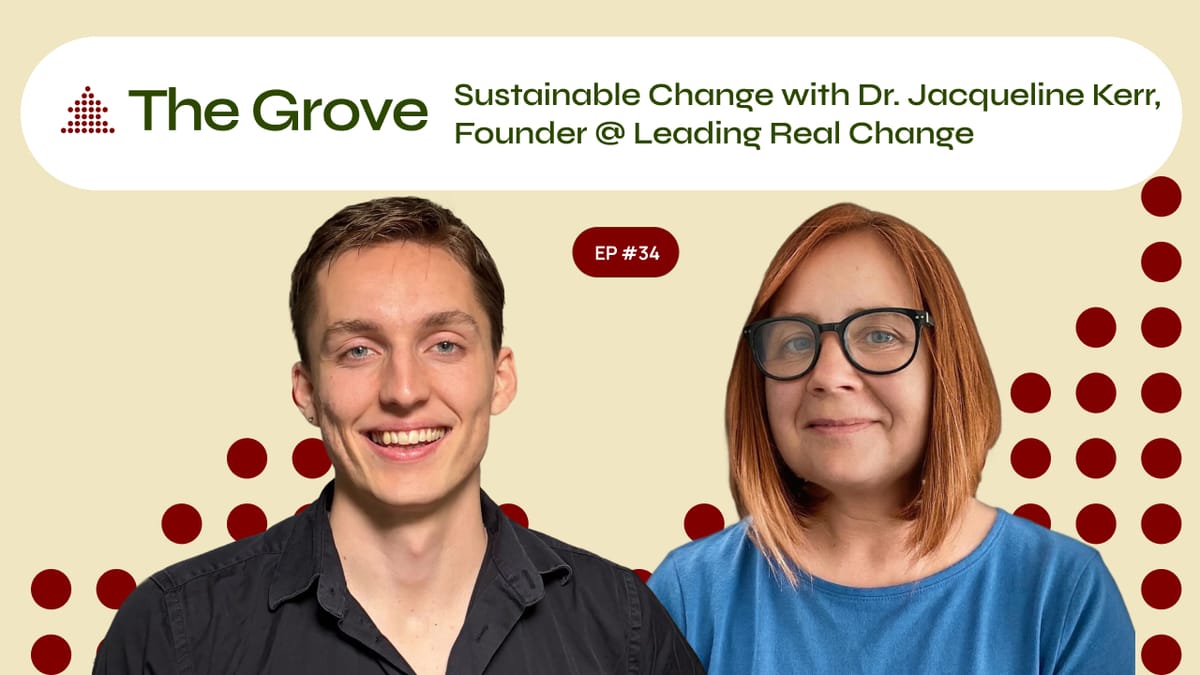
Dr. Jacqueline Kerr has experienced this over and over & is done with it. She shares with us a framework of how to implement change in a way that sticks.
"Just because the science is there and you communicate it doesn't mean that anybody acts upon it," Kerr says. For years she led an international research network on healthy and sustainable cities, producing exactly the kind of rigorous evidence that should have moved policymakers.
Her company now, Leading Real Change, brings that framework to corporations navigating sustainability transformations. The core insight, developed through years of community-level work, holds just as well in a boardroom as it does on a neighborhood sidewalk: information doesn't create change. Experience does.
Step One: Start with Who
The pivotal shift in Kerr's thinking came when she started walking neighborhoods. "Policymakers weren't looking at me as a scientist and saying, 'please, do what they're saying.' They're not persuaded by the science." They're persuaded by their constituents.
This realization reshapes the first question any change effort should ask.
"who are we doing this with?"
Kerr is emphatic about this. When someone recently approached her about launching a food cooperative in their neighborhood, her first response was to ask whether this person actually knew what their neighbors wanted.
The same logic applies inside companies. Sustainability leaders often arrive with their agenda intact but completely misaligned with the people they need to bring along.
Talking to a C-suite about "sustainability" when they're focused on cost savings, supply chain resilience, and commercial value is a version of the same mistake Kerr made in those scientific advisory boards: leading with the thing that matters to you, not the thing that matters to them.
This step is important in order to be a better messenger.
For example, research from L'Oreal found that consumers assumed "green" beauty products wouldn't perform as well — and dismissed them before trying them. Audiences with certain political identities shut down entirely when they hear "green energy," but respond positively to "energy independence through solar." The content of the message can be identical; who delivers it, and how it maps to the listener's values, changes everything.
Kerr's prescription: "Remove yourself as the sustainability professional who knows it all. Ask who are the people we want to change, what do we want them to do, who's the best messenger for them. Let them lead on that message."
Step Two: Tangibly Demonstrate the Change
Once you have the right people, the instinct is to develop a proposal, build a business case, and seek approval. Kerr's framework takes a different approach: make the change real first, then invite decision-makers to support something that's already working.
"You have to show change. You have to let people experience it positively. You have to let them see this is possible."
The New York City congestion pricing rollout illustrates this precisely. Years of debate produced no consensus. Every proposed change generated organized opposition citing fairness concerns for lower-income drivers (who, data showed, predominantly used public transit, not cars).
The city ultimately 'piloted' the congestion charge for a defined period & framed it as reversible if unpopular. The results were quieter streets, improved safety, measurable air quality gains. Here we are now: the charge just slid its way into existence.
In corporate sustainability, this principle challenges the dominant compliance-focused model. Most companies have spent the past decade building sustainability infrastructure around reporting like double materiality assessments, risk frameworks, and disclosure documentation. None of that generates the frontline experience that actually produces change.
"You need your frontline factory workers to be working some of those things out. Or your suppliers coming up with innovative new ways of packaging. None of that's going to happen if they're just focused on checking boxes and reporting."
Kerr recommends starting with behaviors that produce observable results, because the experience of making change happen is itself the engine that powers harder changes later. "We've got experience of making change happen, leading change, of getting people together to do that. Okay, now let's go focus on the more difficult behaviors."
This is where Kerr's community-organizing background converges with corporate sustainability practice. She worked with neighborhood groups organizing community walks to document infrastructure failures, applying for existing government grants to fix them, and running food access programs and farmers market initiatives. Policymakers who came to see those projects then saw the change that was already happening & got involved.
Step Three: 'Action Hubs' For the Long Term
The hardest part of change is making it stick long enough to become normal. Everyone in the world can agree to this.
Kerr's answer is the Action Hub model: a small-group structure designed to build the kind of ownership and accountability that sustains change over time.
Groups need to be small enough that everyone contributes. Large groups produce what behavioral scientists call "social loafing," where people attend but never engage.
Every person in the room needs to know their progress will be reported and their challenges heard. As a result, attendance becomes intrinsically valuable. "A win for one person is a win for the whole group." The sense of collective ownership is what keeps people returning.
Composition matters too. In a corporate setting, Kerr builds hubs that cut across departments because sustainability owns no single function. The sustainability leader's job is to create the conditions for those departments to do their own work differently.
"I want the lawyer in a company to change the legal contract. I'm not going to change a legal contract. You need to bring everyone in from these different parts with different skills and help them build that vision together."
When a hub generates change, the next step is to replicate the model rather than expand the group. Each participant becomes a potential hub leader in their own network. Ex: a procurement contact who carries the model to their supplier relationships, a marketing lead who seeds it in their regional teams.
"Hub to hub, you build this network." This is how community-level change proved durable: the lessons from one neighborhood equipped the next one to do it themselves, rather than depending on the original organizers.
Kerr is developing AI-assisted tools to support this facilitation work. The technology she envisions isn't a greatly enables the for human-led process.
She points to Engage California, which used AI to conduct large-scale qualitative interviews with constituents about rebuilding priorities after the wildfires. The capacity to gather, organize, and analyze interview data at that scale is what can make community-driven and employee-driven change more legible to institutions.
The Close
Kerr's framework is ultimately builds from where the leverage lives in systems change. This model repositions the sustainability leader as a systems architect: someone who builds conditions for other people to lead, own, and replicate change. "We need more people able to do this."
When asked what inspires her to keep doing this work, Kerr pushes back on the persistent cynicism she encounters about human behavior. "I speak to so many people that just say, 'people won't change, nobody wants to change, change isn't possible.' And I just absolutely disagree."
She pulls from her 20 year experience in community and corporate work: people change when they're supported by the right people and structures, when they can see what change looks like, and when making it real feels like something worth coming back to.
To learn more about Leading Real Change's behavioral science approach to corporate sustainability transformation, visit leadingrealchange.com or connect with Jacqueline directly on LinkedIn. Follow her progress on LinkedIn as she continues her mission to build the next generation of leaders capable of driving real, lasting sustainability change inside communities and corporations alike.
Member discussion: