
Thailand produces more rubber than almost anywhere else on earth. Its rice, sugar, and agricultural commodities rank among the world's top exports. And yet the 20 to 25 million farmers who grow all of it earn less than $200 a month — a lump sum that arrives once a year, when they sell their crops. If drought hits, or floods, or disease wipes out the harvest, that income drops to zero.
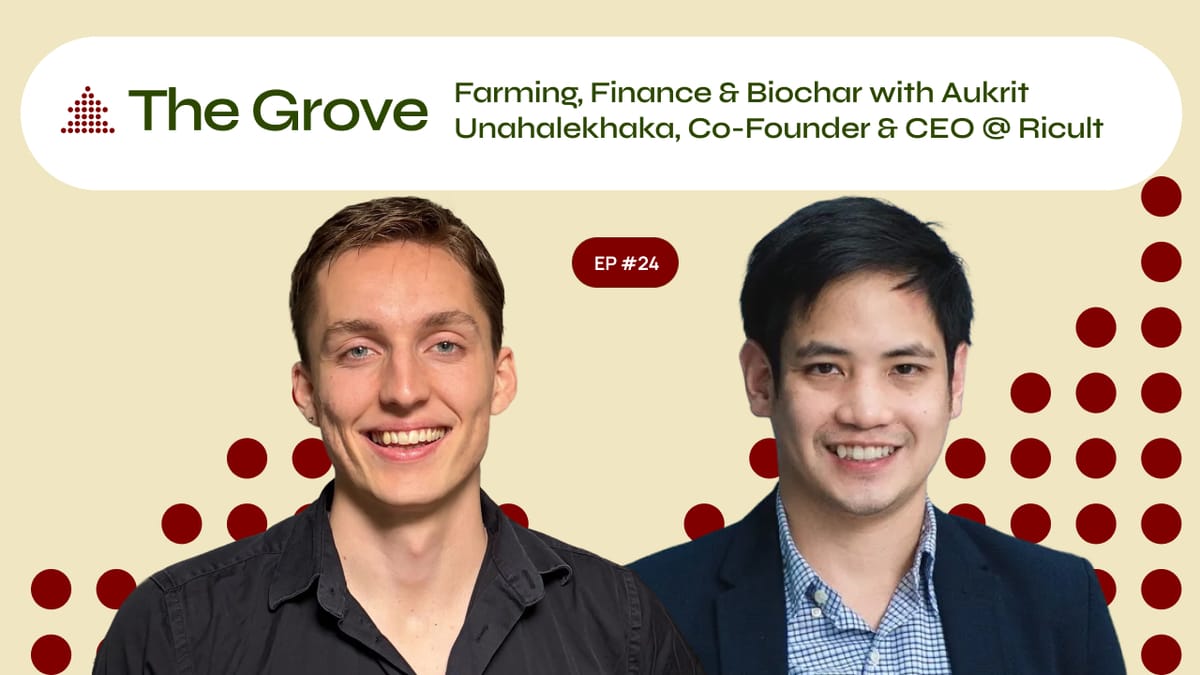
This is the paradox that consumed Aukrit Unahalekhaka's for nearly a decade. He grew up in a farming family in Thailand and experienced this tension first hand. In response, he built Ricult that helped nearly one million farmers make better farming decisions through AI analyzation of high res satellite images. He then advised Thailand's Prime Minister on AI strategy & Thai innovation and now runs Alpi Capital, a nature-based climate fund and venture builder that bets on biochar as the most overlooked carbon removal opportunity in Southeast Asia.
The throughline across all of it: the same farmers who feed the world are also uniquely positioned to help save it. Someone needs to build the right financial infrastructure around them.
Thailand's Agricultural Paradox
When Aukrit returned to Thailand after studying at MIT, he couldn't find a company doing the work he wanted to do. Ricult was born from three other MIT students and set out to build something that could actually change conditions for Thai farmers using AI, machine learning, and satellite imagery.
The early technology gave farmers access to weather data, satellite insights, and yield-optimization tools through a mobile app. The platform grew fast to 20,000 new users per month at its peak, eventually reaching close to a million farmers across Thailand and South Asia. Ricult won the Thai Prime Minister's startup award two years in a row. It raised $12 million USD and became one of the country's most visible agtech companies.
The bigger discovery happened when Aukrit started listening to what farmers actually needed beyond better data. They needed credit.
"Farmers are actually like SMEs," Aukrit explains. "In order for them to grow, in order for them to invest in new tools, new seeds, new fertilizer, they need some financing." The problem was that banks didn't understand how to assess agricultural risk. A traditional small business owner could walk into a Thai bank and borrow at 10 to 15 percent interest annually. A farmer with the same income profile — but income tied to weather, insects, and commodity prices — got turned away. Their only option was loan sharks charging 30 to 50 percent.
Ricult's satellite data, it turned out, was exactly what was needed to solve that underwriting problem. The company could analyze crop health, predict yields, and model a farmer's ability and likelihood to repay a loan. Within a year or two of launching, Ricult pivoted toward fintech, using its remote sensing infrastructure as a risk assessment engine for agricultural lending.
Seven years is a long time to build anything. It feels criminal to summarize this incredibly journey in just a few paragraphs, but Aukrit recently stepped away and our conversation developed elsewhere.
He cites honestly tough economics of scale as a main reason why he wanted to pursue new solutions.
His co-founders still run Ricult and they keep in touch. More to come on this in a future episode.
Entrepreneur's Top 3 Priorities
Between Ricult and Alpi Capital, Aukrit spent time as an AI advisor to Thailand's parliament, trying to translate the lived experience of building a startup into beneficial policy. It sharpened his thinking about what governments get right and wrong when they try to support innovation.
His framework is direct. Early-stage founders need three things: the right problem, a differentiated solution, and (most critically) cash flow runway. "The fundraising scene is quite difficult, at least in Asia," he says. "The most important thing right now in a new company is cash flow. How many months can your company survive and pay your staff?"
This is where government becomes genuinely useful, in Aukrit's view. We spoke of two specific mechanisms:
- grants that extend runway without strings and
- demand-side subsidies that accelerate market adoption.
He points to EV adoption in Thailand as a working example. Government co--payments made electric vehicles cheaper than gas-powered alternatives and demand followed that otherewise wouldn't have existed for years.
"Unless they understand how entrepreneurs actually think," he says of policymakers, "they will not be able to come up with a good policy. It will be like a very theoretical, economic kind of policy rather than something from the ground."
The insight that carried from his government work into Alpi Capital was simpler: Thailand shouldn't try to compete with the US or Europe on advanced deep-tech carbon capture. The capital, the R&D infrastructure, and the technical talent aren't there. But there's one area where Thailand has a structural advantage that almost no one in the climate world has fully recognized yet.
Agricultural waste. Enormous quantities of it. And 20 million farmers who have nowhere to sell it (yet!!!).
Biochar: The Cheapest Carbon Removal Tech
Biochar is charcoal made from organic material. Alpi Capital is focused on the agricultural residues Thai farmers generate after harvest: rice husks, corn stalks, sugarcane waste. The conversion process, called pyrolysis, locks the carbon that plants absorbed during growth into a stable solid form that can persist in soil for hundreds or thousands of years. It doesn't decompose the way organic matter does or return that carbon to the atmosphere.
The economics matter in the carbon credit market. Biochar credits currently sell for $130 to $150 per ton — a fraction of the $500 to $700 per ton that carbon capture and utilization technologies command. Last year, biochar accounted for roughly 80 percent of all carbon removal credit sales globally.
Aukrit's model at Alpi Capital consdiers the whole cycle.
- Small, decentralized biochar machines sit at village centers across Thailand; close enough that farmers can drive their waste in.
- Farmers sell residues that currently have zero market value.
- The resulting biochar gets split: a portion gets sold as carbon credits to corporate buyers; a portion goes back to the farmers to amend their soil.
Biochar's porous structure (its surface area is enormous relative to its size) makes it an effective soil amendment. Farmers who apply it see higher crop yields. That means the same farmers who sell their waste into the system receive both a cash payment for the residues and a productivity boost for their fields. Income rises on two fronts simultaneously.
The construction materials angle is an emerging third revenue stream. Biochar can replace up to ten percent of the material in road asphalt, turning a conventional carbon-emitting surface into a carbon-negative one. As infrastructure investment continues in Southeast Asia, this application could scale significantly.
The Close
Aukrit is clear-eyed about the criticisms. Biochar can't get the world to net zero on its own, there simply isn't enough agricultural waste. Feedstock availability, also, has real limits. Some critics argue that cheap biochar credits crowd out investment in more ambitious carbon removal technologies.
His answer: the comparison misunderstands the market. Biochar can be the foundation that makes voluntary carbon markets liquid enough to function at all. The liquidity eventually funds everything else.
"If biochar, which is cheaper and easier to manage, cannot survive," he says, "the bigger, highly innovative, high-tech carbon capture technology would not be able to exist as well."
The biggest current obstacle is market liquidity. The voluntary carbon market in Asia moves slowly. Regulatory frameworks that would create mandatory demand haven't materialized. Finding LP investors and corporate off-takers willing to commit capital to biochar carbon removal in Southeast Asia remains harder than the underlying opportunity warrants. Aukrit is essentially betting that the market catches up to the fundamentals before his runway runs out.
When he calls the farmers who used Ricult's platform, they don't treat him like a vendor. They invite him to drop by for a meal. That relationship, more than any technology stack or fund structure, is probably the clearest signal that the work is landing where it was always intended to.
The agricultural paradox Aukrit grew up inside — a country that feeds the world while its farmers struggle to feed their families — doesn't have a simple solution. But biochar, decentralized carbon removal, and farmer-centric financial design might be the closest thing to one that's currently available at meaningful scale in Southeast Asia. Alpi Capital is the vehicle he's built to find out.
To learn more about Alpi Capital's nature-based climate fund and biochar carbon removal work, follow Aukrit Unahalekhaka on LinkedIn, where he shares updates on their projects across Asia.
Member discussion: