

Daniel Betts hides a battery inside an air conditioner. Alex Shoer sells and finances batteries that ship in 20-foot containers.
Both built a company around the same moment: the spike. With our battery storage Summit eight weeks out, I went back to both episodes.
Let's dive in.
In this week's issue
- Why the hottest hour sets the bill
- Three answers to how slow utilities really are
- Six funders open for applications
Was this email forwarded to you? Subscribe here 👇
FOUNDER LESSON OF THE WEEK
The hottest hour sets the bill
Daniel runs Blue Frontier, which makes air conditioners for commercial buildings. He started from the grid's side. As we know, the hottest day of the year sizes the projected demand and potential battery needs. “air conditioning that drives the size of everything.”
His unit uses cheap power to charge a salt solution that powers an AC when power is expensive.
The hotter it gets outside, the less electricity it uses.
“It's basically a battery disguised as an air conditioner.”
Daniel Betts, Blue Frontier
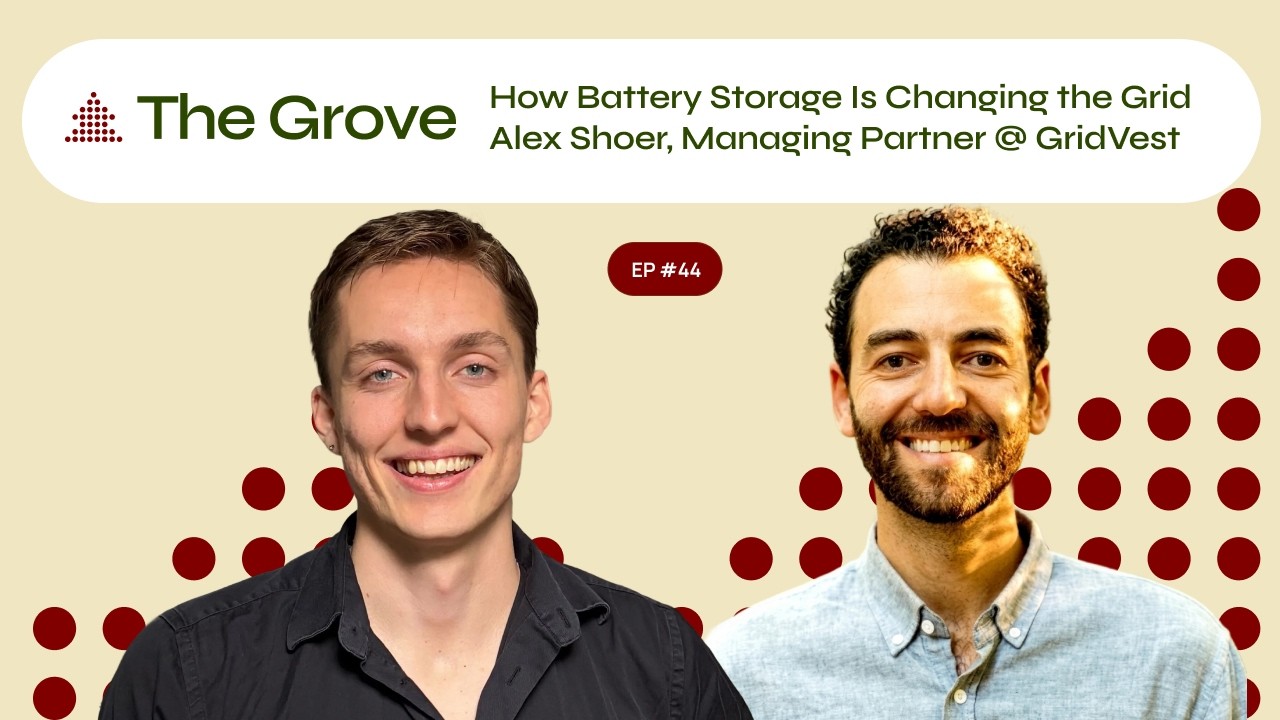
Alex sees the same spike from the meter. GridVest sells and finances batteries for buildings, factories, and small grid projects. In California, he says, a building that normally draws 1 megawatt and touches 1.1 “even for like a second” can land on a higher tariff. The battery covers the spike.
The buyer already wants it. Building owners' bills are rising 10, 20, sometimes 30 percent a year, he says. What stalls the deal is the upfront check and technical risk.
“I think the reality gets scary for people.”
Alex Shoer, GridVest
Lesson: Price the spike and take the risk off the buyer's desk.


FUNDING OPPORTUNITY
Six funders open for applications
Four programs close by mid-November and two funds that closed in September are taking founder inquiries.
- Activate Fellowship ($100K a year plus $100K R&D support) backs scientists commercializing a hardware technology for the first time; applications close October 30.
- Breakthrough Energy Fellows backs early-stage climate technologies that have raised under $2M in dilutive funding; concept papers are due November 2.
- EPA SBIR ($100K Phase I) funds small businesses on water reuse, PFAS removal and lithium-ion battery recycling; proposals close November 8.
- Cradle to Commerce (Berkeley Lab) offers seed funding and lab test beds to US founders licensing national lab IP in grid, storage and other energy fields; applications close November 15.
- Energy Revolution Ventures (Fund II) backs Seed and Series A energy-tech companies with deep science technologies; its contact page takes pitch decks.
- Commonweal Ventures ($54M, Fund II) invests $500K to $2.5M in pre-seed and seed companies that partner with government; reach the team at contact@commonwealventures.com.
BRANCHES
- PJM approves fast-track interconnection for 2.1 GW from Engie, LS Power (2 min)
- FERC rejects most of PJM's large load interconnection plan (3 min)
- 4-hour storage cheaper than gas peakers across global markets: WoodMac (3 min)
- Maryland nets 440 MW/1,760 MWh in first bulk energy storage procurement (3 min)
- US electric, gas utility rate requests spike to $4.5B in Q3: PowerLines (3 min)
- DOE presses PJM on ratepayer protections from large load costs (4 min)
- Will New York's 1GW storage contracts finally break the state's big battery impasse? (4 min)
- A fight between Con Ed and developers is slowing NYC's battery buildout (7 min)
CLOSER
If storage is your problem too, come spend a morning on it with us in December.
Dec 8 ~ the Utility Innovation Summit: Battery Storage.
Know someone on your team who owns this problem? Forward it to them.
Feedback
Have any thoughts about what you'd like to see? Let's build together
Podcast Guests
Would you or anyone you know like to be a guest on The Grove? Reply to this email to get the conversation started.
With love, Blake
See you next week!
Member discussion: