
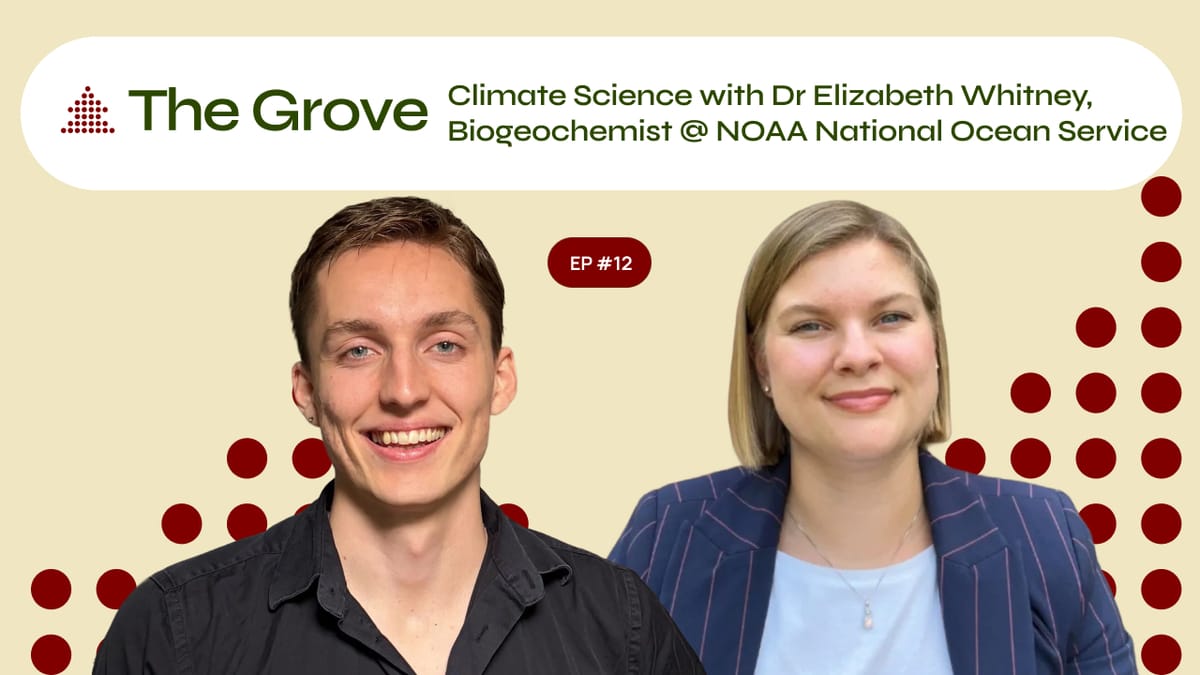
There's a moment in every scientist's journey when the abstract becomes achingly real. For Dr. Elizabeth Whitney, it happened somewhere between mixing chemicals in a lab and standing knee-deep in Panamanian waters, watching the dance of dissolved organic carbon (DOC) and other chemical markers. What started as childhood fascination evolved into something far more urgent: understanding how our most essential resource, water, carries both the promise of life and the burden of human impact.
check out the full episode on youtube or spotify
This episode was the first time I got to address her as "Dr. Liz". It was both funny and genuinely gratifying. I'm so proud of the work she's done to get here. Liz's laugh in response reveals both pride and humility; that of someone who understands that a PhD is less about intelligence than it is about persistence (something we cover later in the conversation).
Her journey from a small-town student fascinated by "charismatic megafauna" in chemistry to a postdoctoral researcher decoding the mysteries of water contamination represents more than academic progression. It's a story about how scientific curiosity, when properly nurtured, becomes a force for environmental justice and community protection.
Clay's Role in PFAS Removal: Ancient Solutions Meet Modern Problems
Liz speaks with the measured precision. "These are the 'forever chemicals' that stay in the environment...forever," she explains, describing PFAS—perfluoroalkyl substances that have infiltrated everything from our water supplies to our bloodstreams. But her tone shifts when she describes her undergraduate research at Union College, taking on a note of excitement.
In undergrad, she contributed to two research projects. The first uses naturally occurring clay materials to remove these PFAS. "What I love about chemistry is that you can mix two things together and see a reaction happening right before your eyes," Liz reflects. The second develops sensors that could amplify signals of heavy metals in water. Imagine sensors deployed in Flint, Michigan, or any community where lead contamination lurks, providing real-time warnings instead of requiring the lengthy process of sample collection and laboratory analysis.
Underlying her technical explanations runs a deeper current: the recognition that environmental contamination isn't just a scientific problem—it's a justice issue. Her clay-based PFAS removal research emerged from understanding that communities shouldn't have to choose between clean water and economic survival.
Funding Science: The Economics of Discovery
"Grad school is hard. It's a huge mental battle," Liz admits. Her voice carries no self-pity, just the matter-of-fact tone of someone describing a mountain they've climbed. "Anyone can get a PhD. It's not about smartness. It's about being driven and probably you're gonna complete a PhD out of spite."The honesty is refreshing in a culture that often mythologizes academic achievement.
How do you fund the pursuit of knowledge when that knowledge doesn't generate immediate revenue?
Liz explains the intricacies federal funding, primarily through agencies like the National Science Foundation and the Environmental Protection Agency. But her tone grows more serious when discussing recent cuts to scientific funding. "The academic world is still reeling from that a little bit and trying to figure out where their money can come from," she observes.
The conversation reveals an uncomfortable truth: the work most essential for our collective future operates on financial models that prioritize short-term returns over long-term impact. Liz's research into water contamination across forests, agricultural areas, and urban environments requires years of patient data collection, analysis, and interpretation. The timeline doesn't align with quarterly earnings reports or electoral cycles.
Yet she maintains optimism about funding recovery while identifying a deeper challenge: encouraging people to enter scientific fields when the path appears increasingly difficult and undervalued. "I think the bigger issue is going to be how do we encourage people to continue to apply to these programs when they're not painted in a pretty light," she reflects thoughtfully.
Her perspective on alternative funding mechanisms reveals strategic thinking beyond the laboratory bench. Philanthropy, industry partnerships, and state-level initiatives all represent potential paths forward, each coming with their own constraints and compromises. The challenge isn't securing resources, it's maintaining the independence and integrity that makes scientific research valuable in the first place.
The economics of discovery, as Liz describes them, mirror the broader challenge of addressing long-term environmental issues in systems designed for immediate gratification. Her doctoral research on water contamination required collecting samples from diverse environments, analyzing them with expensive equipment, and interpreting patterns that emerge over months or years. The work can't be rushed, can't be simplified, and can't always promise the dramatic breakthroughs that capture public attention.
Interviewing Water
As mentioned, Liz & I are good friends and have been for a while. We credit the course we took with planting her PhD seeds. "That is where I realized that I could combine this love that I have for chemistry with field work and environmental applications," Liz explains. The fieldwork experience served as a bridge between the controlled environment of laboratory research and the messy, complex reality of environmental systems.
Her subsequent doctoral research embodies this integration: studying water contamination across forests, agricultural areas, and urban environments required both rigorous laboratory analysis and extensive fieldwork. Each environment presented unique challenges and revealed different aspects of how human activities alter natural water cycles.
The forest samples told stories of atmospheric deposition and natural filtration; agricultural samples revealed the impact of fertilizers and pesticides; urban samples captured the complex cocktail of industrial pollutants, road runoff, and aging infrastructure.
The methodology Liz describes reflects a commitment to primary research that grounds her conclusions in direct observation. "We're looking at the different ions that are present in these water samples and using that as a tracer to try to understand where the water is coming from," she explains.
Making abstract concepts concrete through hands-on experience extends beyond academic settings. Liz's passion for community engagement reflects understanding that effective environmental science requires broader participation. "Science is elite always because we can't solve the problems that we have today without everyone's voices," she argues with quiet conviction.
The fieldwork experience that shaped Liz's career path also demonstrates the importance of mentorship and institutional support for hands-on learning. Not every student gets to travel to Panama for biogeochemistry research, but every student deserves access to experiences that connect abstract knowledge with real-world applications.
The Close
As our conversation draws to a close,I ask what inspires Liz to continue this demanding work. Her response reveals the depth of purpose that sustains researchers through years of grant applications, failed experiments, and incremental progress. The inspiration comes not from individual achievement but from understanding her role in a larger story of environmental protection and community health.
The funding challenges she describes reflect broader questions about how societies prioritize long-term environmental health against short-term economic pressures. Her research requires patience, persistence, and resources that don't always align with immediate market demands or political cycles. Yet the work remains essential for communities struggling with water contamination and policymakers developing environmental regulations.
The experiential learning that shaped her career path offers a model for training the next generation of environmental scientists. Students need opportunities to connect theoretical knowledge with hands-on research, to understand that effective science requires both rigorous methodology and community engagement.
Perhaps most importantly, Liz's story demonstrates that environmental research is fundamentally about justice and equity. The communities most affected by water contamination often have the least access to resources for testing, treatment, and remediation. Her commitment to inclusive science reflects understanding that technical solutions must be paired with social awareness and community partnership.
The conversation ends where it began—with recognition of achievement and anticipation of work still to come. Dr. Elizabeth Whitney's journey from fascinated undergraduate to accomplished researcher represents one path through the complex landscape of environmental science, but her vision of inclusive, community-engaged research offers a model for addressing the challenges that lie ahead.
Her story reminds us that the most important scientific discoveries often emerge not from isolated genius but from patient collaboration between curious minds, supportive mentors, and communities willing to share their knowledge and trust their waters to careful scientific stewardship.
To learn more about Dr. Elizabeth Whitney's environmental chemistry research and postdoctoral work in biogeochemistry, visit her professional profile online or follow her progress on LinkedIn as she continues her mission to develop accessible solutions for water contamination challenges facing communities worldwide.
Member discussion: