
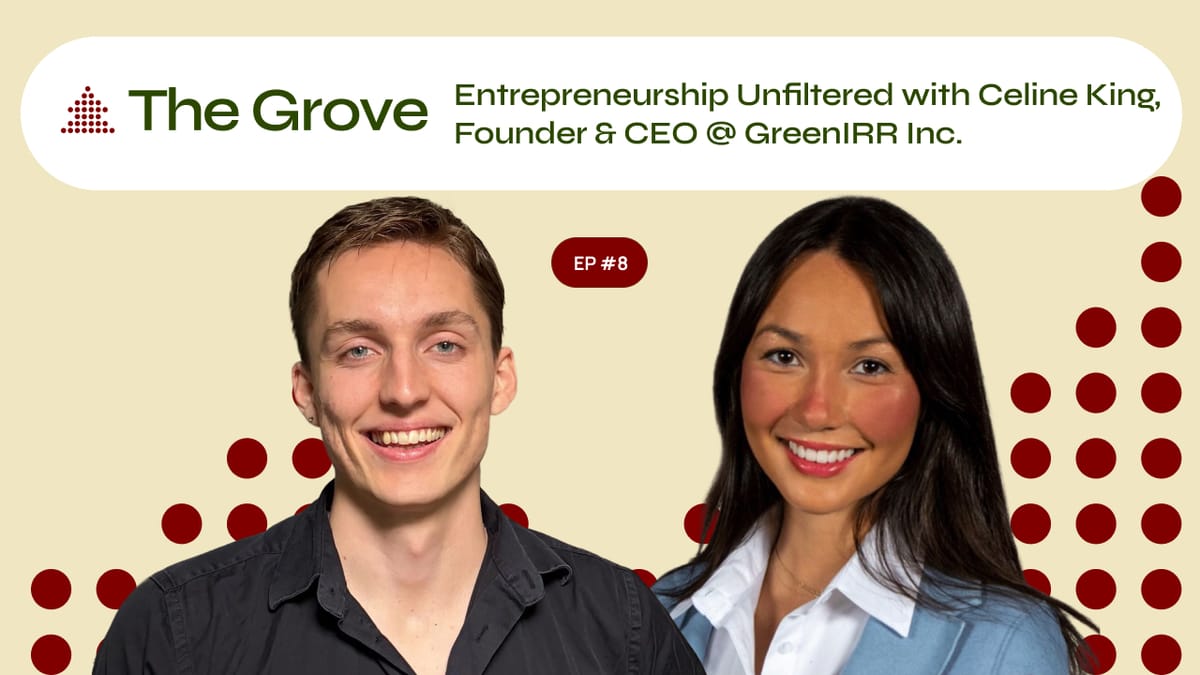
Catch the full conversation here youtube or spotify
If you're watching the episode, you'll see the lights turn off mid-sentence just as Celine King reached the crescendo of a powerful admission. "Building a company is essentially pursuing your dream in public," she says. "It requires an incredible level of vulnerability. Everything is personal."
Coincidence? Nah. Just the power of honesty.
When the lights came back on, she picked up exactly where she left off. To me, that moment captured something essential about Celine's journey with GreenIRR: the ability to find steadiness in uncertainty.
Restlessness from several corporate experiences pushed her into the start up world. It was about consequence. Working in consulting, she explains, means "doing research to inform other people of how to run their organization, but you don't ever have to personally deal with the emotional weight of those decisions." No shade to consulting, but for someone who wants "autonomy over living the whole experience," these roles didn't fit.
Misconceptions of Entrepreneurship
Our journey begins during Fairfield U's nine-month startup accelerator, where students develop ideas and pitch to investors. Celine didn't know what GreenIRR would become, but she felt drawn to concepts of accountability and transparency. When the idea began taking shape, something shifted.
"I felt like I didn't have a choice but to pursue it," she says, with the quiet conviction of someone who has learned to trust her instincts. "It was this very divine, blissful feeling of wow, I found something that feels so true. I felt super called to pursue it. It was just this massive adrenaline rush for months and months to pull that idea out of my head and make it tangible."
The program provided structure, but it couldn't prepare her for the emotional intensity. Every presentation & iteration felt personal because it was personal. She wasn't just building a business; she was externalizing a piece of herself and asking the world to validate it.
When she turned down job offers, she wondered if she was making the right choice. Through this, her support network—family, friends, mentors who had taught her to bet on herself—made the leap feel possible rather than reckless. "I had enough people in my corner to encourage it," she reflects, acknowledging the privilege of having relationships that made risk-taking financially and emotionally feasible.
This decision to embrace uncertainty as a practice, almost "like a religion" as she puts it, would become the foundation of everything that followed. "If you can force yourself into leaning into uncertainty, you'll always be surprised by where you end up," she reflects.
The early days were "so ugly" from a material standpoint: 'embarrassing' one-pagers, crude software mockups, a thin value proposition. The original GreenIRR targeted private equity firms, providing ESG data on portfolio companies' decarbonization performance. The mission was still to 'save the planet', but the execution was entirely different.
For six to eight months, Celine conducted 65 to 80 customer discovery interviews with PE firms, immersing herself in an industry she thought she understood from her corporate experience. The process was grueling but educational in ways she hadn't anticipated.
"I needed to learn the PE industry beyond just my experience working at Greenbacker," she explains. The interviews revealed a fundamental mismatch: private equity firms weren't under-resourced or feeling regulatory pressure around sustainability the way other sectors were. No business model here.
The pivot, when it came, happened in less than a week. After 12 to 14 months of believing in one version of GreenIRR, Celine had to accept that "this thing I fell in love with is not gonna work." The realization was brutal—not just intellectually, but emotionally. She had invested her identity in solving the private equity ESG problem. Her network, her expertise, her sense of professional self were all built around that market.
The decision to shift toward supply chain, and specifically trucking, required divorcing herself from everything she'd learned and everyone she'd connected with in private equity. But it also required something more difficult: admitting that her first instinct had been wrong while maintaining faith in her ability to identify the right path forward.
"To keep the company alive and keep the momentum going was a really difficult decision that required me again to lean into uncertainty," she explains, her voice carrying the emotional weight of that period. The pivot wasn't just a strategic adjustment; it was an act of professional and personal courage.
Pivots are HARD
"The pivot was one of the most uncomfortable things I've ever gone through in my entire life," Celine admits. "When you're ideating, you're dreaming without consequence. And everything that I had spent the past year and a half learning, the entire network I built, was in private equity." Not trucking.
What followed was effectively starting from scratch in an industry she knew nothing about. She found herself making ecosystem diagrams by hand, reading full articles nonstop, trying to understand what a third-party logistics company even was. The trucking industry proved more challenging to penetrate than private equity—a close-knit community skeptical of outsiders, especially young women talking about sustainability.
The breakthrough came through relationships built during the pursuit of credentials. A critical early milestone arrived when she met John, who became GreenIRR's first beta customer at Daybreak. "He chose to believe in what we were building before we had built anything," she says with genuine gratitude. Similarly, a friend's father, Leo Cummings, who was president of operations for UPS in New York, spent six weeks teaching her about the industry.
These connections open doors during the initial stages of believing in a vision that has no data to back it.
"There's an unbelievably high amount of high frequency, high intensity bad news that you just would never experience unless you're putting yourself in a position to be constantly told no," she explains. "That's material, but it's actually pretty easy to deal with. The hardest part is the personal, mental, emotional, spiritual side where you're forced to look at yourself in the mirror every day."
The questions become existential: Am I capable of this? Can I execute? I'm responsible for other people. I'm solving an impossible problem. "In that first 14 to 16 months, there's no evidence reflected back to you that says what you're doing is working. When you wake up every day and put in 16 hours and the needle doesn't seem like it's moving, that's type two burnout."
Yet Celine found ways to continue. The friends and family funding round became a personal test: "Do I believe in this idea enough to take money from my friends and family?" The answer was yes, but it came with recognition that she was building herself into the person capable of running the company she envisioned.
Celine focused on stacking micro-wins: securing John as a pilot customer, raising $500,000 in bits and pieces over time, connecting with UPS, and more. If you stick with it long enough, you find momentum behind you. In GreenIRR's case, this meant landing NFI—one of North America's largest for-hire fleets—along with DB Schenker as additional pilot partners.
From here, the mountain only gets steeper.
'Sustainability Meets Profitability'
By 2024, GreenIRR had evolved into something Celine could never have imagined during those early private equity pitches. The company now operates as a software layer on top of real-time vehicle performance data, integrating with telematics systems + fuel card transactions to provide fleet managers with actionable sustainability analytics.
Celine discovered that sustainability and profitability weren't competing priorities but complementary forces. "If we can help you reduce your fuel consumption by providing analytics to make more informed operational decisions, and you're saving 5% of your fuel every year, you're actually more sustainable and you're more profitable."
This insight transformed GreenIRR's market approach. Instead of leading with environmental messaging, Celine learned to talk practically about efficiency and cost savings. The environmental impact became a beneficial side effect rather than the primary selling point.
If you've been following climate tech over the last 5 years or so, this is just is simply what you have to do to survive. There's no more "do business with us because we're green!". Only "do business with us because this makes sense for X concrete reason, oh and by the way you're being better to the planet".
The strategy worked. GreenIRR spent 2024 piloting and validating technology, building sales infrastructure, and developing channel partnerships with companies like GeoTap, Isaac, OmniTracks, Wex, EFS, and Spark 360. Rather than trying to sell directly to every fleet, they built an ecosystem-led go-to-market strategy that leveraged existing industry relationships.
"We're a bootstrap team," Celine explains. "We didn't have the sales infrastructure to sell direct to all the fleets we wanted without a reference account." The partnership approach solved multiple problems simultaneously: market access, credibility, and resource efficiency.
Today, GreenIRR is commercialized with a team of 10 people and over a million dollars in funding. But Celine measures success differently than she did three years ago. The metrics that matter aren't just revenue or user acquisition—they're the moments when trucking companies realize they can improve their bottom line while reducing their environmental impact.
The legacy nature of the trucking industry, which initially seemed like GreenIRR's biggest obstacle, has become its greatest opportunity. "Automating a legacy industry—not just to help them solve a pain point, but to make them more efficient—is probably one of the largest opportunities I can think of in trucking."
The transformation isn't complete. Celine still faces the daily reality of building a company in an industry that doesn't naturally embrace change. But she's learned to find inspiration in the community of climate tech founders who "solve the same problem on the same mission in a million different ways." Seeing other entrepreneurs double down every day, going through the same peaks and valleys, staying committed to execution—"that's unbelievable."
For Celine, the authenticity—the willingness to embrace pressure, uncertainty, and personal vulnerability in service of a mission larger than herself—has been the key.
"Don't let fear of uncertainty stop you," she says. "You're always gonna be surprised by what comes from that journey."
The lights may flicker, the path may shift, but the mission remains clear: proving that the future of business lies not in choosing between profit and purpose, but in discovering how they can drive each other forward.
To learn more about GreenIRR's fleet optimization technology, visit greenirr.com or contact them directly through their website. Follow their progress on LinkedIn as they continue their mission to help trucking companies reduce fuel consumption while increasing profitability.
Member discussion: