
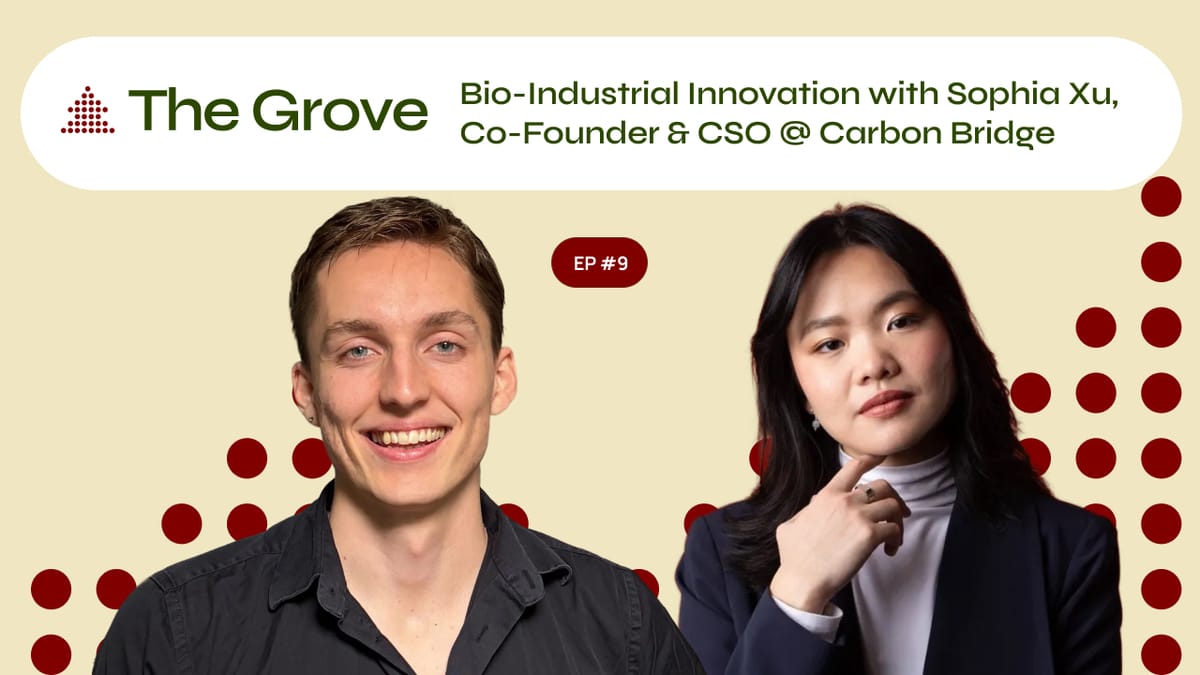
Sophia Xu eats the impossible just like her microbes eat gas. Efficiently.
Her company just sold their first bioreactor and the potential in the tech is powerful. "These microbes are amazing," Sophia tells me. "They've been framed this entire time. We've just given them the resources they need to perform."
Watch the episode here youtube or spotify
It's a statement that describes her own journey as much as the gas-eating microorganisms at the heart of Carbonbridge, the biotechnology company she co-founded in March 2023. While the world debates artificial intelligence and quantum computing, Sophia and her team are quietly orchestrating what might be biology's most elegant solution to climate change: teaching ancient microbes to transform waste gases into renewable fuels and chemicals—all without subsidies, without carbon credits, and at fossil fuel parity.
Three years ago, Sophia was on track to become a doctor, pre-med requirements checked off, medical school acceptance letter in hand. Today, she's leading the scientific charge at a company that promises to revolutionize how we think about fermentation, waste, and the very nature of biological manufacturing. The path between those realities winds through moments of doubt, resourceful creativity, and the kind of first-principles thinking that emerges when you realize the experts might have been asking the wrong questions all along.
Gas-Eating Microbes: Nature's Innovation
To understand what Carbon Bridge has accomplished, you have to start with a physics problem disguised as a biology one. Picture yourself opening a can of Coke that's been shaken—the way it overflows because gases simply don't want to stay dissolved in liquids. Now imagine trying to feed hungry microorganisms a diet of pure gas while they're swimming in a liquid medium. Their food disappears.
"Mixing gas and liquids is actually really hard," Sophia explains. "That's just gas solubility and that type of thing."
For decades, the fermentation industry has been playing this impossible game. Traditional fermentation relies on massive tanks where microorganisms consume sugar and produce valuable products. Gas fermentation follows the same principle, except the food source shifts from sugar to gases like methane, CO2, and hydrogen—the very greenhouse gases driving climate change.
Companies have tried using the same tank designs, bubbling gas through liquid and hoping the microbes could catch enough to survive. What they got instead were starving organisms producing disappointing yields, leading to decades of finger-pointing at the microbes themselves.
"I think the industry has long blamed these microbes for not being performant," Sophia reflects. "But if you really look at what's going on, it's just they don't have access to the gases they need to do the conversion."
This is where Carbon Bridge's breakthrough becomes almost poetic in its simplicity. Instead of fighting physics, they decided to work with it. Their bioreactor design—which Sophia describes as both the flattest and thinnest ever built—creates an environment where gases and microbes can interact directly.
"It's essentially putting these microbes in this environment where they have access to all the gases they can eat," she says. "So instead of going from like starvation, they went to an all you can eat buffet."
The results speak for themselves: microbes that were previously dismissed as commercially nonviable suddenly become productive enough to compete with fossil fuel production. Carbon Bridge hasn't engineered new organisms or discovered previously unknown species. They've simply created the conditions for existing microbes to express their full potential.
First 10 Employees: Building Company Culture
The early days of Carbon Bridge read like a master class in resourceful entrepreneurship. When Sophia moved to New York to launch the company, she didn't have the luxury of funding or gleaming laboratory facilities. Instead, she found herself scrolling through Reddit, searching for alternatives.
"I found this DIY community biolab for $100 a month," she recalls, her voice carrying a mix of nostalgia and disbelief. "It's called Biotech Without Borders. It was this insane experience."
The lab's founder, Dr. Ellen Jorgensen, had built the world's first community biology laboratory with a mission to democratize biotechnology access. What started as a Reddit discovery would eventually become one of Carbon Bridge's most important partnerships—Jorgensen now serves as the company's VP of biotech.
This origin story reveals something essential about how Sophia approaches building teams. The early Carbon Bridge employees weren't hired from elite biotech companies or prestigious research institutions. They were generalists—fast learners with first-principles thinking who could adapt to building something entirely new.
"We started out with more generalists," Sophia explains. "Fast learners, very hard workers may not necessarily have the exact expertise that we were looking for, but then again, we're building something so new that we don't expect someone to have that background."
During her pre-Carbon Bridge experience at an early-stage ag tech startup, Sophia discovered that breakthrough biology doesn't require breakthrough budgets. She watched teams order consumables off Amazon and build functional laboratories with creativity rather than capital.
"I had no idea that you could do biology so cheaply," she admits. "I think that was a huge part of when I got started in Carbon Bridge."
This frugal innovation mindset became woven into Carbon Bridge's DNA. The team of six operates with the efficiency of a much larger organization, each member wearing multiple hats and approaching problems with resourcefulness.
As the company matures, Sophia recognizes the evolution from generalist to specialist that successful startups must navigate. "I think we're moving more towards a specialist nature," she notes. "When you start your company, there's a lot of different hats that you have to wear. But more and more it's very clear like we have this project in mind, we need these types of engineers and these type of biologists."
The transition isn't just about technical expertise—it's about scaling a culture that values first-principles thinking while building the deep domain knowledge necessary to compete at the highest levels of biotechnology.
Building a Biotech Future
The moment when everything crystallized for Sophia didn't happen in a laboratory or during a funding meeting. It occurred during a Friday afternoon journey talk at IndieBio, the biotech accelerator often described as Y Combinator for life sciences companies.
Sean O'Sullivan, founder of venture firm SOSV, was sharing his entrepreneurial journey with the cohort. As Sophia listened to him describe the inevitable valleys that accompany every ambitious venture, something clicked into place—not just about the opportunity Carbon Bridge was pursuing, but about the kind of impact she wanted to create.
"This is obviously there were some, 'he went through a lot'," she remembers. "But I was like, this is what I want to do."
"I was always fascinated by entrepreneurship, but again, had a limiting belief," she reflects with brutal honesty. "I though you absolutely need a PhD to get involved and then you need to have these results first and then raise funding and do all these different things."
What she discovered at that first ag tech startup was that biology could be done cheaply, creatively, and outside the traditional academic-industrial complex. This wasn't just a practical revelation—it was a philosophical one that would shape how Carbon Bridge approached everything from research to company culture.
The vision Sophia articulates for Carbon Bridge's future reveals the ambition lurking beneath her measured exterior. She doesn't envision building a massive corporation with thousands of employees churning out a single product. Instead, she sees a core R&D team constantly evaluating new microbes and pathways.
"We've got one to go from methane to methanol, maybe another that will go from oils to biosurfactants, another one that will take CO2 and make vinegar, all these different microbes," she explains, her enthusiasm building. "But it keeps it very exciting and it kind of maximizes the impact."
Funding Challenges in Climate Tech
The conversation shifts a bit when I ask about Carbon Bridge's biggest current hurdle.
"Funding is very difficult in the current environment, especially for things like climate tech," she says, the words carrying the weight of countless pitch meetings and investor conversations. "We've climate-proofed our company quite a bit. Obviously, the mission and the impact stays the same. But there have been some headwinds, geopolitically and economically as well."
While artificial intelligence companies capture headlines and venture capital with promises of exponential growth, climate tech founders find themselves defending not just their specific approach, but the entire premise that environmental solutions can generate venture-scale returns.
The irony isn't lost on Sophia. Carbon Bridge has solved one of the fundamental technical challenges in biological manufacturing—creating a bioreactor system where microbes can achieve fossil fuel parity without subsidies. They've demonstrated that their approach works not just in laboratory conditions but in real-world applications, selling their first reactor to industrial partners.
Yet the funding environment forces them to compete for attention with sectors that promise faster returns and clearer scalability metrics. "I know rounds are taking longer to close," she continues with quiet determination. "I know a lot of companies have unfortunately shut down."
This funding challenge becomes particularly acute for deep tech companies like Carbon Bridge, where development cycles are measured in years rather than months, and the path to market requires navigating complex regulatory environments and industrial partnerships.
Sophia's response to these challenges reveals something essential about her leadership approach. Rather than becoming defensive or pivoting away from their core mission, Carbon Bridge has "climate-proofed" their business model by ensuring their technology can succeed purely on economic merits.
"We're seeing the light at the end of the tunnel," she says. "We've gotten a lot of interest. I'm very confident in that."
This confidence isn't rooted in blind faith but in the fundamental strength of their value proposition. By creating technology that can compete with fossil fuels on price without requiring policy support, Carbon Bridge has positioned themselves to succeed regardless of changing political winds or fluctuating carbon credit markets.
"It's just about building and it's about building in time and moving as quickly as you can," Sophia concludes, and in that simple statement lies both the urgency and opportunity that define the current moment in climate technology.
What emerges from Sophia's story isn't just the tale of a single company or technology breakthrough. It's a glimpse into how the next generation of entrepreneurs approaches problems that previous generations dismissed as unsolvable—not by accepting conventional limitations, but by questioning whether those limitations were ever as fundamental as they appeared.
The microbes Carbon Bridge works with have existed for millions of years, perfected by evolution to transform gases into valuable compounds. The physics of gas-liquid interactions that made traditional bioreactors inefficient haven't changed. What changed was someone asking why the industrial process had to accommodate the physics rather than the other way around.
In a world increasingly defined by artificial intelligence and digital transformation, Sophia's work represents something different: the recognition that some of our biggest challenges require biological solutions operating at industrial scale. The future she's building doesn't replace nature with technology—it creates the conditions for nature to express its full potential in service of human needs.
Standing at the intersection of biology, engineering, and entrepreneurship, Carbon Bridge represents more than just another climate tech company. They're proving that the most powerful innovations often come not from inventing something entirely new, but from finally giving something ancient exactly what it needs to thrive.
The microbes were never the problem. They were waiting for someone to build them a better world.
To learn more about Carbon Bridge's revolutionary gas fermentation technology, visit www.carbonbridge.io or connect with them on LinkedIn. Follow their progress as they continue their mission to revolutionize the bio-industrial economy through nature-inspired solutions that compete with fossil fuels on pure economics.
Member discussion: