
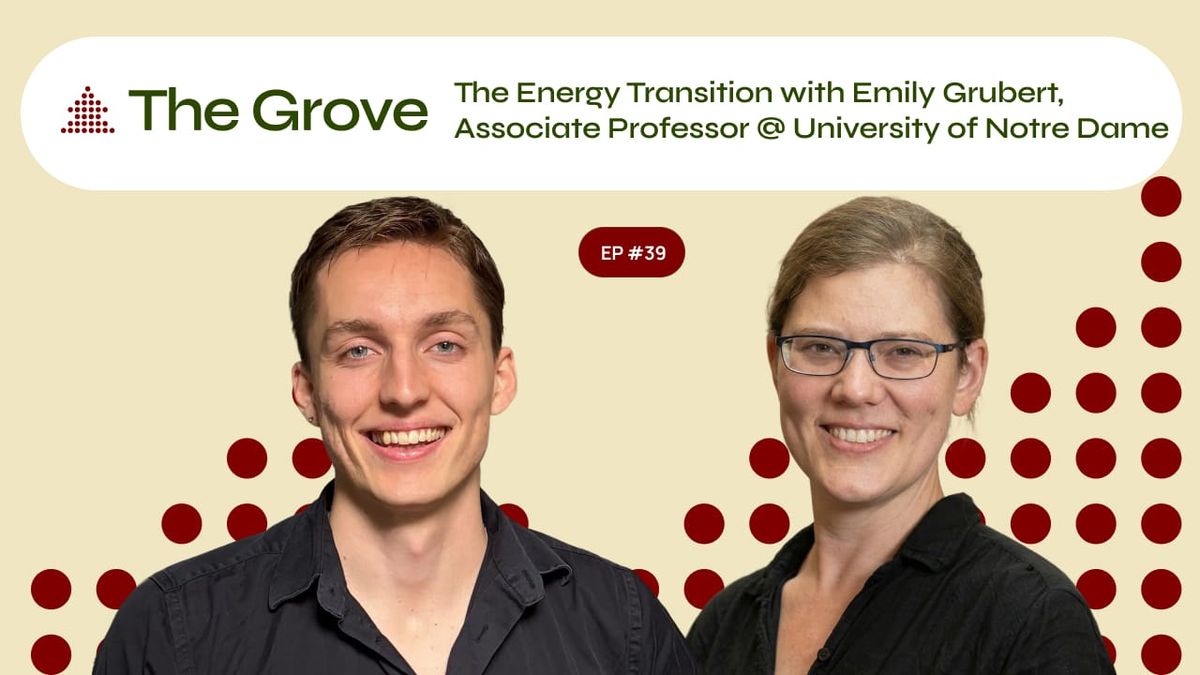
"We haven't decided to do it. That's why it's not working very well."
That's Emily Grubert, associate professor at the University of Notre Dame, with a realistic take on the energy transition.
I talk to a lot of builders on this podcast deep in the weeds of their technology. Every once in a while we need someone who can climb high enough to see the whole map. Emily is that person.
Her research focuses on fossil phase-out. Meaning, how do you actually do a phase-out in a way that doesn't leave people behind? She comes from an engineering family and spent time working inside the Biden administration's carbon capture office. Both as a contributor and a critic.
What has she learned?
US Energy Independence: Fact or Fiction?
Fact: the US is already energy independent.
Have been essentially self-sufficient since around 2022 on oil and a little longer on gas.
So why the massive political narrative around energy independence?
Emily's answer is nuanced. New wells drop off fast. You make a well, it produces a lot for a few months, then tapers significantly. So you do need to keep drilling if you want to maintain production levels using fossil fuels. That part is real.
The broader framing traces back to generational memory. People who lived through the oil crisis of the early 80s carry that scarcity in their bones. As for solar, the sun doesn't need to be imported. The machines that capture it do. But the resource itself is inherently local, which is an energy security argument that doesn't get nearly enough airtime.
What this section of our conversation really unlocked for me, though, was the ownership question. Most people assume the energy system is government-managed. In the US, it mostly isn't. Oil extraction, refineries, gas stations are privately owned, all the way down to the family running the corner station. That private ownership structure is what creates a fundamental tension at the heart of the transition.
"It's really, really hard to get private businesses to make decisions that are going to make them go out of business."
It explains a lot of the inertia we're seeing all the way through the trickle-down infrastructure. Poles, wires, pipes, tanker trucks, and heating systems owned by a lot of different actors; none of whom have a strong incentive to be first to exit.
Understanding that dynamic changes how you read of the policy. It's about who owns what and what it would actually take to get them to change.
Decarbonization: The Missing Commitment
With renewable technology is increasingly viable, why isn't the transition happening?
Emily: We just haven't decided to do it.
Global emissions are still going up. US emissions have dropped somewhat, but the coal story (one that gets held up as evidence that the transition is working) is more complicated than it looks. Coal production has fallen roughly 50% over the last 15-20 years. From an industry perspective, that's a collapse. From a transition perspective, Emily points out that it's "shocking that we've only had coal fall off by half." And almost all of that shift went from coal-fired electricity to natural gas, not to renewables. In her view, it was damaging precisely because of that.
"If we do it on purpose, we can do it a lot better."
There's a version of the conversation where unplanned market shifts get credited as transition progress. Emily's pushing back on that. The coal towns that didn't get support after massive job loss is what happens when you let market forces do the work that policy should be doing.
Which brings up the enforcement problem. A lot of states have zero-carbon targets on the books. Emily says the interim checkpoints are weak enough that she's heard people say, openly, "that's the law but there's no way we're hitting it, so we're not going to bother."
Illinois stands out as an exception. The vaguer the law, the easier it is to play chicken with it.
And with critical infrastructure, she points out, the enforcement leverage is limited.
If a utility just... doesn't comply... are we going to let the power go out?
Historically, no. Asset owners know this. It doesn't make them villains necessarily, but it does mean that without real public management coordinating the transition, you're largely at the mercy of private actors who have every incentive to be the last one to close.
A good transition starts with people. Are they warm enough? Can they get where they're going? Do they have what they need to survive?
"About a third of Americans had trouble paying their power bills in 2024."
That's not a system that's working for people. Any honest conversation about protecting what we have has to start from that reality, not from an idealized version of the status quo.
Carbon Markets: Not Helping Eliminate Emissions
I've had mixed feelings about carbon markets for a while. They feel like a good-faith first attempt at doing something real. Emily agreed.
"If I purchase you saying that you're not going to emit something, but you don't purchase the obligation to do something about my emission, what have we really accomplished?"
The core problem with carbon offsets is the concept. You're not actually exchanging anything in the physical world. When the goal was emissions reduction, maybe you could argue the accounting made some sense. When the goal is really full decarbonization, a market that trades permission to emit is structurally the wrong tool.
The shift toward removal-based credits (actually pulling CO2 out of the atmosphere) versus avoidance-based credits (promising not to emit something you might have anyway) is real and matters. Emily acknowledges the physical difference, but is still skeptical.
There are places where carbon capture makes sense. Cement, for example. When you make carbonate-based cement, CO2 comes off the rock regardless of your fuel source. That's a genuine hard-to-abate application. Coal-fired power plants, on the other hand? If you can build a wind farm with battery backup instead, carbon capture on the coal plant isn't it.
The good offsets, Emily says, cost around $1,000 per ton. The market is trading at five....
"Committed, But Not Optimistic"
I asked Emily the question I ask everyone: are you optimistic?
She said she's committed. Not optimistic.
She spends a lot of her research time figuring out which problems are physically unsolvable versus which ones are institutionally or politically blocked. Thermodynamics is a hard limit. Most other problems in our way are solvable. Knowing the difference lets you focus energy where it can actually move something.
The biggest hurdle, in her view, is also the clearest next step: we haven't decided to do this. No country has made an explicit, enforced commitment to full decarbonization. Evidence we haven't tried.
Emily is doing the hard academic work of mapping what a real transition looks like at the infrastructure level, the workforce level, the policy level. Her research is worth following if you're building in this space, selling into utilities, or thinking seriously about what the next 20 years of energy transition actually requires.
To learn more about Emily Grubert's research on fossil phase-out, just transition, and decarbonization policy, visit EmilyGrubert.org. Follow her progress on LinkedIn as she continues her mission to design an energy transition that actually works for people.
Member discussion: