
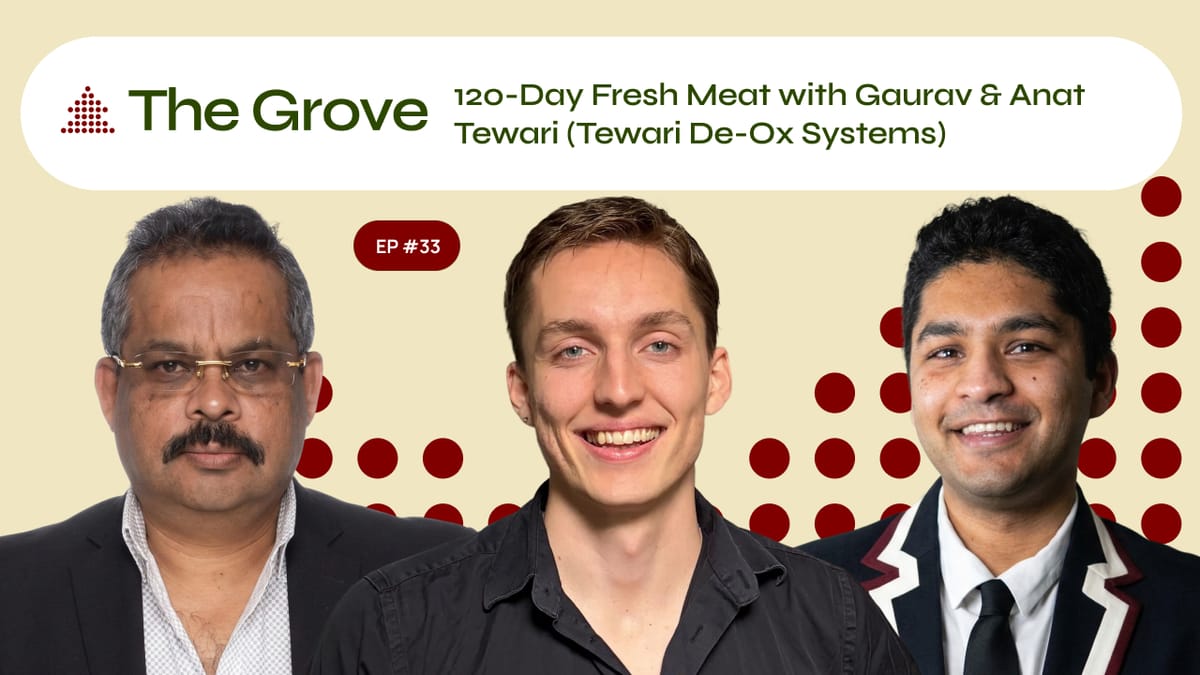
FOUR MILLION COWS is a lot of cows. The equivalent amount of meat is wasted every single year because of a physics.
Dr. Gaurav Tewari noticed this gap before he founded Tewari De-Ox Systems. After decades of leading commercialization projects for companies like Unilever Europe and the FDA, he watched multi-billion-dollar corporations spend millions fixing food safety crises that, in his view, shared a common root cause: the industry never centralized. "I saw problems which I solved and saved millions of dollars for the companies," Gaurav recalls, "thinking that all of these costs could have been avoided."
That observation is the founding logic of Tewari De-Ox Systems. The company's patented Zero Ox Tech process gives retail-ready meat cuts a shelf life of 120 days, prepared centrally, which for the first time makes it economically viable to cut a steak in Pennsylvania and sell it fresh in the Middle East.
His son Anat Tewari, now COO, grew up watching his father build toward this moment. As a toddler, Anat would sit at a tiny table, lick his finger, and flip through a phone book he couldn't yet read, mimicking what he imagined his father did for business. Today, that same instinct to understand how things work drives his work at the intersection of finance, deep tech, and food systems. "Fast forward," Anat says, "I found my first opportunities and it's not too different from what I did when I was two years old."
Zero Oxygen Meat Packaging = 120 Days
Cut an apple and leave it on your kitchen counter. Within minutes, it starts to brown. The same enzymatic reaction happens even faster to meat after exposure to the smallest amount of oxygen.
The conventional industrial workaround sends whole carcasses or large primal cuts across oceans sealed in vacuum plastic. Workers at the destination then fabricate the final retail cuts close to the store. It's a system that has persisted for 60 years, and it carries enormous hidden costs. Gaurav's team calculated that poor resource utilization alone (labor, butchery equipment, energy, and logistics) costs the industry $3 billion annually. On top of that, the double-packaging waste adds unnecessary plastic to the supply chain and roughly 10% of product still gets lost somewhere in transit.
Tewari De Ox's process works by achieving absolute zero oxygen exposure inside the package. "It has to be absolute zero," Gaurav explains, "because when it is absolute zero, certain enzymes within the meat which are already naturally present have the ability to fight against discoloration, they have the ability to fight against microbial growth."
The innovation lies in designing a system that accounts for every source of residual oxygen: what permeates through the packaging film, what gets trapped when the seal closes, and critically, what meat itself diffuses outward over time. That third source is one the industry had largely missed.
The commercial application is elegant.
- Tewari De Ox supplies packers with a patented film and sachet system that integrates into their existing equipment lines.
- A packer seals a retail-ready steak using their current line, adds the Tewari sachet, and that cut now has 120 days of shelf life.
- After 45–50 days at sea, 10–15 days clearing customs, and another 15–20 days moving through distribution, the product still arrives at the retail shelf with 30 days remaining.
Anat frames it as a material science innovation: "It's a consumable that our clients are able to purchase and reduce their plastic waste, but also still increase their shelf life."
The analogy Gaurav reaches for is Netflix replacing Blockbuster. What was once a distributed, local operation — renting physical media store by store — became possible to centralize once the underlying infrastructure caught up.
The meat supply chain sits at the same inflection point. "That is why Zero Ox Tech is a game-changing platform," he says. "Think about the level of water, the level of energy that is used — all because you can't make retail cuts centrally. That is the elephant in the room problem that we have addressed."
Working with Meat, Not Against It
The science that makes Zero Ox Tech possible lies within the meat's own biology.
Like we've established, even the smallest traces of oxygen quickly activate spoilage and discoloration. Once those enzymes are gone — as with the browning of a cut apple — there's no recovery. The entire current distribution system exists to delay that moment until the last possible step. But in doing so, it exports the problem downstream along with the product, passing the fabrication burden to retailers who lack the trained staff, inspection infrastructure, or food safety protocols that a centralized federal plant provides.
Gaurav draws a direct line from this structural gap to food safety outcomes. A 2008 Maple Leaf Foods listeria outbreak in Canada killed ten people. An article he published during COVID revisited the same argument: food preparation that can be centralized should be centralized.
"Think about all the USDA protocols, the global food safety initiatives that the plant is used to, all the employees are trained — companies spend millions of dollars every year to train them," he says. "The moment it gets to the downstream, you don't have that level of trained butchers, you don't have that level of food safety happening at the retail level."
Today, an Australian beef producer selling into the premium Middle East market ships their product as primals: large, minimally processed cuts sealed in vacuum packaging. The retail customer receives the product and fabricates steaks themselves, which means the producer can only sell their meat cheap, at primal prices.
With 120 days of centralized shelf life, that same producer ships retail-ready premium cuts directly. Anat puts it: "When they sell it as primals, they're asking their clients to finish preparing the product. Imagine going to Best Buy and seeing a Best Buy employee assembling a computer. We do that with food."
The profit margin difference between selling primals and selling retail-ready cuts is substantial enough that, for the first time, export-focused producers can access premium international markets they previously couldn't afford to reach.
Innovating in the Present for the Future
It would be easy to position Zero Ox Tech as a stopgap — a solution for today's meat industry while the world transitions toward alternative proteins and cell-cultured foods. Anat rejects that framing because he thinks it reflects a flawed theory of how meaningful innovation actually works.
His reference point is Pixar. The studio built its own hardware and software to achieve 3D animation. After, Pixar paired that innovation with something timeless: the ability to make audiences cry over a toy's existential crisis, regardless of the medium. One step into the future, one step in the present. "I don't care how many times you've watched Toy Story or how old you are — you're going to shed a few tears," Anat says. "And I'll be the first to admit that."
The food industry, in his view, has gone two steps ahead without solving what's right in front of it. The conversation around alternative proteins, lab-grown meat, and plant-based foods treats the conventional supply chain as something to leapfrog rather than improve.
The waste, inefficiency, and food safety risks in that supply chain don't disappear because a new protein category exists. "What's the point of it all if we throw away four million cows worth of meat every single year?" he asks. "If we don't resolve it now, it'll just be a problem that will continue."
This is also where Gaurav's career-long frustration with large organizations becomes constructive. The food industry's deep familiarity with the current system is an asset to Zero Ox Tech's adoption. The clients who most acutely feel the pain of the existing system are the first to recognize what 120 days of centralized shelf life actually unlocks.
Tewari De Ox currently operates across three continents and is raising a $1.5 million seed round to scale operations.
The Close
For Gaurav, the deeper motivation is legacy. He left India more than 30 years ago on a scholarship with no intention to stay, and built a career commercializing other people's technologies. Zero Ox Tech is his own is being scaled by a founding team that includes his son. "I should do something which is remarkable within my career and to the industry where I kind of learned a lot," he says. "The inspiration is to do something which stays."
What stays, if Tewari Deox executes on its vision, is a redrawn global meat supply chain. Imagine premium cuts moving across oceans without losing their freshness or a centralized food safety standard that replaces the decentralized improvisation of the current system.
Coming soon: Philly steakhouse cut you in a Dubai hotel
To learn more about Tewari Deox Systems' patented zero-oxygen shelf life extension technology, visit their website or connect with the team directly on LinkedIn. Follow their progress as they continue their mission to centralize and globalize premium retail-ready meat through science-first food innovation.
Member discussion: