
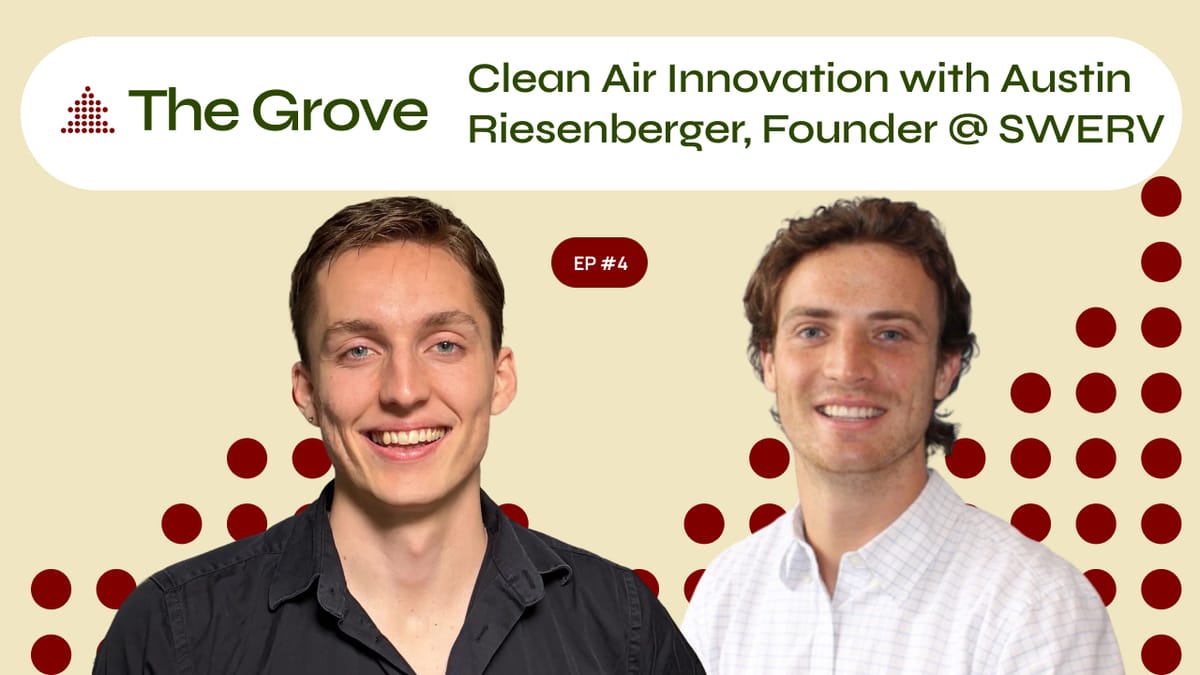
Listen to the full episode on youtube or spotify
Austin Riesenberger's phone buzzed. Five days before he planned to fly across the world to Hawaii for a dream job, the CEO on the other end delivered an ultimatum: give up your company, sign over the intellectual property, or no job.
Most 22-year-old recent graduates would have folded. The Hawaii company offered stability, a decent salary, and the chance to work on cutting-edge heat pump technology. Austin's own venture, Swerve Air, was barely more than a senior design project—a compact energy recovery ventilator that promised to bring fresh air to homes without wasting energy. Rationallity suggests taking the job.
Well...Austin had just shipped his first unit to a paying customer. Somewhere in America, someone trusted enough in his vision to install his prototype in their home. That single sale (+five more orders that same week) represented something more valuable than a paycheck; a validation of an idea born from personal struggle and engineering curiosity.
"I could not give up Swerve," Austin recalls. Here is where the journey begins.
First Customer Returns Product
The story of Swerve Air begins not with sales, but with illness. Austin spent his childhood battling severe asthma and air quality issues, a struggle that followed him to Columbia University where he contracted mold sickness in his dorm. While other students complained about bad cafeteria food or difficult professors, Austin fought for each clean breath.
"I grew up with pretty bad asthma and air quality issues," he explains. This personal battle underlies the motivation to understanding air.
At Columbia, Austin threw himself into mechanical engineering and physics, driven by the same curiosity that had him dismantling vacuum cleaners as a child. "I would be the one just taking apart vacuum cleaners as a kid and taking apart all different things, putting them back together to make whatever I was interested in," he remembers.
His academic path became HVAC engineering. Here he discovered Energy Recovery Ventilators (ERVs): sophisticated systems that (1) bring fresh outdoor air inside and (2) expell stale indoor air without wasting the energy used to heat or cool that air. These ERVs, he learned, were the units keeping executives and employees breathing clean air in standard in high-end commercial buildings.
When Austin searched for residential versions, he found a frustrating gap. Home ERVs cost thousands of dollars and required massively invasive installations. For families like his own, struggling with poor indoor air quality, the best solution remained financially and logistically out of reach.
"The best way to improve air quality in your home is to get fresh air from outside, filter it and bring it in," Austin explains. Air purifiers, he discovered, only filter large particles and some volatile organic compounds if they include expensive activated carbon filters. They can't solve the fundamental problem: stale, oxygen-depleted indoor air.
During his senior year, Austin convinced two of the smartest students he knew to join his capstone project. His teammates wanted to build solar-powered drones—the kind of high-tech, attention-grabbing project that looks impressive in a portfolio. Austin pushed for something different: a consumer product that could improve people's lives and protect the environment.
The early prototypes were clunky, inefficient, and barely functional. But they proved the concept: a window-mounted ERV that could be installed by any homeowner, without cutting holes or hiring HVAC contractors. Through months of 40-to-60-hour weeks spent in Columbia's machine shop, Austin refined the design, tested airflow rates, and solved thermal efficiency challenges.
When the first customer contacted him through the basic website he'd built, Austin felt a mixture of excitement and terror. Someone real was willing to pay money and trust their home's air quality to his prototype.
The installation went smoothly. The unit operated as designed, quietly exchanging stale indoor air for filtered outdoor air while preserving thermal energy. For the first time, Austin's theoretical understanding became practical reality. (The unit was eventually returned, but not after a sizable amount of operating time.)
Then came the moment that would define his entrepreneurial journey: five more orders arrived through the website in rapid succession. People he'd never met, who had no obligation to support a student project, chose to invest in his vision. In that cascade of early adoption, Austin glimpsed the market validation every entrepreneur seeks.
First Employer to First Investor
Austin still expected to follow a traditional path after graduation. His plan was logical and safe: work as a sales engineer for an HVAC representative, learning the industry from established professionals while developing the expertise needed to eventually launch his own venture.
The opportunity with the Hawaii heat pump company seemed to accelerate this timeline perfectly. The founder had just raised $13 million to develop innovative heat pump technology, and they wanted Austin's ERV expertise to integrate ventilation into their system. Hawaii offered professional development, industry connections, and the chance to work on cutting-edge clean tech.
In entrepreneurship, timing can sometimes be everything. Austin's call with the Hawaii CEO came just after his first successful sale. The ultimatum to abandon Swerve or lose the Hawaii opportunity forced Austin to choose between two versions of his future.
The Hawaii company's response surprised everyone involved. Rather than simply withdrawing their offer, they converted Austin's relocation bonus and first paycheck into Swerve Air's first investment. In trying to acquire his technology, they inadvertently became his first investors. Plot twist.
"That's how we got our start," Austin says, still somewhat amazed by the serendipity of the situation. Sometimes the universe conspires to push entrepreneurs toward their destiny, even when they're ready to choose the safer path.
Revolutionizing Window ERVs
Today, Austin's workspace at Greentown Labs. Behind him, sleek wooden panels conceal the revolutionary technology that could transform how American homes manage indoor air quality.
"These big high-end commercial ERVs cost five to forty thousand dollars," Austin explains, gesturing toward the compact units that represent months of iterative design. "This one is a lot cheaper, easier to install by anyone, and essentially does the same thing—bringing in fresh air without wasting energy or making people uncomfortable."
The technical achievement behind Swerve Air's simplicity is profound. Commercial ERVs require extensive ductwork, professional installation, and significant structural modifications. Austin's innovation compresses this functionality into a window-mounted unit that homeowners can install themselves in minutes rather than hours.
The device operates on the principle of heat recovery; a process where outgoing stale air transfers its thermal energy to incoming fresh air through a specialized heat exchanger core. In winter, this means cold outdoor air gets warmed by the expelled indoor air before entering the home. In summer, the reverse occurs, with cool indoor air pre-cooling the hot outdoor air.
"You get fresh air from outside, filter it and bring it in," Austin explains. The result challenges the fundamental assumption that improving indoor air quality requires choosing between energy efficiency and air quality.
Current market solutions force homeowners into uncomfortable compromises. Traditional ventilation systems waste enormous amounts of energy by discarding heated or cooled air. Air purifiers recirculate the same stale air without adding fresh oxygen. HVAC contractors charge thousands for whole-house ERV installations that many homeowners can't afford.
Swerve Air's approach eliminates these tradeoffs. The window installation requires no structural modifications, professional contractors, or permit applications. The cost target brings ERV technology within reach of middle-class families who previously had no affordable options for improving indoor air quality.
But transforming a working prototype into a manufacturable product presents challenges that Austin confronts daily. "We're manufacturing these ourselves, shipping in components from all over the world, doing quality control and packaging these up," he explains, describing the reality of hardware entrepreneurship.
Each component must meet precise specifications for airflow, thermal efficiency, noise levels, and durability. Austin spends his days redesigning parts, testing modifications, and solving problems that don't exist in software startups. When a 3D-printed bracket fails, he can't simply push a code update—he must redesign the physical component and test it under real-world conditions.
"I've just got a bunch of 3D printed parts all over my desk. I'm just making small changes, prototyping little parts and trying to get this thing to actually work," Austin says, revealing the meticulous iteration required in hardware development. "We get closer every day."
The current challenge extends beyond engineering into manufacturing and quality control. Each unit must operate reliably in diverse climates, from humid Florida summers to frigid Minnesota winters. The installation process must be simple enough for homeowners without sacrificing performance or safety standards.
Financial constraints add another layer of complexity. "Having low cash on hand, being constrained by money" represents Austin's biggest current challenge, but he's learned to view these limitations as creative catalysts. "It forces you to be creative in how you're spending that money. You don't waste money on things you don't need."
The next phase focuses on getting beta units into early adopters' homes, gathering real-world performance data, and refining the product based on customer feedback. Each installation teaches Austin something new about user behavior, installation challenges, or performance optimization.
"We're trying to get this next Swerve out there as fast as possible to get it into the hands of early beta testers," he explains, speaking with the urgency of someone who knows that market timing can determine entrepreneurial success. The goal is creating enough validated demand to justify larger manufacturing investments and potentially attract additional funding.
The vision extends beyond individual sales to systemic change in how Americans think about indoor air quality. If successful, Swerve Air could make ERV technology as common as air conditioning, fundamentally improving public health while reducing energy consumption.
"I want to look back and be like, wow, I gave that my all and look at what I made," Austin concludes, revealing the combination of ambition and humility that characterizes the most compelling entrepreneurs. In choosing to pursue this vision, he's betting his career on the belief that great products emerge from personal conviction combined with relentless execution.
The outcome remains uncertain, but Austin's commitment is absolute. In a world where many young professionals optimize for financial security and career advancement, he's chosen to optimize for impact and meaning. Whether Swerve Air succeeds or fails, Austin will never wonder what might have been if he had taken the safer path.
To learn more about Swerve Air's innovative ERV technology, visit SwerveAir.com or follow their progress on LinkedIn and Instagram. Austin encourages interested users to apply for beta testing to experience the future of residential air quality firsthand. Follow their progress as they continue their mission to make clean, energy-efficient air accessible to every American home.
Member discussion: