
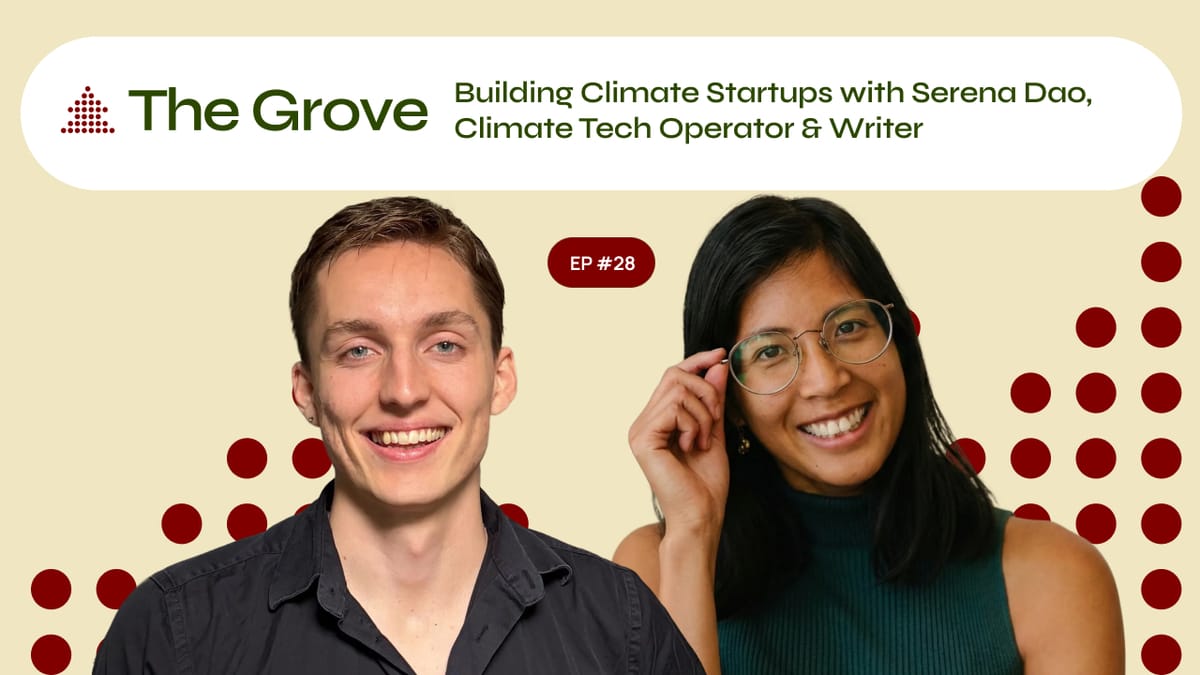
Serena Dao was dropped into the woods at 13 years old with a crate of food and told to figure it out for 48 hours. That's Maine's idea of education.
Turns out to be pretty good training for a career in helping founders turn radical science into working companies.
full conversation at youtube or spotify
By the time she landed at The Engine, MIT's nonprofit startup accelerator in Cambridge, Serena had spent years moving through biotech, ag tech, food tech, and carbon removal, watching startups succeed and collapse from the inside.
She worked at Ginkgo Bioworks when it had fewer than 100 people, reported to a manager who withheld information for weeks, seen data inflated by 30%, and watched companies duct-tape their infrastructure while already scaling.
In the end she developed the business vocabulary to explain what her scientist's intuition had already been telling her.
The Grove caught up with Serena at a rare moment: the week between leaving The Engine and starting her next role as Chief of Staff at an early-stage startup. Below is what she learned about building the organizations that make hard tech possible — the human infrastructure that outlasts any single piece of technology.
On Carbon Removal
Before Serena ever thought about team-building or organizational design, she was chasing a more fundamental question: what does it actually mean to work on climate?
Her path through science was deliberately adjacent to that question for years: Chemistry and physics at Northeastern.
Marine chemistry at Woods Hole Oceanographic Institution.
Big pharma.
Ag tech company in San Francisco.
Food tech.
Each stop moved her closer, but the connection felt abstract — improving yield efficiency, reducing water use, finding better production methods. Real work, but not the thing.
Then she joined Charm Industrial.
"We were taking corn feedstock and turning it into oil and putting it back into the ground," she says. "Taking what would have been degrading carbon into the atmosphere and putting it underground where it could be stored long-term — that was so tangible and clear to me."
Working in carbon removal also forced Serena to reckon with the business reality of climate tech; mainly, the voluntary carbon market & dependency on tax incentives like the 45Q credit.
Her MBA equipped her with the vocabulary she'd been missing as a scientist: "I always looked at things through the science brain of like, well, this is really impacting our environment, so why aren't people investing in it? And now having gone to school, I understand the voluntary carbon market. I understand that it's not sustainable to have a business fully dependent on a government tax subsidy."
Her view on where the sector goes from here centers on utilization, not just capture. The carbon removal companies she watches most closely — including Charm itself, which now supplies bio-oil to the iron and steel industry — pair the removal with a second use. Sustainable aviation fuel. Soil remineralization through enhanced rock weathering. Wastewater treatment. The physics of pulling carbon down matters; having somewhere real to put it matters more.
That dual lens — the scientist who also understands the market — became the foundation of everything she'd do next at The Engine.
Startup's Data Infrastructure Struggles
The Engine describes its focus as "tough technology" — climate, healthcare, infrastructure, advanced manufacturing. The founders Serena worked were building new forms of concrete, new drug delivery systems, new ways to pull CO2 from the atmosphere. Timelines measured in decades, not quarters.
Her job was to find those teams and then help them build the organizational scaffolding around the science. That scaffolding, she learned quickly, breaks in predictable ways.
One of the most consistent failure modes she observed had nothing to do with the technology. It was data infrastructure — and specifically, founders who treated it as a cost rather than a foundation.
"They had never built it to be the size of the work that they were going to be doing," she recalls of one company she worked closely with. "Even though they knew they were a data company, they went with the cheapest packages for everything. And then by the time they were actually scaling up into their seed round, their systems were not prepared to handle the amount of data they had. Everything had to be bootstrapped backwards."
The duct-tape-and-MacGyver phase that followed cost the company far more — in time, in focus, in investor confidence — than the upfront infrastructure investment would have.
The same principle applies at the most basic level. Serena saw information siloed on personal computers across multiple companies — institutional knowledge that evaporated when someone left, or simply couldn't be accessed when someone needed it. "It should just not be siloed on personal computers," she says. "There should be something shared that is visible to everyone." A shared Google Drive, a Dropbox, any common repository — the tool matters less than the habit of putting things there.
Also, before the first hire arrives, two things should already exist: a clear mission and values document + a basic system for organizational information. The people you're about to hire deserve to know what they're joining, and because the information you generate from day one has compounding value if it's organized and compounding cost if it's not.
"It's not just the goal of the company," Serena says of mission-setting. "It's also the pillars of the organization — is it honesty, integrity, high EQ? What are the foundational core values of who we are here?" The founders who skip this step tend to hire in their own image by default, which works until it doesn't.
Founders: Listen, Don't Defend
The story Serena tells about her time at a previous company is uncomfortable in the way that useful stories typically are.
She was hired to report directly to someone the organization already knew was difficult to work with. That person withheld information from her for weeks. Serena would run experiments and make errors because critical steps in the process had never been shared with her. When she finally learned the full protocol and started generating her own data, her numbers came in 30% lower than her manager's reported results (and unequivocally more accurate).
She raised the discrepancy but was told she was new and must be doing something wrong. Then an external review confirmed what she'd suspected: her numbers were correct. Her manager had been inflating results by 30%, and the company had been reporting those numbers to investors.
The person was fired. The company survived, though not without significant turbulence.
What makes this story useful is the extreme version of a more common problem. The lesson is in how the hire happened: through a recommendation that the founding team weighted more heavily than the signals from the interview process itself. People didn't love the candidate. They hired them anyway because of their technical credentials and because someone vouched for them.
"Just because you have someone brilliant doesn't mean they're the best person for your company," Serena says flatly.
At sub-10-person companies, the interview process needs to do two things that most technical founders haven't thought about: assess technical fit and assess cultural fit with every person on the existing team.
"When you're less than 10 people, every bit of time counts. You are all working very closely together. You need to make sure you can actually communicate with this person — that information is being shared, that you can go to them and ask questions, that you can help each other out when things are really hard."
The Close
The communication questions that technical founders rarely ask in interviews: What's the best way for you to receive feedback? How do you like to be managed? What's your preferred working style? These questions feel soft until the moment you realize you've hired someone you can't have a hard conversation with.
And on the founder side of those hard conversations: the single most important leadership skill Serena names isn't strategy or technical vision. It's the ability to receive feedback without becoming defensive.
"If someone gives you feedback, don't have an immediate defensive reaction or try to explain it away. Just listen. Stay neutral, ask some qualifying questions, then go have your feelings away from them. If you stay calm, they will stay calm."
The hierarchy doesn't disappear just because you're a seven-person startup with no org chart. Founders carry authority whether they want to or not, which means the team is reading every reaction for signals about whether honesty is actually safe. A founder who defends, explains, or deflects when they receive difficult feedback isn't just missing information — they're teaching their team that feedback carries a cost.
The inverse is also true. Founders who cultivate genuine psychological safety — who ask questions instead of justifying, who separate the feedback conversation from their emotional response — build organizations where problems surface early, when they're still solvable.
That's the through-line of everything Serena observed across years of working inside startups and then helping founders build them: hard technology requires a long time horizon, and long time horizons require organizations where people can tell the truth. The lab bench work is hard. The regulatory path is hard. The fundraising — especially right now, she notes, with grant standards higher than she's ever seen and VCs more cautious than ever — is genuinely brutal.
The companies that navigate all of it tend to share something beyond technical credibility. They've built teams where the hard conversations happen early, where the data lives somewhere everyone can find it, and where the founders have learned, sometimes painfully, that the feedback they least want to hear is usually the feedback they most need.
Serena Dao is stepping into her next chapter as Chief of Staff at an early-stage climate tech startup. Follow her work and thinking on LinkedIn at Serena Dao.
To learn more about The Engine's work supporting tough technology startups in climate, healthcare, infrastructure, and advanced manufacturing, visit engine.xyz. Follow their progress on LinkedIn as they continue their mission to support the scientists and engineers building the technologies the world needs most.
Member discussion: