
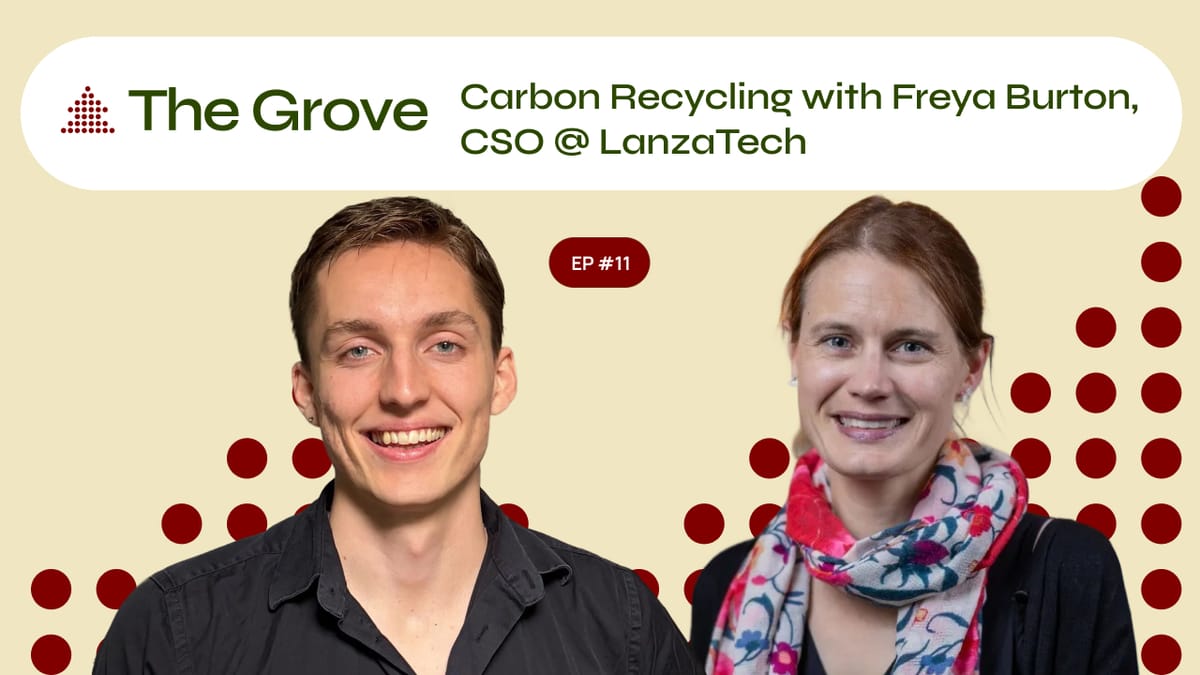
I asked Freya: "What inspires you?", but she had other plans.
After nearly two decades building one of the world's most ambitious climate technologies, after weathering funding droughts and technical obstacles that would have broken lesser spirits, her answer cuts with refreshing honesty.
"I don't know, I mean I could say, you know, my family and blah blah blah, but actually I'm more stubborn than inspired," Freya admits. "I've been at this for so long. What inspires me is the fact that we have to make this work. Like I will not leave here until I've done every single thing I can."
It's 2007, and LanzaTech exists as little more than an audacious idea, a leased photocopier, and four people sharing lab space with another company. Freya, with her biology background and a hunger for meaningful challenge, becomes the fourth employee of what will become a pioneering force in carbon recycling technology. The company's mission sounds like science fiction: use biology to capture pollution and transform it into the very products that traditionally require fossil fuels to create.
Today, nearly twenty years later, LanzaTech operates at commercial scale, turning industrial waste gases into sustainable ethanol, jet fuel, and chemicals. Freya's journey from that cramped shared laboratory to Chief Sustainability Officer of a publicly traded company illuminates not just the arc of one remarkable career, but the gritty, often unglamorous reality of building breakthrough climate technology in a world desperate for solutions.
First Data: Pollution to Ethanol
When Sean Simpson approached Freya about joining his fledgling company, the proposition carried all the hallmarks of a risky venture. Two biologists had developed a technology platform that promised to capture industrial pollution—steel mill emissions, petroleum refinery waste gases, agricultural residues—and convert these carbon-rich streams into valuable products through engineered bacteria.
"I used to work with Sean's wife teaching English, but I'm having biology background and I chatted with Sean who said I've got this idea for a company for this technology," Freya recalls, revisiting a pivotal moment. The timing felt serendipitous. She was seeking a change of pace, drawn by an inexplicable pull toward challenges that others deemed impossible.
The early proof-of-concept work represented a fundamental shift in how we might approach industrial waste. Rather than viewing pollution as an unfortunate byproduct requiring expensive disposal, LanzaTech's platform treated these emissions as raw materials. Their proprietary bacteria, evolved through careful genetic engineering, could consume carbon monoxide, carbon dioxide, and hydrogen—the primary components of industrial waste gases—and excrete ethanol as naturally as yeast ferments sugar.
"I thought, all right, I'll join. Let's, you know, probably not going to last, you know, we'll see how long this sticks around for," Freya remembers. The technology's first successful demonstrations occurred in laboratory bioreactors, small-scale systems that proved the biological conversion could work consistently.
Those early experiments yielded something more valuable than ethanol—they produced data that validated a completely new approach to carbon utilization. Traditional biofuels competed with with food systems by requiring dedicated land, water, and crops. LanzaTech's bacteria thrived on waste streams that factories produced anyway, turning environmental liabilities into economic assets without displacing agricultural resources.
The breakthrough moments came in increments rather than sudden revelations. Each successful fermentation run generated crucial metrics: conversion efficiency, bacterial growth rates, product purity. Freya found herself documenting processes, optimizing growth conditions, and gradually building the technical foundation that would support much larger ambitions. The work demanded patience with biological systems that operated on their own timelines, resistant to the urgency venture capital demands.
Overcoming Cash Challenges in Tech
The path from laboratory success to commercial viability stretched across years of what Freya describes as relentless fundraising cycles. "I think a hurdle always is cash, regardless of what technology you're approaching this from, and Lanza is no exception," she explains.
The first major milestone arrived with their Series A round in 2007, led by Vinod Khosla through Khosla Ventures. Landing this investment represented more than financial validation—Khosla had built a reputation for backing transformative energy technologies, and LanzaTech became his first investment outside the United States. For a small team operating from New Zealand, securing Silicon Valley's attention felt surreal.
"I did everything in the company until we could afford to hire somebody who was qualified," Freya remembers, speaking with the quiet pride that comes from necessity breeding competence. The funding allowed them to hire specialists, but the fundamental challenge persisted: deep technology companies require enormous capital investments before generating revenue, and investors grow impatient with development timelines measured in decades rather than quarters.
Moving operations from New Zealand to Chicago marked another inflection point, positioning LanzaTech closer to both potential industrial partners and additional funding sources. The relocation brought new pressures. Operating in the world's largest economy meant competing for talent, facilities, and investor attention against countless other ambitious startups. Freya adapted to American business culture while maintaining focus on the underlying technology development.
The cash challenges extended beyond corporate fundraising. Industrial partners evaluating LanzaTech's platform required their own investment committees to approve demonstration projects. These potential customers operated massive facilities where any new technology represented both operational risk and potential competitive advantage. Convincing steel companies, oil refineries, and chemical manufacturers to integrate unproven biological systems into their processes required extensive pilot testing and patient relationship building.
"You need to really think about why people need to invest in your type of technology," Freya reflects, her tone carrying the thoughtful patience of someone who has learned to frame complex technical benefits in business terms. "And it helps you think about what you're offering and why it's important." Each funding conversation forced the team to articulate not just how their technology worked, but why the world needed it enough to justify the risks and timelines involved.
The opportunity embedded within these cash challenges became clearer over time. Investors and partners who committed to LanzaTech's vision demonstrated genuine belief in the platform's potential. These stakeholders brought more than money—they provided industry expertise, regulatory insights, and validation that helped open doors to additional opportunities.
Sustainability: Business Survival
By the time LanzaTech reached commercial scale operations, the conversation around climate technology had fundamentally shifted. What began as an environmental imperative evolved into a business survival strategy for industries facing increasing regulatory pressure and stakeholder demands for decarbonization.
"There's more willingness to include new technologies today because people are talking about it," Freya observes, noting policy changes across multiple jurisdictions. European regulations now recognize recycled carbon fuels as distinct categories, while American incentive programs specifically support ethanol production from waste streams and carbon capture utilization.
The steel industry emerged as an ideal early partner for LanzaTech's platform. Steel production generates massive quantities of carbon monoxide-rich waste gases that companies traditionally flare or vent to the atmosphere. LanzaTech's bacteria convert these emissions into ethanol, which can be further processed into jet fuel, chemicals, or consumer products. Steel companies reduce their environmental impact while generating revenue from former waste streams.
Commercial demonstration projects validated the platform's economic potential. LanzaTech's first commercial facility, integrated with a steel mill in China, processes millions of cubic meters of waste gas annually. The installation produces thousands of gallons of ethanol daily, demonstrating that the technology scales beyond laboratory conditions while maintaining biological productivity and product quality.
The business model aligned industrial efficiency with environmental goals rather than forcing companies to choose between profitability and sustainability. Factory operators discovered that optimizing waste gas capture for LanzaTech's system often improved their primary manufacturing processes, creating operational synergies beyond the direct revenue from ethanol sales.
Airlines emerged as eager customers for LanzaTech's sustainable aviation fuel, seeking alternatives to petroleum-derived jet fuel that could reduce their carbon footprint without requiring new engines or infrastructure modifications. The aviation industry faces unique decarbonization challenges—electric propulsion remains impractical for long-haul flights, making sustainable liquid fuels essential for meeting climate commitments.
Consumer brands building supply chains around recycled carbon products created additional market demand. Fashion companies began using LanzaTech's ethanol to produce polyester fabrics, allowing them to market clothing made from captured industrial emissions. This application demonstrated how carbon recycling could penetrate consumer markets, creating awareness and demand that supported continued investment in the platform.
A Note to Women
"What we're trying to do is tough," Freya acknowledges. "And, you know, there is no reason why you shouldn't be able to play a part in trying to change the world."
The company's CEO, Jennifer Holmgren, embodies a defiant approach to leadership as woman. "Anybody who's ever told her that she couldn't do something, her response is watch me," Freya explains. This philosophy that has become central to LanzaTech's culture. The company maintains strong female representation across its board and executive team, creating natural role models for the next generation of clean technology leaders.
The reality of being a woman in energy and climate technology remains challenging, as Freya. "It is hard in this space just generally and traditionally there's not many women in energy or in the science sort of STEM subjects," she reflects, noting how Jennifer often jokes about being able to count the women on one hand at industry events.
This scarcity creates opportunity rather than obstacle for those willing to persist. The shortage of female voices in these critical sectors means that women who do enter the field often find themselves uniquely positioned to influence decisions and shape company cultures in innovative ways.
Freya's advice for young women considering careers in climate technology balances realism with encouragement, rooted in two decades of experience navigating this landscape. "Don't take no for an answer. If someone says you shouldn't be doing that, think, watch me, you're going to do it. But also just keep going because it's a relentless cycle," she emphasizes. "Don't ever feel pressured to go into something or into a subject because people think you should be doing it. You absolutely should be doing what you love and what you want to do."
The Close
As LanzaTech continues expanding globally, with new facilities planned across multiple continents, Freya's role involves balancing technological advancement with sustainable business practices. The platform that began with four people and a photocopier now processes industrial waste streams worth billions of dollars annually, but the fundamental mission remains unchanged: transform pollution into useful products while building a economically viable business.
"I will not leave here until I've done every single thing I can," Freya declares with the unwavering determination that has sustained her through nearly two decades of technical challenges, funding crises, and market skepticism. Her stubborn optimism reflects not naive idealism but practical recognition that breakthrough technologies require leaders willing to persist through inevitable obstacles.
The conversation ends with practical wisdom hard-won through experience. "Make sure you have some other outlets or interests, because otherwise it won't consume you," Freya advises, mentioning her dog, romantic novels, and puzzles as essential counterbalances to the intensity of building world-changing technology. "Something that switches your brain off, super important. Otherwise, if you don't look after yourself, you can't achieve what you need to do."
LanzaTech's story continues evolving, with new applications for carbon recycling emerging as industries recognize the economic and environmental benefits of treating waste as resource. Freya's journey from teaching English to leading sustainability strategy for a global technology platform demonstrates that meaningful careers often emerge through unexpected opportunities rather than predetermined plans.
The leased photocopier has long since been replaced by sophisticated laboratory equipment and commercial production facilities. The shared workspace evolved into corporate offices spanning multiple continents. But the core mission that attracted Freya to LanzaTech's founding team persists: prove that biology can transform industrial pollution into valuable products, creating economic incentives for environmental stewardship rather than depending solely on regulatory compliance.
In an era where climate technology solutions require massive scale and patient capital, LanzaTech's trajectory offers both inspiration and practical guidance for entrepreneurs tackling similarly ambitious challenges. The company's success validates Freya's belief that breakthrough innovations require stubborn persistence rather than sudden inspiration, sustained effort rather than dramatic breakthroughs, and diverse leadership teams willing to tackle problems others consider impossible.
Twenty years after joining a startup with little more than an audacious idea and borrowed laboratory space, Freya continues finding new challenges within LanzaTech's expanding platform. Her commitment to making the technology work reflects not just professional dedication but recognition that meaningful solutions to industrial pollution require leaders willing to dedicate decades rather than years to seeing innovations through to global impact.
To learn more about LanzaTech's carbon recycling platform technology, visit lanzatech.com or contact them on social media at @LanzaTech on X and LinkedIn. Follow their progress on LinkedIn as they continue their mission to transform pollution into valuable products that would otherwise come from fossil fuels.
Member discussion: