
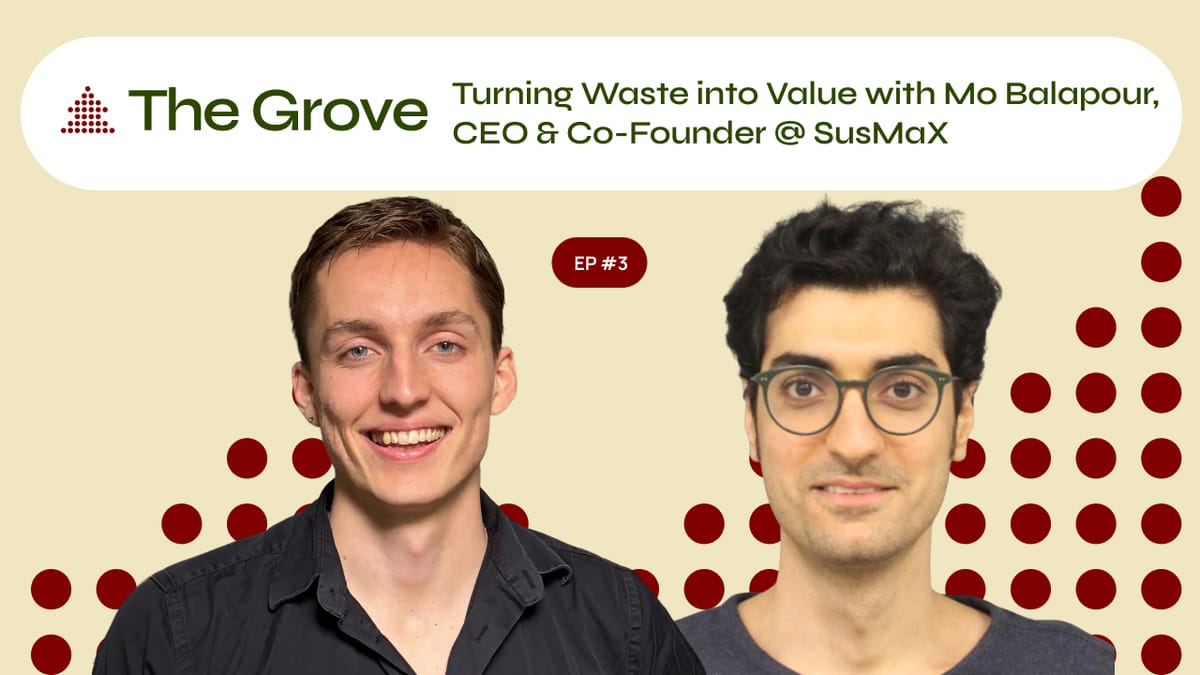
Listen to the full episode on youtube or spotify
Mo Balapur never intended to become an entrepreneur. At 27, he was three years deep into a PhD at Drexel University, eyes set on a professorship and a life of academic research. Then, a National Science Foundation grant for market research that would reveal a $2 billion opportunity to change his life.
"I didn't have any experience of entrepreneurship before SusMax," Mo admits. "This was just what I was doing at Drexel for my PhD. We kind of did a market research and figured out there is some opportunity out there."
That opportunity wasn't buried in some exotic new technology or flashy software platform. It was sitting in 750 coal ash landfills across the United States. There are over two billion tons of industrial waste that most people drive past without a second thought. What Mo discovered through his research would become SusMax, a company that transforms this overlooked waste into valuable construction materials. Sometimes revolutionary ideas emerge from the most mundane of problems.
The story of SusMax isn't just about turning waste into wealth. It's about the peculiar journey of deep-tech entrepreneurship, where patience and urgency must coexist, where a single pivot can reshape an entire career trajectory, and where the most valuable lessons often come from realizing how little you initially understood about the challenge ahead. To my entrepreneurs out there - sound familiar?
Recycling Coal Ash: The $2B Opportunity Hidden in Industrial Waste
The genesis of what would become SusMax began before Mo ever arrived at Drexel. When coal power plants burn coal to generate electricity, they create a byproduct that the industry has struggled with for decades: ash. Good quality ash finds its way into concrete applications, but the remaining low-quality material gets trucked to landfills where it takes up space and creates environmental concerns.
"Coal power plants in the past and even now, some of them that are still in operation, when they want to generate electricity, they burn coal that generate heat," Mo explains. "The byproduct of that coal burning is ash, leftover ash. If it's good quality ash, it usually goes into concrete. If it's not, it goes into the landfill."
When Mo joined Drexel in 2017, the university was already exploring how to recycle this low-quality ash into aggregate for concrete applications.
"Fun story," Mo smiles. "I thought I'm going to work on a different project. My professor said, oh, you're going to work on pavement concrete or whatever it was. And then I joined Drexel and my project was something else. But that's how I got thrown into it."
The research was intensive: deep dives into the physical and chemical properties of coal ash, understanding how those properties affected recycling processes, and determining optimal process parameters.
The breakthrough came around 2018-19, when that small NSF grant opened the door to market research and customer discovery. Mo began talking to people in the construction industry, utilities companies, and waste management firms. What he discovered was striking: the market for lightweight aggregate—the type of construction material SusMax could produce from coal ash—was enormous and underserved.
"We have 750 coal ash landfills in the United States," Mo explains, "And it's estimated to have about two plus billion tons of ash sitting in these landfills. So there is a huge opportunity to recycle this material and get rid of these landfills."
The math was compelling. Rather than mining virgin materials and dealing with the environmental costs of extraction, SusMax could transform waste into valuable construction aggregate.
But recognizing an opportunity and building a company to capture it are entirely different challenges, as Mo would soon discover.
Scaling R&D: A 4.5-Year Journey Through Deep-Tech Reality
By 2020, Mo faced a pivotal decision. He was approaching the end of his PhD with two clear paths ahead: find a traditional job or commercialize his research by forming SusMax. The decision, he insists, wasn't as calculated as it might seem from the outside.
"After I finished my PhD, I was faced with two decisions, either go find a job or form Susmax and start commercializing what I was working on," he reflects. "I've had the experience of working for other people. I figured out that's not what I'm interested in and taking risk at that time, it wasn't a huge risk for me."
At 28, without significant financial obligations, Mo saw the potential downside as manageable. "When I started Susmax I was probably 27, 28 and then I didn't have much money, I didn't have anything. So it wasn't like 'oh there is a huge risk going into Susmax' and I thought it was gonna be a fun process and that's how I decided to go about it."
As he would soon find out, SusMax operates at an entirely different speed than the traditional SF VC-backed software company.
"For us, because of the R&D and the amount of work that needs to go into scaling up that process, scaling up the process itself is gonna be a longer life cycle," Mo explains, "We've been at it for about four, four and a half years and we're still not at commercial scale to be able to generate revenue and sell our material."
The technical challenges are matched by the capital intensity of the business model. Unlike software that can scale with marginal costs approaching zero, SusMax requires significant capital investment for each production facility. Every new market requires new infrastructure, new partnerships with local utilities, new relationships with regional construction companies.
Yet Mo and his team have methodically worked through each challenge. They've secured agreements with utilities, conducted extensive testing with potential customers, and refined their process parameters through thousands of iterations. The progress is real, even if it's measured in years rather than months.
"We're hopeful in 2027, we have a plant that is operational at scale, recycling material at scale, and then we're able to sell our material to ready-mix concrete suppliers," Mo states.
Patience and Urgency: The Paradox of Deep-Tech Growth
Perhaps the most counterintuitive lesson from Mo's journey is how successful deep-tech entrepreneurs must master the paradox of simultaneous patience and urgency. It's a mindset that runs counter to the "move fast and break things" mentality that has come to define startup culture.
The urgency comes from market realities.
The patience requirement is equally critical.
Rushing to scale before fully understanding your process parameters can be catastrophic when you're dealing with physical infrastructure and industrial customers. "Scaling the process itself takes a long time, making sure everything works and it's a kind of a capex heavy model for our case. And that itself makes it a little bit more challenging."
For Mo, managing this paradox has meant maintaining unwavering focus on de-risking the technology while aggressively pursuing customer validation. "Just to have patience and make sure everything is right and you de-risked the technology considerably so when you get to that commercial scale nothing is going to go wrong."
This approach has shaped how SusMax approaches every aspect of their business development. Rather than viewing the extended customer testing process as a hurdle, Mo frames it as an opportunity to build stronger relationships and gather better market intelligence.
"I wouldn't call it a hurdle. It's just the natural life cycle of the business that we need to go through," he explains when describing the time-intensive process of customer validation. "It's just a time consuming process and we're going through it. But I wouldn't call it a problem. It's definitely an opportunity."
The opportunity lies in understanding exactly what customers need, how they make purchasing decisions, and what price points make sense across different market segments. This deep customer knowledge becomes a competitive advantage that's difficult for competitors to replicate quickly.
The Vision That Drives the Marathon
What sustains Mo through the extended timeline and technical complexity isn't just the financial opportunity. It's the environmental impact that provides deeper motivation.
"I think the first vision that I had when I started in 21, I was thinking we're going to have a commercial facility. We're going to recycle this material at scale. We're going to have a positive impact," Mo reflects with genuine enthusiasm breaking through his typically measured tone. "Having that positive impact, that's something that drives me."
The environmental math is compelling: "Being able to generate, produce this material out of waste ash instead of mining virgin and natural material is something, I think it's positive for the environment. And we can maybe recycle these landfills and close these landfills for good for a long time and at the same time produce a useful material for the construction market."
As SusMax approaches its goal of commercial-scale operations in 2027, Mo's journey from reluctant entrepreneur to deep-tech CEO offers important lessons for anyone building in physical industries. Success requires a fundamentally different mindset from software entrepreneurship; one that values thorough understanding over rapid iteration, patient capital over quick returns, and systematic validation over minimum viable products.
The stakes are significant. If SusMax succeeds in proving their model in the Mid-Atlantic region, they have plans to expand to the Southeast and Midwest markets, then internationally. "There are a lot of these coal ash landfills sitting in other countries that can be basically monetized and be recycled into useful construction products."
For Mo, the path from PhD student to CEO wasn't planned, but it represents something more valuable than a career pivot. It's proof that the most impactful innovations often emerge from the intersection of deep technical understanding and persistent market development.
The story of SusMax is still being written, but the foundation has been carefully laid through years of research, testing, and relationship building. Remember....patience!!
To learn more about SusMax's coal ash recycling technology, visit their website or contact them directly through their site. Follow their progress on LinkedIn as they continue their mission to transform industrial waste into valuable construction materials while reducing environmental impact.
Member discussion: