
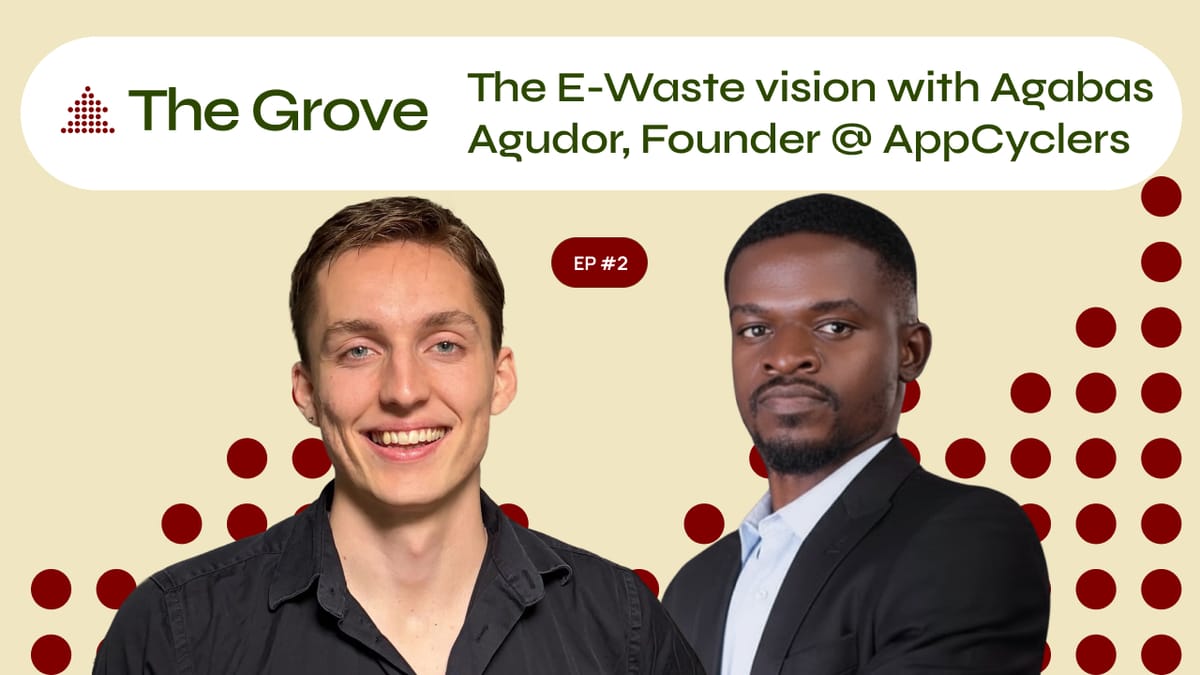
Listen to the full episode on youtube or spotify
The phone kept ringing. Everyone from students, businesses, and radio listeners wanted Agabas Agudor to come collect their old electronics. What started as a university hackathon project had somehow triggered a groundswell of demand that the young Ghanaian entrepreneur wasn't prepared for. Standing in his backyard, surrounded by growing piles of discarded computers, phones, and televisions, Agabas faced a problem that would define the next seven years of his life: he had successfully convinced people to dispose of their e-waste responsibly, but Ghana had virtually no formal recyclers to process it.
"We realized that there were no formal recyclers within the value chain that we could give the waste to for them to recycle," Agabas recalls. "So we had to hold most of these waste in our backyard, keep on looking forward for various solutions."
This moment captures the essence of Agabas's journey with Appcyclers, his clean tech startup that has quietly built one of Ghana's most promising e-waste management platforms. From those humble beginnings as a student group in 2019, Appcyclers has evolved into a nine-staff operation preparing to launch a marketplace that could reshape how electronic waste moves across Africa. It's a story of persistence through funding droughts, innovation born from necessity, and the slow, methodical work of building an industry from scratch.
Agabas's story begins long before that first hackathon, rooted in the rhythms of family business and the entrepreneurial instincts that would eventually drive him to tackle one of the world's fastest-growing waste streams.
E-Waste: A Double-Edged Sword
Growing up in northern Ghana, Agabas learned the fundamentals of business through his family's restaurant operation. "I really had first-hand experience when it comes to customer service and providing services to people," he explains.
But it wasn't until his final year at university that Agabas discovered the peculiar economics of electronic waste. Volunteering at an incubation hub, he joined a hackathon organized by a development agency with a specific mission: bring young minds together to solve Ghana's mounting e-waste crisis.
"I didn't know what e-waste was," Agabas admits honestly. "It was my first time getting to know what exactly e-waste is and how it is posing a whole lot of detrimental effects to human health and the environment."
The education was sobering:
But Agabas saw something else in those statistics; aka "the flip side of the coin." Electronic waste contains valuable materials: precious metals, rare earth elements, and reusable components that could generate income while protecting the environment. "I love the fact that it kind of helps solve certain environmental issues, but then as well there was also a bit of economic gain out of it," he says.
This dual nature of environmental threat and economic opportunity became the philosophical foundation of Appcyclers. Rather than simply removing harmful materials from communities, Agabas envisioned a system that could transform waste into wealth while building formal recycling infrastructure where none existed.
The hackathon team agreed to pursue the idea beyond the competition. They had no business plan, no funding, no clear understanding of how massive the challenges ahead would be. What they had was a shared conviction that technology could bridge the gap between Ghana's informal waste collectors and the formal recycling industry that barely existed.
"Right from 2019, we've been pursuing the idea," Agabas says. The road has been...uneven to say the least.
E-waste Recycling Marketplace MVP Launched
The early days required a different kind of entrepreneurship—one measured not in venture capital rounds but in radio station visits and school presentations. Agabas and his team started as pure advocates, traveling from community to community with a simple message: electronic waste is dangerous when handled improperly, but valuable when processed correctly.
"We started mainly in education as a student group, moving from schools to schools, and as well moving from radio stations to radio stations," Agabas explains. Their goal was basic awareness that helps people understand how old phones and computers couldn't simply be thrown in regular trash or burned in backyards.
The education campaign worked too well. Calls poured in from individuals and businesses ready to dispose of their electronics responsibly. But Ghana's formal recycling infrastructure couldn't handle the volume. "Upon getting most of these calls, people reaching out to discard their electronic waste, we realized that there were no formal recyclers within the value chain," Agabas recalls.
The team found themselves operating an ad-hoc collection service, gathering electronic waste faster than they could process it. Their backyard became an informal warehouse, filled with the technological detritus of Ghana's growing digital economy. It was unsustainable, but it revealed the market gap that would eventually define their business model.
"We had to hold most of these waste in our backyard, keep on looking forward for various solutions," Agabas says.
Years of incremental progress followed. While still students, the team built connections with informal recyclers, developed collection routes, and slowly constructed the beginnings of a formal e-waste value chain. They learned the economics of component recovery, the logistics of safe transport, and the complex web of regulations surrounding electronic waste.
By 2024, this accumulated knowledge crystallized into AYAT—Appcyclers' flagship marketplace platform. The MVP launch marked a fundamental shift from advocacy to infrastructure, creating a digital marketplace where waste generators could connect with certified recyclers.
"The first MVP was out, we had a series of feedbacks," Agabas explains. "Currently we've built on most of those feedbacks. So we're looking forward to fully launching, hopefully in January."
The platform addresses the core inefficiency that Agabas discovered in his backyard years earlier: the disconnect between people who want to dispose of electronics responsibly and recyclers who need steady material streams. By creating a digital marketplace, Appcyclers can aggregate demand, ensure proper handling protocols, and track materials through the recycling process.
AYAT's bigger vision is= the foundation for Agabas's larger ambition to formalize Ghana's entire e-waste sector. "We really want to position ourselves as a full technological company within this value chain," he says.
Reflection on the Entreprenurial Environment
The transformation from student advocacy group to formal business reflects broader changes in Ghana's clean technology ecosystem. When Agabas started, "there were literally no support within the value chain," he explains. "There were more focus on plastic waste, so there were no focus on electronic waste and there were no specific funding opportunities for entrepreneurs basically operating in this sector."
Building a business in this vacuum required what Agabas calls "being very innovative with our models." Instead of traditional funding, the team pursued advocacy and educational programs that generated small revenue streams while building their expertise. They wrote grants, organized workshops, and gradually convinced stakeholders that formal e-waste management represented both an environmental necessity and an economic opportunity.
The persistence paid off slowly. "Only recently we came across various funding opportunities focused on the e-waste phase," Agabas notes, describing the gradual emergence of financial support for his sector. The company has raised funding sufficient to employ nine staff members and build their marketplace platform.
"We're more focused on organically using the little we have to kind of grow the trajectory that we are looking for," he explains.
The team growth tells its own story about Ghana's developing clean technology talent pool. Early employees came from personal networks and university connections, but Agabas notes that finding qualified staff has become easier as awareness of the e-waste sector has grown. "Getting the right skills was somehow difficult in coming by," he recalls of the early days. "Then gradually, gradually it turns out, currently, it's working out bit by bit."
This measured approach reflects lessons learned during years of bootstrapping. Agabas describes the early period: "As a young graduate right from school with no proven business management skills, all kind of theory learning, it was really difficult at the beginning. We made some mistakes, but then we also were able to learn from some others."
Looking ahead, Agabas envisions dramatic expansion while maintaining this foundation. "We foresee AYAT being the go-to for us in terms of building it to be a Pan-African movement where e-waste could be traded across Africa," he explains.
This Pan-African vision represents the natural evolution of lessons learned in Ghana's challenging environment. If Appcyclers can create efficient e-waste markets in a country with minimal recycling infrastructure, the same technology could theoretically work across the continent's diverse economic and regulatory contexts.
Agabas remains grounded in the immediate work. January's full platform launch will test whether five years of relationship-building and technology development can create sustainable e-waste markets. "We need certain amounts to kind of help us actualize more profit margins and also to be able to grow the team to the capacity that we are projecting," he acknowledges, speaking with the practical focus of someone managing real constraints.
As Ghana's e-waste sector matures and Appcyclers prepares for continental expansion, Agabas's journey offers lessons for entrepreneurs tackling complex environmental challenges. Success comes not from dramatic breakthroughs but from consistent progress, relationship-building, and the stubborn belief that waste can become opportunity with enough creativity and persistence.
The phone still rings with people wanting to dispose of their electronics. But now, instead of a backyard full of waste, Agabas has built the infrastructure to transform those calls into a sustainable business that could reshape how Africa handles its growing stream of electronic waste.
To learn more about Appcyclers' groundbreaking e-waste platform, visit https://www.appcyclers.com/ or contact them at @Appcyclers on all media platforms. Follow their progress on LinkedIn as they continue their mission to solve e-waste recycling for Africa.
Member discussion: