
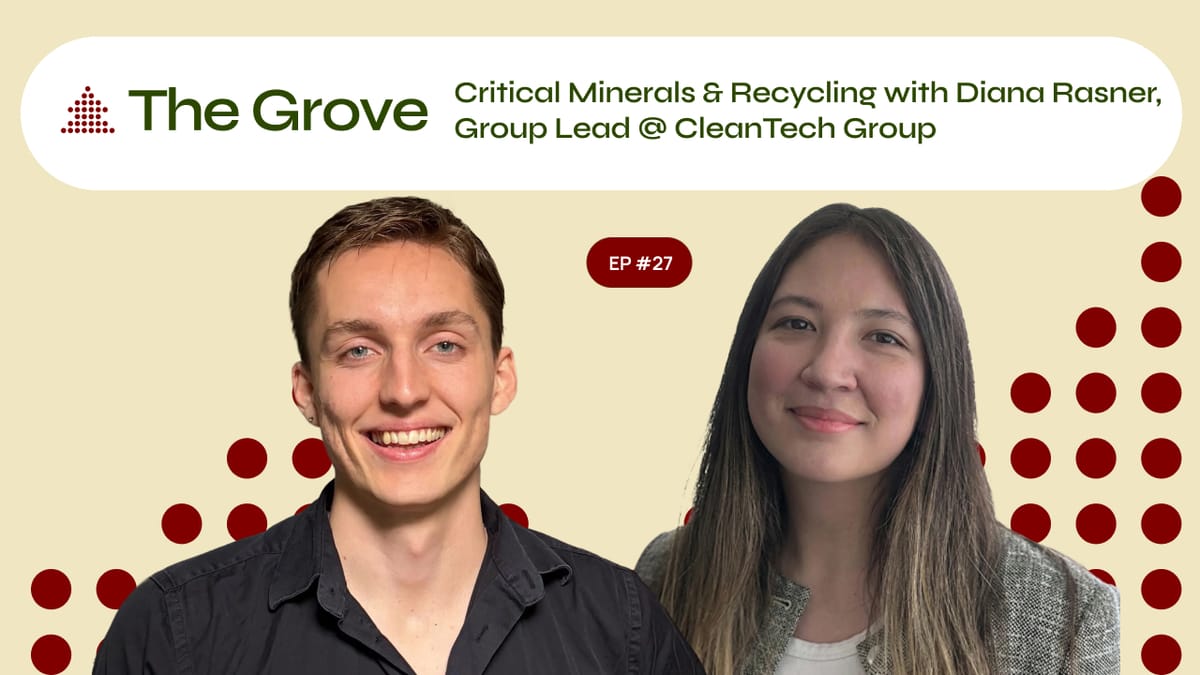
Diana Rasner wanted to be an architect. In a way, you can say she is.
This is article 2/4 a special series with Cleantech Group breaking down their research in Global Cleantech 100 report. Full episode available on youtube and spotify
After years spanning traditional manufacturing, oil and gas R&D, and a five-year stint at a Houston cleantech startup, she joined Cleantech Group as group lead for materials, chemicals, waste, and recycling. Her section of the annual GCT 100 report covers what she calls 'the backbone of the industrialized world': Critical Minerals.
In our conversation, Diana architects (see?) a framework for how to understand the huge and complex industry of Critical Minerals. Using that framework, we can make more sense of the insights & hot takes she drops. Lets step into the scaffolding.
Bucket 1: Upstream
Where you find where to dig, extract ore, and process it into concentrate. Two subbuckets:
1. Exploration & Finding Ore Bodies Finding a place in the earth's crust that is economically feasible to mine. Requires geological surveys, drilling programs, and a lot of time and planning. Typically ~5 years off your timeline before anything else happens.
2. Active Mining / Extraction & On-Site Concentration Digging up ore, crushing it down, running it through flotation tanks to separate waste from value. Gets ore up to roughly the 60–70% metal content that that midstream needs. Techniques are simple and have carried through millennia. Ore grades are dropping over time, meaning companies must dig more rock to fulfill the same orders.
Bucket 2: Midstream
Where concentrate is turned into usable refined metal. Currently dominated by China. Approximately 80% (yes, that number is EIGHTY PERCENT) of all globally mined minerals are sent there for smelting and refining:
3. Smelting & Refining Taking concentrate from 60–70% and getting it to 100% needed to make a refined metal or compound. Emissions-intensive and chemically complex.
Bucket 3: Downstream
Where refined metal becomes goods and what happens at end of life. Two subbuckets:
4. Manufacturing Taking refined metal and making products: wires, steel beams, magnets, battery materials, whatever the end product requires.
5. Battery Recycling & Circular Economy Recovering materials from end-of-life batteries to return them to the supply chain. Constrained by whether domestic manufacturing capacity exists to actually use what gets recycled. Without an end customer for the recovered material, the recycling loop is economically unsustainable.
Now, Upstream Action
Lots of AI activity- who's surprised?
AI is the primary tool the industry is reaching for. Mining companies live in a commodity world where every cent and every kilowatt hour gets tracked.
One of Cleantech Group's clients, among the largest mining companies in the world, told Diana their data science team had grown large enough to constitute its own standalone company. Diana's read: if you're not going to use AI, you are going to fall behind.
AI's impact falls into a few areas:
- The most significant is precision targeting. Here, we enhance the identification of where economically viable ore concentrations exist before committing to drilling or blasting. Companies can now drill less rock and blast less rock, versus excavating an acre of land to recover maybe 10% of what they were looking for.
- The second area is operational decision-making at mid-sized and smaller companies. Here, there's faster visibility into what's coming out of the ground, earlier detection of equipment and fleet problems, better real-time optimization of continuous processes.
- The third is 'historical data as an asset'. Mining companies have accumulated geological and operational data across decades, in some cases centuries. That archive is now becoming feedstock for models that can extend the productive life of existing assets, figure out what the next targets are, or identify how to extend the life of current assets.
A favorite for Diana: VerAI. She positions them as a company using AI and sensors to look down into the earth's crust to figure out what ore bodies exist.
Upstream is interesting because, in this phase, the mine is not approved for operation yet and many real social/political factors dictate success. It can take decades to find the ore body, permit it, get regulations in place, and building the social trust required to operate with local workforce.
Diana points to humanitarian issues in places like Chile, the DRC, and Zambia as part of why that social trust is hard to build and why the timeline doesn't compress easily.
In many cases at this stage, brilliant PhDs make strides in technology that then has to be operated by workers in the middle of a rural stretch of country who may not speak English or have formal education. If it fails or breaks down, it's their risk.
SQM is an example Diana cites of a company having success. They work step-in-step with local and indigenous communities to explain what they're doing, how it works, and create local jobs around it. She notes this is becoming more prevalent, but not yet prevalent enough.
Midstream: Basically just China
The China dominance in midstream was a global effort. For roughly fifty years, Western nations chose to protect their land and resources and let other countries absorb the environmental burden of smelting and refining.
The consequence now is that China controls the supply of refined metal, the advanced versions of refining technology, and the goods manufactured from it.
Diana explains: China has had decades to build and scale this capacity and they're now using that scale to look at cleaner ways to do it. The gap between where they are and where Western domestic processing capability is today is "daunting".
It is simultaneously one of the biggest opportunities for startups in the space. The Cleantech Group highlighted several in the GCT 100 as a result.
Lithium is the example we walk through in detail.
- Most lithium is currently extracted in Chile and South America by pumping lithium-rich salty water into large evaporation ponds, letting the sun remove the water (the enormous volumes of water diverted from local communities is another conversation) and shipping the concentrate to China.
- Direct lithium extraction changes this. Instead of evaporating ponds, companies extract and refine lithium in the same step, on-site, closing the bottleneck and keeping supply chain control domestic. Mangrove Lithium is a rockstar in the space. They make the precursors needed for battery materials without the China leg of the journey.
Scale is the biggest challenge for founders in this Bucket. Lots of incredible technologies have proof at a few tonnes in a shipping container, but mines operate in megatons. Are you going to put a thousand shipping containers out there? The more things you have, the more things that can break and the more things you have to maintain.
I asked if anyone is doing midstream as well as China yet. Diana's answer is simply: no. Not at the moment.
Downstream: Magnets and Battery Recycling
For manufacturing, magnets is the massive theme. Rare earth permanent magnets sit inside anything that turns or carries an electronic signal: motors, pistons, speakers, EV engines. That supply chain runs through China.
Diana's most detailed downstream example is Niron Magnetics. Niron's approach is to use earth-abundant materials to produce permanent magnets with the same properties, sourced domestically in the US. They have partnerships in the speaker space and recently signed one with Stellantis for engines.
As the rare earth supply chain gets tighter, you're going to need alternatives that perform the same, if not better. Niron gives buyers the option to source locally rather than pay for a rare earth magnet with an uncertain supply chain behind it.
Battery recycling is another way to release supply chains from the China reliance. While modern advances are exciting, Diana is strong about it only working if the full value chain is built around it
Northvolt failure is her anchoring example. Europe invested heavily in battery recycling infrastructure before it had the domestic manufacturing base to absorb what that infrastructure produced. No European battery manufacturer existed at scale to consume recovered materials. The recycling loop had no end customer and wasn't economically sustainable. Compounding this: EV batteries lasted longer than projected, and many batteries coming out of vehicles aren't at end-of-life — they're viable as secondary energy storage, which further reduced the feedstock the recycling industry was built to process.
China avoided this by building the full vertical. The company Build Your Dream produces vehicles, batteries reach end of life, and Brunp (the recycling operation) recovers the material that feeds back into the next battery. Every link was built to connect to the next one.
The companies Diana points to as doing this intelligently in the Western context share one characteristic: they didn't build ahead of the feedstock.
Nth Cycle //A PERSONAL FAVORITE OF THE GROVE// uses a modular electrochemical platform (Diana describes them as little oysters that you put battery materials into and get raw metals back out) to build units that can scale incrementally. These grow as the economy and ecosystem grows rather than committing to a giant factory before the support and feedstock exists.
Ascend Materials, also on the GCT 100, takes the same approach, partnering with end users to provide them with the materials needed to produce batteries before scaling recovery capacity.
The EU is still heavily investing in this space, Diana says, but getting wiser — focusing more on who the battery manufacturers and automotive customers are going to be before building the recycling infrastructure around them.
The Close
What Diana describes is a supply chain that the Western world largely chose to hand off and now urgently needs to rebuild. This is happening under time pressure, against an incumbent (China) that has decades of scale, and without the luxury of waiting for economics to naturally favor the transition.
The upstream needs to stay economic while facing declines in ore grade. The midstream needs domestic refining capacity that doesn't yet exist at meaningful scale. The downstream needs manufacturing infrastructure that makes recycling economically rational rather than aspirational. None of these problems have a single solution or resolve quickly.
Diana's through line is time. You can fund everything & have the technology, but you'll still be pressed against decades-long mining timelines. China didn't build its position in a year and the Western world won't rebuild its position in one either.
The companies doing this well found a specific link in the chain where a bottleneck is sharpest and built something that works at that link. The supply chain won't be rebuilt quickly, but it is being rebuilt.
To learn more about Cleantech Group's research on critical minerals, materials, and the clean energy supply chain, visit cleantech.com or reach out through their website. Follow their work on LinkedIn as they continue tracking the innovations reshaping the global minerals and metals supply chain.
Member discussion: