
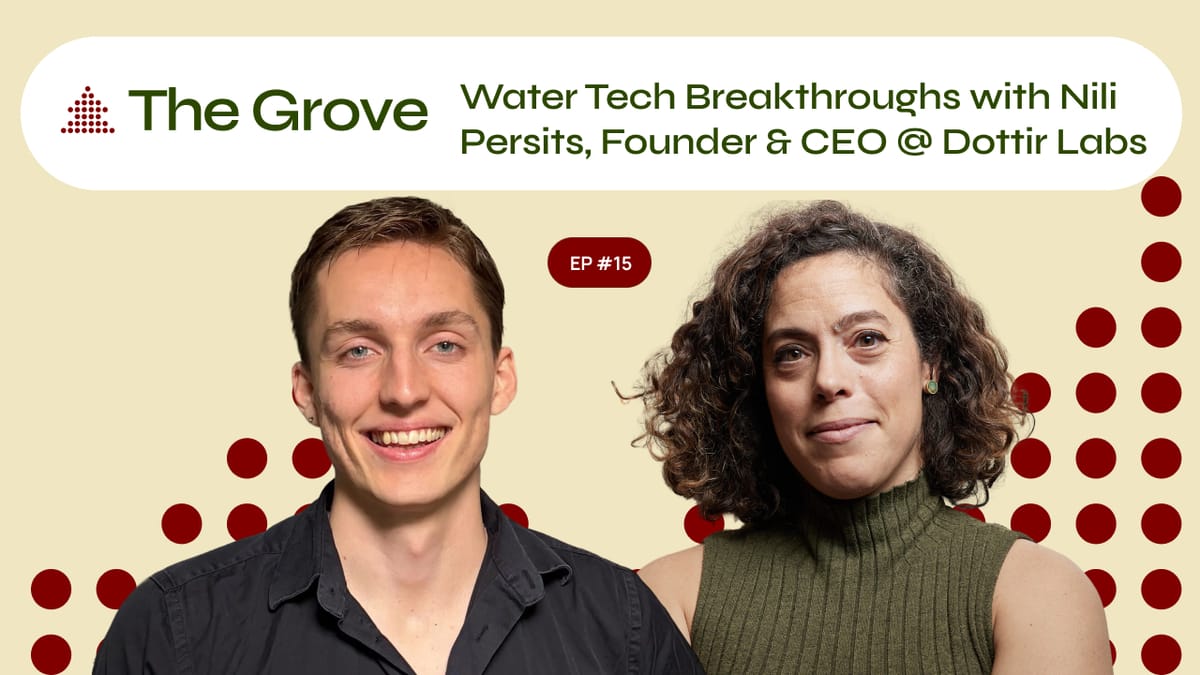
"Too many people have been burned by promises that no one actually acted on," Nili explains. "I don't ever want to do that. I want to build something that people can trust."
watch the full episode on spotify or youtube
Nili knows what it's like when technology fails in the field. After fifteen years building systems for the defense industry—where failure isn't just expensive, it's life-threatening—she understands that reliability isn't negotiable. So when she decided to tackle water monitoring, she brought an uncompromising commitment to building things that actually work when customers need them most.
That philosophy drives everything at Dottir Labs, the company she founded to monitor toxicity fast enough to actually prevent catastrophic losses.
The technical challenge is deceptively complex. Traditional water quality monitoring relies on sending samples to labs, a process that takes days while aquaculture farmers, for example, need answers in hours. Existing sensors measure basic parameters like temperature and pH, but can't detect the specific toxins that cause mass mortality events. Nili's solution combines Raman spectroscopy with machine learning to create sensors that can identify specific molecular signatures in real-time, providing the toxicity alarm that the industry desperately needs.
But building that technology required abandoning everything safe about her career—and moving her entire family across an ocean to pursue a PhD at MIT.
From Lab to Farm: A Year of Growth
The transition from defense contractor to MIT doctoral student wasn't exactly conventional. "I was much older than the traditional PhD and I also had two very young children," Nili recalls. "They were one and four. And I decided to quit my job and pursue a PhD in something I was totally passionate about."
That something was the intersection of biology and engineering—a field that had always fascinated her but seemed impossible to pursue. "I would say maybe a midlife crisis," she says. "I was like, I will do something different with my life from now on."
The gamble paid off. MIT accepted her application, and she moved her husband and two young children from their established life to Cambridge, Massachusetts.
In her research, she found that existing approaches were solving the wrong problem. Most water monitoring systems focus on measuring known parameters—temperature, dissolved oxygen, pH levels. But the toxins that cause mass mortality events in aquaculture don't show up in those standard measurements. Farms needed something that could detect unknown threats, not just quantify known ones.
"When I hear about mass mortality events where literally an entire farm dies in a single day because there's no toxicity alarm and we provide that toxicity alarm," Nili explains, "I know we can solve it. And that keeps me going because without us, I don't know if anyone's going to be addressing this in the near future."
The solution emerged from a more accessible version of Raman spectroscopy. Turning that laboratory proof-of-concept into something that could survive in the harsh conditions of actual fish farms required everything Nili had learned about building durable technology.
Customer-Driven Product Redesign
The first conversations with potential customers delivered a reality check that most PhD entrepreneurs find devastating. Nili found them clarifying.
"Trust your customers when they tell you what they need," she says. "Sometimes this happens with entrepreneurs, especially technical entrepreneurs with fancy PhDs, they think they know better. We don't."
Those early customer interviews revealed that her initial assumptions about the market were completely wrong. Fish farmers didn't just need toxicity monitoring—they needed it integrated into systems that could survive the corrosive marine environment, operate reliably without constant maintenance, and provide actionable information rather than just data streams.
"We actually need to listen to our customers and really understand their pain points and why what they currently have isn't working for them and really address those points and not gloss over them," Nili explains. This customer-first approach forced fundamental changes to the product roadmap.
The original design focused on maximizing sensitivity and detection capabilities. The redesigned version prioritized durability and ease of use. Instead of building the most sophisticated sensor possible, they built the most reliable one that could still detect the threats that mattered most to farmers.
This meant making expensive component choices that seemed counterintuitive for a cash-strapped startup. "You might want to upgrade the things you're using just so they last longer, that they actually deliver," Nili explains. "And that is a really hard trade off because you're building and things are expensive, especially hard tech is wildly expensive. But the bottom line is this has to endure. And if it breaks, people will never use it."
The customer-driven redesign process also revealed new market opportunities. While developing sensors for aquaculture, the team discovered that the same technology could address monitoring needs in industrial water treatment, environmental compliance, and even municipal water systems. Each application required different sensitivity levels and detection targets, but the core platform could adapt to multiple use cases.
This flexibility proved crucial when funding challenges forced the company to explore alternative revenue streams and deployment strategies.
Affordable Raman Spectroscopy for the Real World
Making Raman spectroscopy work in real-world conditions required, as we could guess, solving problems. Laboratory-grade spectrometers cost hundreds of thousands of dollars and require trained technicians to operate. Fish farmers need something that costs a fraction of that amount and works reliably without expert intervention.
"It actually starts with not over promising," Nili says. "When you're an entrepreneur, you always have to have that vision in mind of what things will look like when you're done building them. But A, you're never done building. And so you have to be optimistic, but also can't make wild promises."
The technical approach focused on simplifying the optical design while maintaining the spectroscopic resolution needed to detect relevant molecular signatures. Instead of building a general-purpose spectrometer, they optimized for the specific wavelength ranges and sensitivity levels required for toxicity detection in aquatic environments.
The machine learning component proved equally challenging. Training algorithms to recognize toxicity signatures required building datasets that didn't exist in the academic literature. The team had to create their own contamination scenarios, expose test organisms to various toxins, and correlate spectroscopic signatures with biological responses.
"Building that trust is pivotal to this industry," Nili emphasizes. "And I feel like so many people have been burned."
The solution emerged through iterative testing with pilot customers who were willing to provide feedback on prototypes. Rather than developing the technology in isolation and then seeking customers, Dottir Labs embedded the development process within actual operational environments.
This approach revealed unexpected technical challenges—like the interference from biofilms that naturally form on sensors submerged in aquatic environments, or the calibration drift that occurs when temperature and salinity fluctuate throughout the day. Solving these problems required innovations that weren't apparent in laboratory conditions but were critical for real-world deployment.
The result is a sensor platform that delivers laboratory-quality molecular analysis at a price point that makes sense for commercial aquaculture operations. More importantly, it provides early warning of toxicity events with enough lead time for farmers to take protective action.
During all of this, the funding environment for climate ventures changed drastically.
Opportunity in Funding Uncertainty
The phone call came just as Dottir Labs was hitting its stride. The NOAA SBIR Phase 1 grant that Nili had been counting on for the next year's funding had been frozen due to a government shutdown. "We never got it because of government shutdown," she recalls. "So this has been like a huge issue where the funding we were relying on for the next year has ceased to exist."
For most startups, losing committed funding would trigger panic and layoffs. Nili treated it as validation that her defense industry training in contingency planning was more relevant than she'd expected.
"Having said that as an opportunity we're bootstrapping we're learning how to do things with less we're learning to reach out to other sources that we kind of didn't think we would be able to do before," she explains. The forced pivot pushed the company to explore revenue opportunities they might otherwise have ignored while waiting for grant funding to materialize.
Instead of scaling back the technology development, they accelerated customer engagement. If government grants weren't available, paying customers would have to validate the business model. This shift forced earlier commercialization but also provided more direct market feedback on product development priorities.
"And so it kind of made us kind of reevaluate and being even more flexible than we thought we would be," Nili says. "But I think we're learning so much out of it and also learning to be fearless, to just ask for help as much as we possibly can."
The community response surprised her. Rather than viewing Dottir Labs as competition for scarce resources, other companies and industry veterans offered support, introductions, and collaborative opportunities. "We're constantly pleasantly surprised by how much enthusiasm and support is in this community," she notes.
This network effect opened doors that traditional grant funding might not have provided. Instead of reporting to government program managers, Nili found herself building relationships with potential customers, distribution partners, and strategic investors who understood the commercial potential of reliable water monitoring technology.
The funding uncertainty also forced operational efficiency that strengthened the company's long-term prospects. "Constantly shifting, constantly being agile, having a lot of options planning ahead," she explains. "I think this is something actually I've seen a lot of female entrepreneurs doing women entrepreneurs having way more contingencies."
Rather than pursuing a single path with maximum confidence, Dottir Labs developed multiple parallel strategies for market entry, technology deployment, and revenue generation. When one approach hit obstacles, alternatives were already in development.
The Persistence Engine
What drives someone to abandon a successful career, move their family across the ocean, earn a PhD in their forties, and then start a company in one of the most capital-intensive sectors of the economy? For Nili, the answer comes back to those mass mortality events that devastate aquaculture farms.
"Once in a while, I will hear about this terrible thing happening with oceans. I will hear about all the pollution and all the waste," she says. "There's mass mortality events where literally an entire farm dies in a single day because there's no toxicity alarm and we provide that toxicity alarm. So when I hear that, I know we can solve it."
This conviction carries her through the daily uncertainties that destroy most early-stage companies. When pilot deployments reveal unexpected technical challenges, she treats them as engineering problems to solve rather than fundamental flaws in the business model. When funding falls through, she explores alternative paths to the same destination rather than abandoning the mission entirely.
"Just keep going and grabbing onto the small things that cause you joy is the way to move forward," she says. "Keep going, that's it. Keep swimming. Just keep swimming."
The reference to Finding Nemo isn't accidental. Like Dory's relentless optimism in the face of overwhelming obstacles, Nili's persistence isn't based on blind faith but on accumulated evidence that problems can be solved if you keep working on them intelligently enough for long enough.
The fish farms need toxicity alarms that work. Nili's building them. Everything else is just engineering.
To learn more about Dottir Labs' innovative water monitoring sensors for aquaculture and industrial applications, visit their website or contact Nili Persits on LinkedIn. Follow their progress as they continue their mission to protect precious water sources while enabling sustainable industrial use through reliable, real-time toxicity detection technology.
Member discussion: