
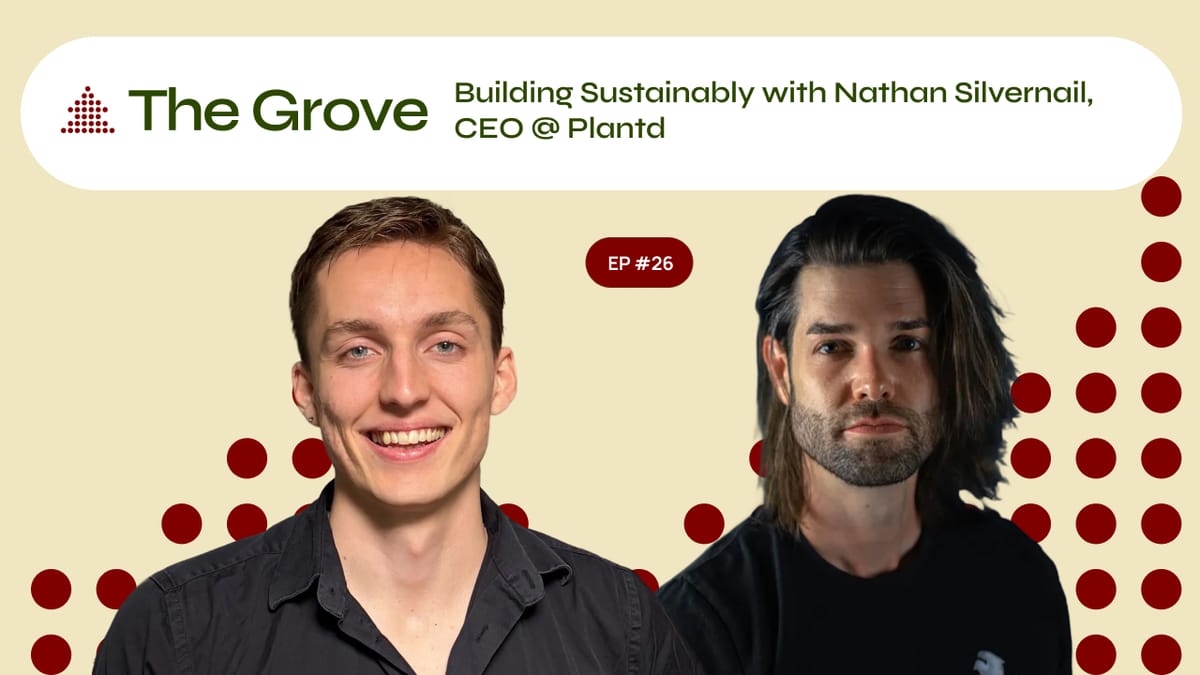
Nathan Silvernail wanted to be an astronaut. That door quickly closed (the Space Shuttle decommissioned in 2011) along with his stint in ROTC lasting exactly one week before he realized the military "did not like his personality".
In response, he did what engineers do: he redirected. Seven years at SpaceX followed, building rockets and human-rated space vehicles. He left with a particular way of seeing problems that would later shape everything he built next.
That framework is first principles thinking. Nathan watched Elon Musk look at a payload fairing — the nose cone that protects a spacecraft during launch, roughly $4 to $5 million per unit — fall into the ocean after every flight and ask a question nobody else was asking: Why aren't we catching it? Not whether it was hard to catch or if anyone had tried before.
Just: given that $4 million is falling out of the sky thousands of times, what's the actual case for not catching it?
That question and the mentality behind it followed Nathan out of aerospace. By 2021, he was done with rockets. "It wasn't sexy to me anymore," he says. He wanted something closer to home and, in his words, "a much larger problem than anything I'd worked on." He found it in the built environment. Specifically, in the deeply strange economics of how humanity builds its homes.
The result is Plantd Materials, a company Nathan co-founded with a fellow SpaceX engineer with a background in biomass and a passion for rock climbing that gave the company its name.
Plantd makes a new type of wood: structural building panels that don't come from trees, sequester carbon rather than release it, and slot into the same supply chains that currently depend on old-growth lumber that barely exists anymore. It took three years to find the right material, another two to build the machines to produce it, and an unexpected call from D.R. Horton — the largest homebuilder in the United States — to prove the market was real.
Inventing Carbon-Negative Building Materials
The starting point wasn't wood. It was a mycelium table.
In the early days, Nathan and his cofounder were still at SpaceX, running experiments in a garage & trying to figure out what a genuinely carbon-negative building material could look like. They understood the mechanism — photosynthesis captures CO₂, fast-growing plants capture it faster than slow-growing trees — so they started testing biomass candidates. Mycelium grows explosively fast and produces significant biomass per plant. They made a table out of it. By their own account, it was a really good table.
But they couldn't make the economics work. Scaling mycelium to the tonnage needed for structural building materials, at margins that made commercial sense, didn't pencil out. They spent roughly three years in this phase testing different biomasses, eliminating candidates, circling back. Hemp showed up in their garage. Different agricultural waste streams.
Each one failed for its own reason: too much waste during processing, structural properties that didn't meet certification requirements, saw blades that wore out so fast they destroyed the profit margin on their own.
The process Nathan describes is iterative, expensive, and often wrong. "Every time you choose a biomass, you also have to figure out how do you process it to get it into the form that you need to make the material in the first place," he explains. A material that passes structural tests but can't be processed efficiently isn't a product. It's a prototype that can't scale.
What eventually unlocked the path forward was talking to the people who actually build houses & learning firsthand how the lumber supply chain works/how much of it doesn't make sense. The result was a pivot toward a new type of oriented strand board (OSB): structural panels made from a fast-growing plant crop rather than Southern Yellow Pine, produced in a facility that looks nothing like a traditional lumber mill.
Traditional OSB mills are the size of small neighborhoods with $400 million in German-engineered equipment, six months to commission, and essentially never turned off.
Plantd's production system fits in a 150,000-square-foot warehouse, reconfigures in an hour, starts and stops in 30 minutes, and accepts different biomass feedstocks without major retooling. The physical properties of the panels exceed what traditional OSB delivers. The first samples showed a higher strength-to-weight ratio than steel. Than steel!!!!!!!
When D.R. Horton reached out through their environmental and sustainability arm, just weeks after Plantd publicly announced its carbon-negative building materials, the company was operating out of a warehouse with no equipment and a handful of people. Nathan had 30 days before the site visit. He built a design studio the way SpaceX builds mission presentations: renderings of future machines on the walls, structural and moisture test data laid out, physical samples for the team to handle.
D.R. Horton walked in, saw what the panels could do for their customers, and signed on. They've since placed a purchase order for 10 million panels and taken an equity stake in the company.
Embrace Failure to Succeed
The hardest lessons at Plantd haven't come from the material science. They've come from agriculture.
Nathan is direct about this: the hardware failures are table stakes. You build something, it doesn't work, you iterate, you build again. Engineers understand this loop intuitively. What's harder is failing on a timeline you don't control, with variables you can't engineer your way around.
The agricultural setback cost Plantd a full year. Nathan had to establish thousands of acres of their biomass crop quickly, with limited capital, so he chose a faster, cheaper propagation method rather than the tissue culture cloning and plant division approaches the industry typically uses.
The logic was sound — faster, cheaper, get to scale sooner. The result was a year of no meaningful output. He eventually had to restart with conventional methods, which worked.
"I ended up having to go back and say, okay, it turns out this is much harder than I thought it would be," he says. He ran through three or four different strategies before landing on a reliable approach. The year wasn't wasted in the sense that it ruled out paths that needed to be ruled out, but it was expensive in time, capital, and the opportunity cost of production volume that didn't materialize.
What Nathan draws from this, and what he teaches his team, is a very specific disposition toward action. Most people, he argues, stall because they're afraid of the wrong decision. His answer is to make the decision anyway, fail fast, and treat the iteration as the actual product development process. "Make a move. Most people just don't start." The machine currently running in their facility still doesn't work perfectly every time they turn it on. It works better than it did last week. That trajectory is what matters.
This extends to how Nathan thinks about financial modeling, team building, and strategy. He built Plantd's Series A financial models himself, in a format that looked like engineering charts. They were precise, internally consistent, and grounded in the physics of the problem rather than the conventions of venture finance. Investors found it odd and then found it compelling, at least until they made him hire a CFO.
The SpaceX analogy holds here too. At the rocket company, the question was never whether catching a $4 million fairing was difficult. It was whether the difficulty justified not trying. Plantd applies the same test to every decision: given what we know, what's the actual argument for not solving this?
Sustainable Manufacturing: Turning Waste into Value
Plantd's panels solve a specific problem: producing structural wood products without cutting down trees, while actively sequestering carbon. Nathan is already building the next layer of the business around a principle that maps directly back to the SpaceX fairing question: if there's waste in your process, why aren't you catching it?
When Plantd harvests its biomass crop and produces panels, it generates agricultural and manufacturing waste. Rather than treating that waste as a cost to manage, the company routes it through pyrolytic and gasification processes that convert it into products: biochar that returns carbon to soil as fertilizer, plant-based anodes for lithium polymer batteries, and potentially graphite for the rare earth elements market.
The logic Nathan describes is commercial. Every waste stream that becomes a product improves the unit economics of the core business. Every byproduct that replaces a carbon-intensive material in steel, concrete, or batteries extends Plantd's carbon impact far beyond the panels themselves.
"We're going to make a product that comes from the waste of our wood product that can go into concrete and make that more sustainable, can go into steel and make that more sustainable, can go into batteries and make that more sustainable."
The demand picture: D.R. Horton's 10 million panel purchase order represents just one customer in one market. Plantd has significant interest from the furniture market, from commercial real estate, and from Meta, which is exploring how timber-based construction in data centers could offset the environmental footprint of that infrastructure.
International interest is also accelerating in countries that currently import all their lumber and absorb the tariff and supply chain costs that come with that dependency.
The agricultural expansion is the current constraint. Nathan has 350 acres established and producing. He's working to lock in 10,000 acres this year, with a target of 1,000 new acres per year by end of 2025 and 5,000 acres per year by end of 2026.
The Close
Nathan frames his own motivation in terms that aren't typical for a climate tech founder. He's not primarily energized by the environmental outcome, though he tracks carbon sequestration carefully. What drives him is the complexity of unsolved problems. "I really love the idea of taking a problem that's just really horrible and just incredibly painful to work on and has no obvious solution to, and really just diving in and trying to figure out how to solve it." Boredom, he says, is his real enemy.
That energy from difficulty & impatience with problems that persist because nobody decided to actually solve them is what built a company that invented its product. It also invented the supply chain for its product, then invented the machines to manufacture its product.
The lumber industry has operated roughly the same way for a long time. Plantd is making the case that it doesn't have to.
To learn more about Plantd Materials' carbon-negative wood panels and sustainable building solutions, visit their website or reach out directly via their website. Follow their progress on LinkedIn as they continue their mission to replace traditional lumber with a scalable, carbon-negative alternative for the built environment.
Member discussion: