
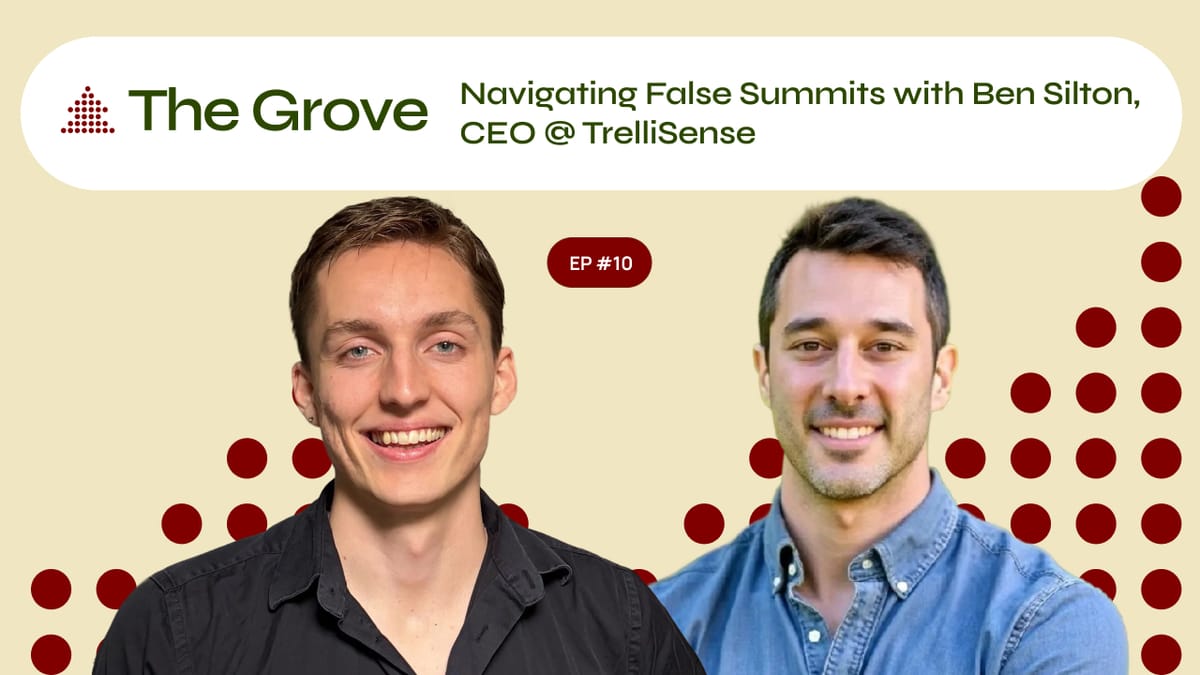
Picture a college senior, resume in hand, sitting across from a finance recruiter who would unknowingly become the catalyst for a climate tech revolution. The woman put Ben's resume down on the table with deliberate finality and asked a question that sliced through years of conventional career planning: "If money was no object, what would you do? Would you be here?"
"I don't think so," Ben admitted.
The interview was over.
What followed was an hour-long meditation on a dorm room floor. "I just laid there thinking about what can I see myself doing? What do I care about? What makes the most sense to me in terms of things that have to be done in the world?" Ben recalls.
That floor session produced a revelation that would guide the next decade of his life: he wanted to work on reducing the environmental burden that our daily practices place on the world. It wasn't a lightning bolt of inspiration but rather the gradual recognition of something that had always been there, waiting to be acknowledged.
From Zero to One: Startups' False Summits
The path from that dorm room epiphany to founding TrelliSense wasn't a straight line. It was more like a mountain climb punctuated by what Ben calls "false summits," those moments when you think you've reached the peak only to discover another ridge ahead.
His first taste of startup life came at Divert, a food waste reduction company where he learned that building something from nothing requires a particular kind of resilience. "I've been in startups that were essentially ground floor, single-digit number of FTEs upon joining," he explains, with the matter-of-fact tone of someone who has learned to find opportunity in uncertainty.
The Divert experience taught him that false summits aren't obstacles—they're features of the startup landscape. "You have to go into the next conversation as in, hey, this is the product, this is the solution," he emphasizes. "Even if in the back of my mind I'm like, this is not real, whatever it is. There's a certain level of confidence that you need to go into these conversations with potential clients with."
It's a paradox that defines early-stage entrepreneurship: you must believe completely in something you know is incomplete. But each false summit teaches you something essential about the terrain ahead, and Ben was learning to read the landscape with increasing sophistication.
From 0 to 1: Leveraging Assets
The transition from food waste to methane emissions wasn't as dramatic as it might seem. "There's kind of a winding stream through all of it," Ben notes, describing how seemingly disparate experiences connect in unexpected ways. His undergraduate research on the economic damages from air pollutant emissions suddenly became relevant when leading a methane monitoring company. Previous consulting work with the EPA provided crucial understanding of regulatory frameworks. Even those early days walking through landfills at Divert prepared him for the physical realities of industrial emissions monitoring.
"I feel right at home walking into a landfill, you know, throwing my boots on," he says.
But the real asset Ben leveraged wasn't technical knowledge—it was pattern recognition. After years of working on waste reduction across different contexts, he began to see methane emissions as another form of waste, one with enormous economic and environmental implications. "I just kind of fell in love with waste reduction as both an economic problem and an environmental problem," he reflects.
This perspective allowed him to approach methane monitoring not just as a technical challenge but as a systems problem that required understanding economics, regulations, customer needs, and environmental impact. He wasn't just building sensors; he was building a solution to a multifaceted waste problem that most people couldn't even see.
Customer Discovery Before Launch
The invisible nature of methane creates a unique challenge for customer discovery. How do you sell a solution to a problem that's literally invisible to most people? Ben's approach reveals the sophistication that comes from experience: start with the customers who already understand the problem exists.
"You're not a Titanic that has to swerve. You're a tiny little speedboat," Ben explains, describing the advantage of startup agility. "Build your concepts and find one or two trusted people to give you feedback on that as you build it." But with TrelliSense's hardware-based solution, this agility has to be more carefully managed than with digital products. "If it's hardware, then you have to be a little bit more careful about do we really need to build this feature? Does it really enhance the product if we did it this way or that way?"
This careful approach to customer feedback reflects hard-won wisdom about the difference between what customers say they want and what they actually need. Ben learned to listen not just to explicit requests but to the underlying problems customers were trying to solve. In methane monitoring, those problems often involve regulatory compliance, operational efficiency, and environmental responsibility—all goals that require different approaches to measurement and data presentation.
The key insight that emerged from this customer discovery process was that different customers needed the same core technology for vastly different purposes. Oil and gas companies wanted leak detection and mitigation. Agricultural operations needed to measure methane reductions for carbon credit programs. Landfills required continuous monitoring for regulatory compliance. The technology platform could serve all these needs, but the business model and customer relationships required different approaches for each segment.
CEO in the Trenches
Leading TrelliSense means operating simultaneously as a technologist, salesperson, fundraiser, and industry researcher. "Any given day I'll draw from skills and expertise from certain pockets of my career," Ben explains.
But perhaps the most challenging aspect of his current role is navigating the tension between moving fast and building credible science. "In a lot of applications we're pursuing, they essentially require peer-reviewed research," he explains, highlighting a fundamental challenge in climate tech: "That's not something you can do in a week. It's not something you can build into your product. It is something you still just have to do."
This requirement for rigorous validation creates what Ben calls his biggest hurdle. Controlled release studies for oil and gas applications can take months. Peer-reviewed research for agricultural carbon credits can take years. Yet without this validation, industry adoption remains limited. "Unless you have recent data and high fidelity data, then it's either the conversation ends or it's un-lubricated, shall we say," he notes with the wry humor of someone learning to navigate regulatory requirements in real-time.
But Ben has learned to reframe this hurdle as an opportunity. "If we do that in partnership with potential customers, that's a good way to build a relationship and sort of get their feedback along the way," he explains. Instead of viewing validation studies as barriers, he's positioning them as collaborative opportunities that can strengthen customer relationships while generating the credibility needed for broader market adoption.
The strategy reflects a mature understanding of how technical startups scale: you don't just build a product and find customers, you build relationships with early adopters who help you prove the value of your solution to the broader market.
The Laser Light at the End of the Tunnel
What makes TrelliSense's approach unique isn't just the invisible laser technology—it's the combination of continuous measurement, long-distance detection, and passive sensing that uses sunlight rather than requiring additional power sources. "We measure methane emissions using optical sensors. We use invisible lasers to do this," Ben explains, describing technology that sounds like science fiction but addresses a very practical problem.
The elegance of the solution lies in its simplicity: instead of requiring complex infrastructure or invasive monitoring equipment, TrelliSense's sensors can detect methane emissions from a distance, providing continuous data about invisible leaks that might otherwise go unnoticed for months or years.
But technology alone doesn't create value—application does. And Ben's journey through food waste, consulting, and environmental economics has taught him to think about methane monitoring not as a technology problem but as a business ecosystem challenge. Different customers need different data, different reporting formats, different integration approaches. Success requires not just building great sensors but building great relationships with customers who understand the value of seeing the invisible.
Finding Purpose in the Invisible
As our conversation winds down, Ben reflects on what keeps him motivated through the long validation studies and complex customer development processes. "I'm inspired by the absolutely tireless work of the rest of my team. You look around you and everyone's working hard and like really cares about what they're doing. Like that's just inherently inspiring."
But it's the personal motivation that reveals the deepest truth about entrepreneurial sustainability. "I want to give him a case study role model," Ben says, referring to his one-year-old son, "someone to say, here's what my dad did in his career. I want him to be proud of what his dad did or does."
It's a reminder that the most powerful business motivations often aren't about markets or technologies but about legacy and meaning. Ben isn't just hunting invisible gases—he's building a future where waste reduction becomes a fundamental part of how we operate, one laser measurement at a time.
The false summits continue, but now Ben knows that each one teaches him something essential about the terrain ahead. And somewhere in that terrain, invisible methane emissions are waiting to be discovered, measured, and ultimately eliminated by sensors that turn sunlight into environmental insight.
For a numbers nerd who once lay on a dorm room floor wondering what to do with his life, it's turned out to be exactly the kind of problem worth solving.
To learn more about TrelliSense's methane emissions monitoring technology, visit trellisense.com or contact them at ben@trellisense.com. Follow their progress on LinkedIn as they continue their mission to make invisible environmental waste visible and actionable.
Member discussion: