
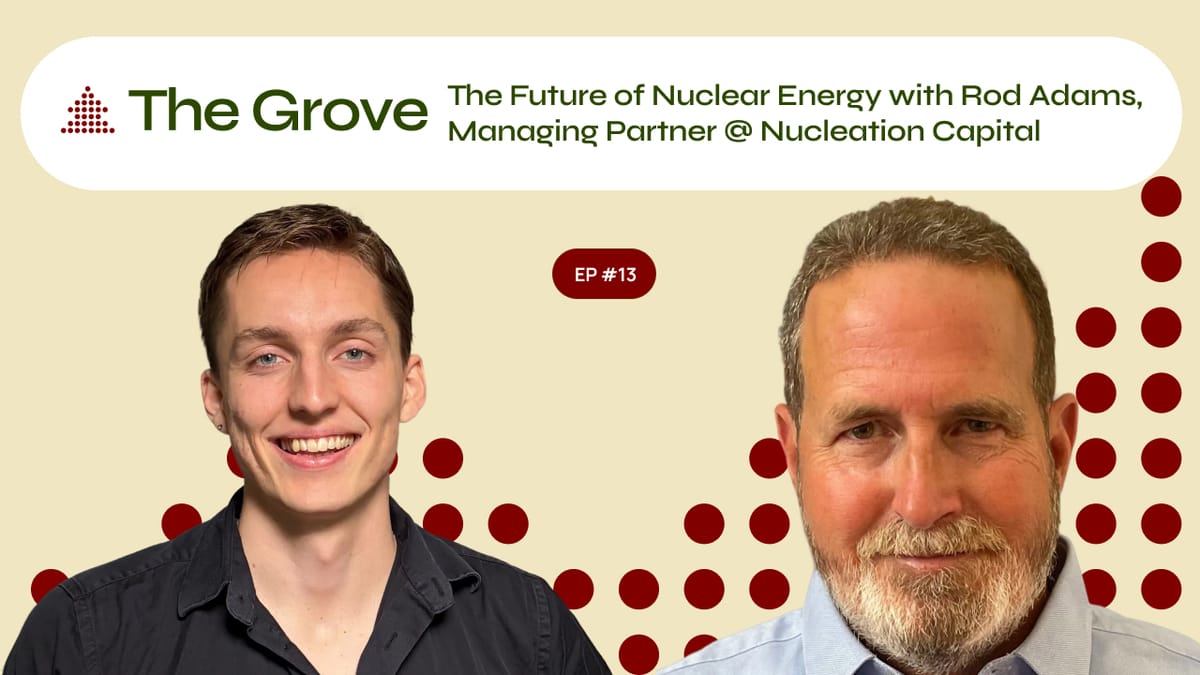
"A fuel pellet the size of the tip of my pinky," he says, holding up his finger, "contains the energy equivalent of a ton of coal, 147 gallons of diesel fuel, or 17,000 cubic feet of natural gas."
watch the full conversation youtube or spotify
In an energy landscape dominated by fossil fuel giants and renewable energy newcomers (ha), Rod Adams represents something entirely different: a bridge between nuclear's reliability and venture capital's appetite for the next big breakthrough. His journey from submarine officer to co-founder of Nucleation Capital reveals not just one man's evolution, but the untapped potential of nuclear energy in an economy desperate for clean, reliable power.
Reactor Cores to Atomic Rod
Rod Adams was eight years old when nuclear energy first entered his consciousness, though he didn't know it would define the next five decades of his life. His father worked for a utility company, and young Rod had spent countless hours playing in the shadows of massive smokestacks at company picnics. The industrial landscape of power generation was as familiar to him as any playground.
"My dad came home from work one day and said, 'Hey, Rod, my company's building this new power plant that doesn't even need smokestacks,'" Adams recalls. The eight-year-old who had grown up around the obvious, visible infrastructure of coal-fired power plants couldn't fathom electricity generation without towering concrete monuments.
Adams came of age during a decade when energy was existential. "I'm a child of the 70s," he explains. "Energy was an incredibly important topic for the whole country, maybe even the whole world. We had two major oil crises, two times when our way of life was being directed by the need for energy and access to energy."
The teenager who watched America's vulnerability to oil shocks saw nuclear energy as independence, not just an alternative. From there, understanding nuclear's potential required more than just enthusiasm. It required getting inside the technology itself.
When Adams told his high school guidance counselor he wanted to study nuclear engineering, the response was pragmatic and prophetic: "If you want to study nuclear, the people who do it best in the world are the US Navy. And they operate the school that you can go to for free."
The Naval Academy offered both rigorous technical education and a guaranteed pathway into the most advanced nuclear program on earth. He convinced Admiral Rickover (father of the nuclear navy) to accept him into the nuclear program, beginning a journey that would take him from classroom theory to the cramped control rooms of nuclear submarines.
Nuclear Power Flexibility
While surface ships burned thousands of gallons of diesel fuel and required constant resupply, Adams found himself aboard vessels powered by reactor cores "only about the size that would fit underneath a decent-sized office desk." The submarine could "go pretty fast in the water" while simultaneously producing fresh water from seawater and even generating breathable oxygen by splitting water molecules.
Adams' vision extended far beyond naval applications. "Reactors didn't have to be big to be powerful," he reflects. "They didn't have to produce enough power for a city of a million when there were places where a thousand or two thousand or five thousand people needed power."
In 1993, still early in his naval career, Adams took an unprecedented step. He left active duty for six years to start Adams Atomic Engines, a small modular reactor company founded on the radical premise that nuclear energy could be right-sized for diverse applications. The concept was decades ahead of its time, anticipating today's small modular reactor renaissance by nearly thirty years.
"Small reactors have always been something of interest to me," Adams explains. "More to broaden the catalog of available options, because there are so many energy customers in the world and only a very small portion of those energy customers buy giant power plants of any kind."
The timing was brutal. By 1993, the commercial nuclear industry was in deep freeze. Chernobyl's shadow loomed large, cost overruns had become legendary, and no new nuclear plants had been ordered in the United States for over a decade. Adams' attempt to commercialize small reactor technology was, by his own admission, premature.
"When I finished my obligated service to the Navy, most building had stopped," he acknowledges. "There had been no new orders in half a dozen years and there was no real growth being forecast for the commercial nuclear industry."
Yet even failure taught crucial lessons. The experience of trying to commercialize advanced nuclear technology in a hostile market gave Adams insights that would prove invaluable three decades later. He learned to speak the language of investors and regulators, to understand the gap between technical capability and market readiness, and to recognize that revolutionary technologies often require patient capital and perfect timing.
Nuclear Renaissance: Beyond Data Centers
The nuclear renaissance, when it finally arrived, came from an unexpected direction. By 2020, artificial intelligence and cloud computing had created an unprecedented demand for reliable, always-on power. Tech giants like Microsoft, Google, Meta, and Amazon began recognizing that their data centers needed the kind of baseload electricity that only nuclear could provide.
"It's exciting to have customers who are very deep pocketed and very technically competent and can recognize and do math and say, yeah, nuclear is a good thing," Adams acknowledges.
But Adams bristles at the notion that data centers alone drive nuclear's revival.
"There's too much emphasis being placed on data center power domains as the only reason that people are now interested in nuclear energy," he states with the gentle firmness of a teacher correcting a persistent misconception. "I didn't know anything about data centers when I got excited about nuclear."
The real opportunity, Adams argues, lies in the vast landscape of industrial and commercial applications that have been underserved by conventional energy solutions. "There's an awful lot of energy out there that needs to be done better," he explains. "There's a lot of power systems that are either old and tired or just plain dirty that need to be replaced."
Mining operations in remote locations. Steel production facilities that need continuous high-temperature heat. Shipping companies looking to decarbonize maritime transport. Chemical plants requiring process heat that fossil fuels have traditionally supplied. Each represents a potential nuclear customer with specific requirements that small modular reactors could address.
"There's other customers out there that, given the choices, they'd much prefer to buy power that is reliable, dependable, predictable, clean, abundant, affordable," Adams continues. "Data centers are great, but they're only icing on the cake."
This broader vision required a different kind of capital—patient money willing to fund the long development cycles and regulatory challenges that nuclear startups face. Traditional venture capital, with its emphasis on rapid scaling and quick exits, seemed poorly suited to nuclear energy's unique timeline.
Adams recognized an opportunity to build something different: an investment fund specifically designed for nuclear innovation, led by people who understood both the technology's potential and the industry's challenges.
Building the Future: A Strategic Portfolio Approach
Adams' investment philosophy becomes clear when discussing Nucleation Capital's portfolio companies. Rather than chasing the latest reactor technology for its own sake, he looks for teams that have identified specific market needs and designed their solutions accordingly.
"It's not driven by the technology per se," Adams explains. "It is driven by the team and the vision and they're working to make the product match the customers they have identified."
The portfolio reflects this market-driven approach across diverse applications and geographies. Core Power, their first investment, tackles maritime decarbonization—a sector where nuclear propulsion has been proven for decades but never commercialized. "Obviously, we've been running nuclear-powered ships and submarines since the 1950s," Adams notes. Core Power's team of maritime industry professionals works on the complex international infrastructure needed for nuclear shipping, while also developing the Molten Chloride Fast Reactor that can consume nuclear waste.
Copenhagen Atomics represents thermal breeder technology designed for modularity. "Their concept is to have their reactors, the heat source, just the reactor part, packaged into a box the size of a 40-foot shipping container," Adams explains. The technology could democratize nuclear deployment by producing 40 megawatts of electricity from 100 megawatts of thermal energy.
In Sweden, Nucleation Capital invested in Blykalla, a lead-cooled fast reactor company positioned to benefit from Sweden's dramatic policy reversal toward nuclear expansion. The U.S. portfolio includes Radiant, founded by former SpaceX engineers who discovered nuclear was "really the only way" to power lunar missions and applied that insight terrestrially, and Oklo, which Adams describes as "probably the fastest moving nuclear company by some measure," planning their first reactor critical by summer 2026 despite being formed just two years ago.
The technical diversity is intentional. "Our interests go from fast spectrum, thermal spectrum, from liquid metal, liquid sodium, liquid lead. We've got molten salts," Adams catalogues. Each technology offers different trade-offs: fast spectrum reactors excel at consuming nuclear waste, thermal spectrum designs maximize fuel efficiency, liquid metal cooling enables high temperatures.
This broader vision required a different kind of capital—patient money willing to fund the long development cycles and regulatory challenges that nuclear startups face. Traditional venture capital, with its emphasis on rapid scaling and quick exits, is poorly suited to nuclear energy's unique timeline.
The Long View: Nuclear Energy as Human Flourishing
As our conversation draws to a close, I ask Adams what inspires him after decades of nuclear advocacy and investment.
"What inspires me is doing my little teeny part to enable humans to flourish," he responds, "to enable us to have access to all the clean air and clean water and clean power that we need."
Adams' journey from Navy nuclear officer to venture capitalist represents more than personal evolution. It embodies nuclear energy's long path from military application to commercial viability, from niche expertise to mainstream necessity.
The submarine that could operate for fourteen years without refueling has become the data center that runs continuously without carbon emissions. The young naval officer who left active duty to start Adams Atomic Engines has become the seasoned investor who understands that revolutionary change requires patient capital and perfect timing.
As artificial intelligence drives unprecedented demand for reliable power, as climate change makes decarbonization urgent, and as geopolitical tensions highlight energy independence, nuclear energy stands poised for renaissance.
Adams and Nucleation Capital are positioned at the intersection of technological capability and market opportunity, backed by decades of experience and driven by a vision of human flourishing powered by abundant clean energy. The eight-year-old who couldn't imagine electricity without smokestacks has become the advocate for a future where clean power flows as reliably as water from a tap.
To learn more about Nucleation Capital's nuclear energy investments and portfolio, visit nucleationcapital.com or contact them through their website. You can also follow Rod Adams' continued insights on nuclear energy at atomicinsights.com and through the Atomic Show podcast. Follow their progress on LinkedIn as they continue their mission to enable human flourishing through abundant clean nuclear energy.
Member discussion: