
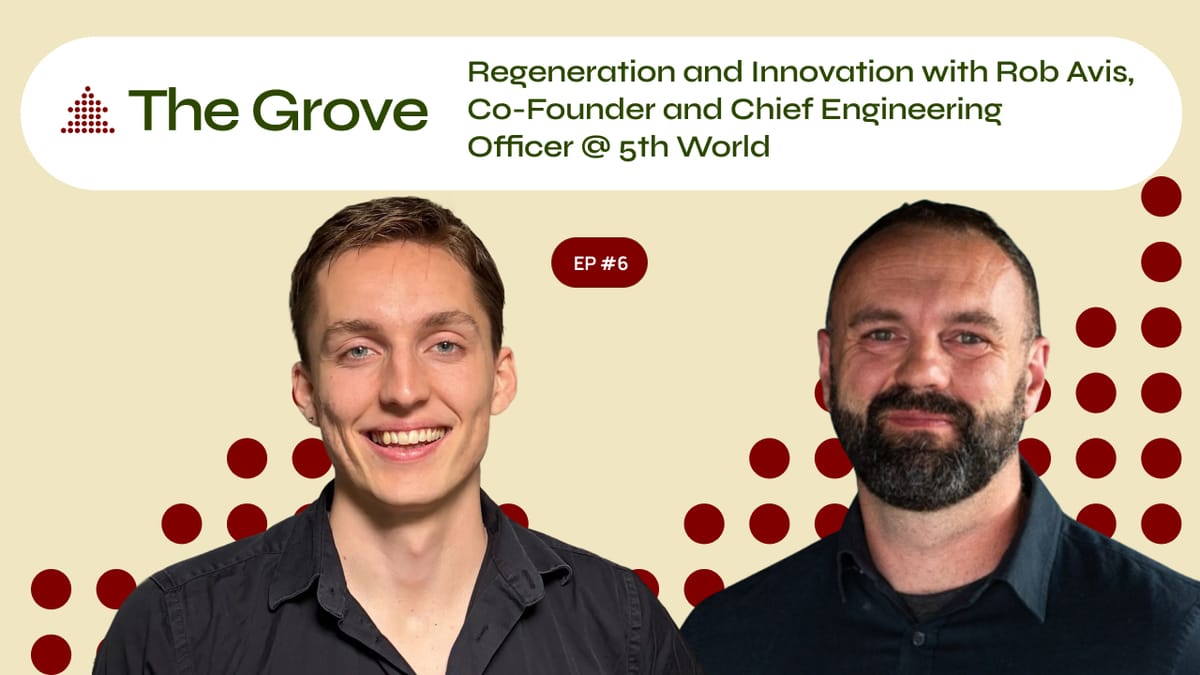
Listen to the full conversation on spotify or youtube
Rob Avis wears a forest-green shirt during our conversation. Likely a deliberate choice that mirrors the philosophy he's spent the last decade refining.
Around him, invisible to the podcast camera, sprawl 160 acres of Canadian wilderness where eight beaver families have become unlikely teachers in the art of 'positive disturbance'. This life is far from previous time spent in industrial food or oil & gas; places where every day meant extracting more from the earth without considering what was left behind.
"I'm originally Charlie in the chocolate factory," Rob admits. "I grew up in a cake factory. We made about a hundred thousand cakes a day."
This story is about discovering that the most radical act of self-interest might just be healing the planet. As co-founder and chief engineering officer of Fifth World, Rob has spent the years since COVID building a business model that promises autonomous food, energy, water, and resilient shelter.
The question isn't whether we'll leave a footprint. The question is whether that footprint will create twenty-eight times more life in its wake.
Oil: Bottled Human Labor
To understand where Rob is going, you have to grasp where he's been. For fifteen years before founding Fifth World, he inhabited the belly of the beast that powers our civilization. As a petroleum engineer, he was the guy who brought natural gas and oil from the ground to the facilities that heat our homes and fuel our cars. He understood, with the intimate knowledge that comes from designing systems, exactly how our modern world functions.
"If they actually had to pay for that landfilling service, transportation would be very different," Rob explains. He's talking about how the automotive industry operates with free access to use Earth's atmosphere as a dumping ground—a hidden subsidy that makes fossil fuels artificially cheap.
In Alberta, where Rob lives, it costs seventeen dollars to bury garbage forever. Seventeen dollars. The math, when you really look at it, reveals an economic system built on a foundation of unaccounted costs.
Rob's awakening came from the gradual realization that the conventional paradigm we operate within was asking the wrong questions entirely. "How do I get more stuff and ignore that the more stuff actually requires not accounting for the negative externalities?"
The transformation began with teaching permaculture. Rob started to see patterns that his engineering background had trained him to recognize. Systems. Feedback loops. The difference between extraction and regeneration. He began to understand that oil wasn't just fuel—it was bottled human labor.
This realization carries profound implications. If the typical barrel of oil takes an average of 5 years cumulative human labor and we sell it for $55 a barrel, the hourly rate comes out to fractions of a cent per hour. The oil economy is not even built to properly consider the full cost of human labor in the supply chain, let alone the cost to the environment.
Once we take some R&R to fully digest the weight of these realities, where do we go?
Regen: A Humanist Approach to Nature
A turning point came when Rob encountered what would become the co-founder of Ethereum, who owned property in British Columbia and was interested in scaling regenerative practices globally. This was serious technological thinking applied to one of humanity's oldest challenges: how to live on Earth without destroying it.
"Fifth World kind of emerged out of this idea that maybe there'd be a way to bridge the atoms and the bits," Rob explains. The goal wasn't to reject technology, but to use it more intelligently. To apply the same innovative thinking that created blockchain to the challenge of planetary regeneration.
First, Rob had to articulate what regeneration actually means. Most people, he discovered, are stuck in what he calls the "sustainable paradigm"—the idea that we should minimize our impact, reduce our footprint, aim for net zero. It sounds virtuous, but Rob identifies a pernicious problem lurking beneath the surface.
"If you came to me, Blake, and said, hey, Rob, how's your marriage doing these days? And I said, it's pretty sustainable," pauses for effect, "you'd probably feel pretty sorry for me." The analogy lands because it reveals the fundamental limitation of sustainability thinking. What exactly are we sustaining? Dead zones in our oceans? Depleted soils? Food with diminishing nutritional content?
Worse, the sustainability mindset carries an embedded guilt that Rob describes as deeply uncomfortable but rarely articulated. The logical conclusion of reducing your footprint, minimizing your impact, aiming for net zero—if you follow it to its end—is that humans are inherently destructive. That our very existence is a problem to be solved.
"The only way to deal with that problem in their paradigm is to get rid of all the humans," Rob states flatly. "Which is not very positive, and we kind of all sense it in the posts that we read on a daily basis."
This is where the regenerative paradigm offers a fundamentally different approach. Instead of asking how to minimize harm, it asks: "If the most negative thing that we've done on earth is a nuclear bomb, what's the most positive?" It's not wishful thinking or fairy dust optimism. It's a scientifically grounded exploration of how human systems can create net positive impact.
The shift from conventional to sustainable to regenerative thinking represents more than just environmental strategy. It's a humanist approach that recognizes humans as part of nature, not separate from it. We're not inherently evil beings who need to minimize our existence. We're one of nature's species, capable of learning how to create the kind of positive disturbance that enhances rather than degrades the systems we touch.
Beavers: Nature's Positive Disturbance
To understand what positive disturbance looks like in practice, Rob takes visitors on walks through his 160-acre farm. To the untrained eye, the beaver activity looks destructive. Trees cut down and scattered. What was once a neat forest now appears chaotic, damaged.
"These beavers are just destroying your land," guests invariably observe, with the concern of people who have learned to equate human-like order with health.
But Rob has learned to see differently. Those downed trees become beaver dams. The beavers eat the cambium layer that grows just beneath the bark, getting their nutrition while creating infrastructure that transforms the entire ecosystem. And the results are measurable: every time a beaver creates a dam, they increase the background biodiversity by twenty-eight times.
Twenty-eight times as much biodiversity as a direct result of the water harvesting and ecosystem modification that beaver activity creates.
"Every species on earth, whether it's humans, whether it's woodpeckers, whether it's foxes, we all have an impact, we all have a footprint," Rob explains, settling into the patient tone of someone who has had to explain this concept many times. The key insight isn't that impact is bad—it's that impact is inevitable. Newton's third law applies to ecology: every action creates an equal and opposite reaction.
The question becomes: how do we understand our place within nature well enough to ensure that our disturbance creates twenty-eight times more life rather than twenty-eight times more death?
This isn't abstract philosophy. It's engineering applied to living systems. At Fifth World, they're designing what Rob calls "off-grid homesteads," though that description understates what they're actually creating. These are integrated systems that provide autonomous food, energy, water, and shelter—human settlements that function like beaver dams, creating more life in their wake.
The business model emerging from this thinking represents what Rob calls "an intermediate step to our longer-term mission of planetary regeneration within a generation." Instead of extracting value from ecosystems, they're designing human habitats that enhance the productivity of the land they occupy.
"All of the solutions exist in nature," Rob states. "We just have to have the humility to go out and spend time without our phones observing how those natural processes occur."
The path from petroleum engineer to planetary healer isn't as dramatic as it might seem. It's the same engineering mindset applied to a different set of problems. Instead of designing systems to extract maximum value in the short term, Rob now designs systems to create maximum life over generations. Instead of treating the Earth as a collection of resources to be consumed, he approaches it as a partner in creating abundance.
The early results suggest this approach might be more than idealistic vision. Fifth World's integrated systems demonstrate that regenerative practices can be more profitable, not less, when you account for the true costs of extraction-based thinking. By including negative externalities in the design process from the beginning, they create systems that enhance both human wellbeing and ecological health.
But perhaps the most radical aspect of Rob's approach is how thoroughly optimistic it remains about human nature. In a cultural moment dominated by climate guilt and apocalyptic thinking, he offers a different narrative: that humans are capable of becoming a keystone species in the best sense. That our intelligence and creativity can be applied to enhancing life rather than diminishing it.
The challenges Fifth World faces reveal how deeply our current economic system resists regenerative thinking. In Canada, where Rob operates, political uncertainty and cautious spending have created headwinds for construction projects. But he sees opportunity in the disruption.
"People are realizing that decentralized and autonomous systems are a good thing to own," Rob observes with the measured optimism of someone who has learned to read long-term trends through short-term turbulence. Supply chain vulnerabilities exposed by COVID and geopolitical tensions have awakened interest in systems that provide genuine security rather than just efficiency.
When I ask what inspires him through the magnitude of work ahead, Rob's answer comes without hesitation: "Nature. 4.2 billion years of research and development." His voice carries the reverence of someone who has spent enough time in wild places to understand that human cleverness pales beside evolutionary wisdom.
As our conversation draws to a close, it's clear Rob is not just building off-grid homesteads. He's prototyping a different relationship between human civilization and the living systems that sustain us. He's proving that the most practical thing we can do might just be learning to live like beavers—creating positive disturbance that leaves the world more alive than we found it.
What kind of impact will we choose to have? After spending decades in the business of extraction, Rob has chosen regeneration. Not as sacrifice, but as the ultimate act of enlightened self-interest.
To learn more about Fifth World's autonomous food, energy, water and shelter systems, visit 5thworld.com or contact Rob on LinkedIn where he posts daily updates under Rob Avis. Follow their progress on LinkedIn as they continue their mission to achieve planetary regeneration within a generation.
Member discussion: