
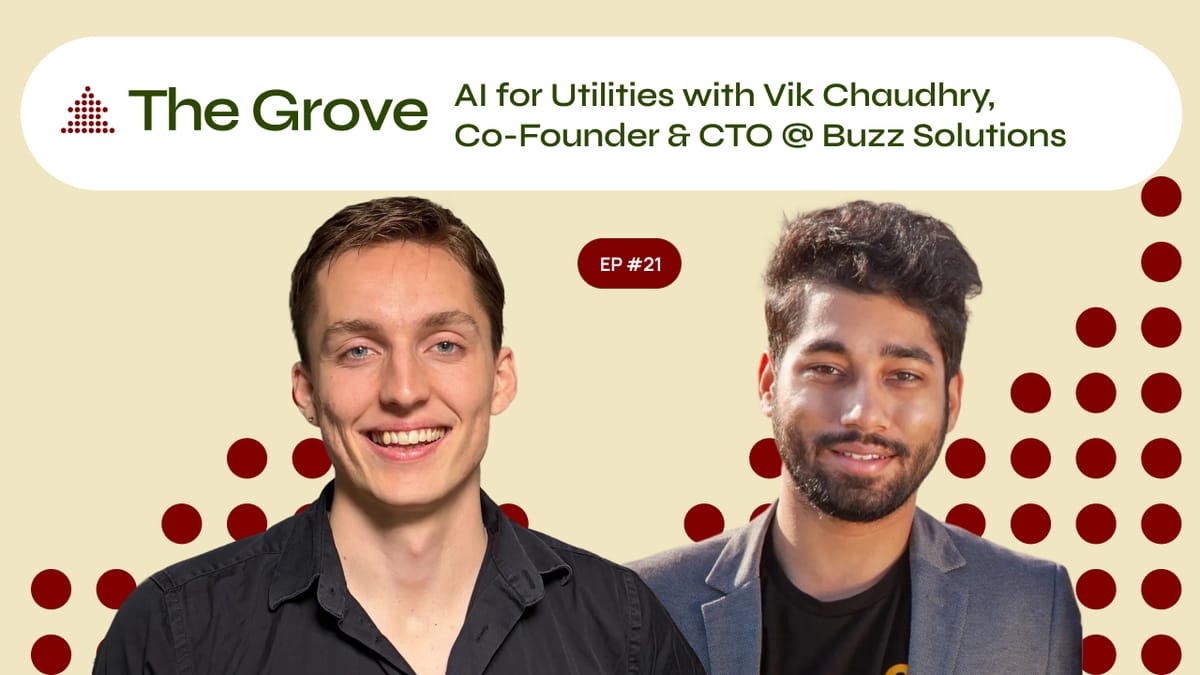
As we'll see, seven minutes is what launched Buzz into the world (seven minutes with nearly a decade of patient work behind it).
Vik Chaudhry and his co-founder had placed a calculated bet on a future where utilities would finally embrace the automation technology they'd resisted for decades.
watch the full episode on spotify or youtube
That bet paid off in 2022 when New York Power Authority selected Buzz Solutions to power their AI-enabled infrastructure inspections. They were selected from a crowd of over 100 vendors; GE and ABB included.
Vik & I get into how to build the team that develops the technology five years before the market catches up and why that early commitment to an unsexy but critical problem positions Buzz at the center of America's power grid transformation.
Trust Your Gut in Hiring
There are some painful lessons about talent evaluation. No one is looking to hire and fire, though it inevitably happens. For Vik, despite developing sophisticated interview processes and technical assessments, he discovered that intuition often trumped formal evaluation criteria.
"One lesson we learned over the years is never underestimate the power of intuition and gut feeling," he reflects. Early hiring mistakes taught him that cultural fit and genuine alignment with Buzz's mission matter as much as technical qualifications. "Sometimes our intuition would be off about someone, and it tended to be that the intuition was right."
Even within the dynamic between Vik's technical background and his co-founder's business expertise is a natural foundation for team building. With complementary skill sets and shared values around persistence and quality, they could evaluate candidates for both technical competency and cultural alignment.
The stakes were particularly high for early engineering hires. With limited resources and an eight-year development timeline, every team member needed to contribute meaningfully to the product vision. Bad fits don't just underperform—they actively hindered progress during critical development phases when the market was still evolving toward readiness.
As the company scaled post-commercialization, hiring shifted from pure technical execution to sales, business development, and customer success roles. The same principles applied: finding people who could navigate long utility sales cycles, build trust with skeptical customers, and maintain enthusiasm for complex technical solutions that required significant education and change management.
"Obviously we've had our bad fits in the company as well," Vik acknowledges. The key was learning to identify misalignment early and make necessary adjustments quickly. In a resource-constrained startup environment, prolonged hiring mistakes could derail critical initiatives or damage customer relationships.
Today, with proven technology and established market presence, Buzz can attract talent excited by the mission and growth opportunity. The hiring challenges have shifted from convincing people to join an uncertain venture to selecting the best candidates from a stronger applicant pool. But the fundamental lesson remains: technical skills matter, but cultural fit and genuine passion for the problem determine long-term success.
AI Wins NY Power Authority RFP
In the midst of this marathon to develop their assessment tech, 2017,was the year for cold calling utilities. "We were naive," Vik admits, "but it kind of worked out."
Early conversations revealed that utilities were already flying drones & collecting massive amounts of visual data, but they lacked the AI capabilities to make sense of it all. A utility like PG&E collects 50 million images annually—an impossible volume for manual analysis. Extreme weather events intensify the infrastructure demands & reliance on this data only increase.
From 2017 to 2019, Buzz Solutions operated in pure R&D mode, building proprietary AI models while most of the industry remained skeptical about artificial intelligence applications. "We launched the company five years before the market caught up," Vik explains. "We had to wait five years for the industry to get to where it had to go."
That patience created an insurmountable technical advantage. When utilities began moving beyond pilots in 2021, Buzz had already solved fundamental data problem that others were still getting familiar with. "Data is the key for any AI architecture," Vik emphasizes. "Garbage in, garbage out."
The RFP process with New York Power Authority showcased this technical moat. After initial rounds eliminated most vendors, the final ten faced what Vik calls an "AI bake-off"—analyzing a blind dataset in thirty minutes with no manual intervention allowed. Buzz returned results in seven minutes with 85% accuracy. The closest competitor achieved 32% accuracy and exceeded the time limit.
"That was a great moment," Vik reflects, "landing your first customer like that. We knew this was going somewhere."
The ripple effects extended beyond one contract. In utility circles, early adopters matter enormously. "No one wants to be the first and second customer for new technology," Vik notes, "but everyone wants to be the fourth and fifth." That first major win opened doors across the industry as utilities recognized the competitive advantage intelligent automation could provide.
AI: A Tool, Not a Replacement
Obviously we had to go there. Vik's whole career so far has been AI. I think he has a good perspective on it.
To him, misconceptions started early and persist today. Utility executives hear "artificial intelligence" and imagine job losses, black-box algorithms making critical decisions about power infrastructure, or over-hyped technology that promises everything and delivers nothing. Vik encounters these concerns constantly as Buzz expands across North America.
"People think AI is everything, but it's just a tool at the end of the day," he explains. He compares it to when the internet was new and workers needed to be trained on it. AI requires similar education and process integration to deliver value.
Buzz addresses risk adversion by positioning their platform as augmentation rather than automation. Field technicians still make critical decisions about infrastructure maintenance, but they have AI-powered insights to guide those choices. Instead of manually reviewing thousands of images looking for damaged insulators or vegetation encroachment, they focus on the specific problems the AI identifies, applying their expertise where it matters most.
"This is another tool in your tool shed," Vik tells utility teams during training. "You use wrenches and hardware tools—this is a digital tool that makes your job more efficient and safer."
The education process extends beyond individual users to organizational change management. Utilities need to understand not just how AI works, but how to interpret its outputs, build confidence in its recommendations, and integrate intelligent insights into existing maintenance workflows. Buzz has evolved from a pure technology vendor into a consulting partner, helping utilities navigate both the technical and cultural aspects of AI adoption.
The timing couldn't be better. As extreme weather events strain aging infrastructure and data center loads demand unprecedented grid capacity, utilities need every available tool to maintain reliability. The question isn't whether they'll embrace AI—it's how quickly they can deploy it effectively. Companies like Buzz that invested years in education and trust-building now find themselves positioned as essential partners in that transition.
The Future of Grid Intelligence
Standing at the intersection of AI advancement and grid modernization, Vik sees opportunities most people miss. While media coverage focuses on data centers consuming power, he recognizes the deeper connection: AI technologies like Buzz's platform help utilities unlock additional grid capacity to serve those same data centers. "AI helping more evolution of AI," he calls it—a closed loop that accelerates both technological progress and infrastructure improvement.
Traditional inspection and maintenance approaches cannot handle this complexity. Manual processes that worked when utilities faced predictable, steady demand become inadequate when grid conditions change rapidly and infrastructure operates closer to design limits. The highway of electrons that Vik describes is becoming congested, two-directional, and far more demanding than the system it was designed for.
"What that requires is utilities need to inspect infrastructure more frequently," Vik explains. Drones enable more comprehensive data collection than helicopters, but they also generate ten times more imagery for analysis. Without AI platforms like Buzz's, utilities drown in data while missing critical problems that could trigger outages or safety incidents.
The company's eight-year journey from cold-calling utilities to becoming their trusted technology partner positions Buzz uniquely for this growth phase. While newer entrants struggle to access proprietary data and build utility relationships, Buzz has already solved those fundamental challenges. The market validation they waited years for is now driving demand faster than they can scale to meet it.
"We have to schedule out projects because we have so much demand," Vik explains. Every utility faces infrastructure challenges—power outages, wildfire risks, storm damage, equipment failures—that AI-powered inspection intelligence can help address. The conversation has moved from whether these tools work to how quickly utilities can deploy them.
The future Vik envisions extends beyond inspection intelligence to comprehensive grid optimization. As utilities gain confidence with AI applications and accumulate more data about infrastructure performance, the potential grows for predictive maintenance, dynamic load management, and sophisticated resource allocation. The platform Buzz built for analyzing drone imagery becomes the foundation for broader infrastructure intelligence.
"We're living in an age of solutions," he reflects. "There's a lot of opportunity, and hopefully Buzz can help with that as well." The combination of technical expertise, market timing, and patient execution that brought them this far now positions the company to shape how the power grid evolves to serve an increasingly electrified, AI-powered world.
To learn more about Buzz Solutions' AI-powered infrastructure inspection platform, visit their website or follow Vik Chaudhry on LinkedIn. Follow their progress as they continue their mission to make power grid operations safer and more efficient through intelligent automation.
Member discussion: