
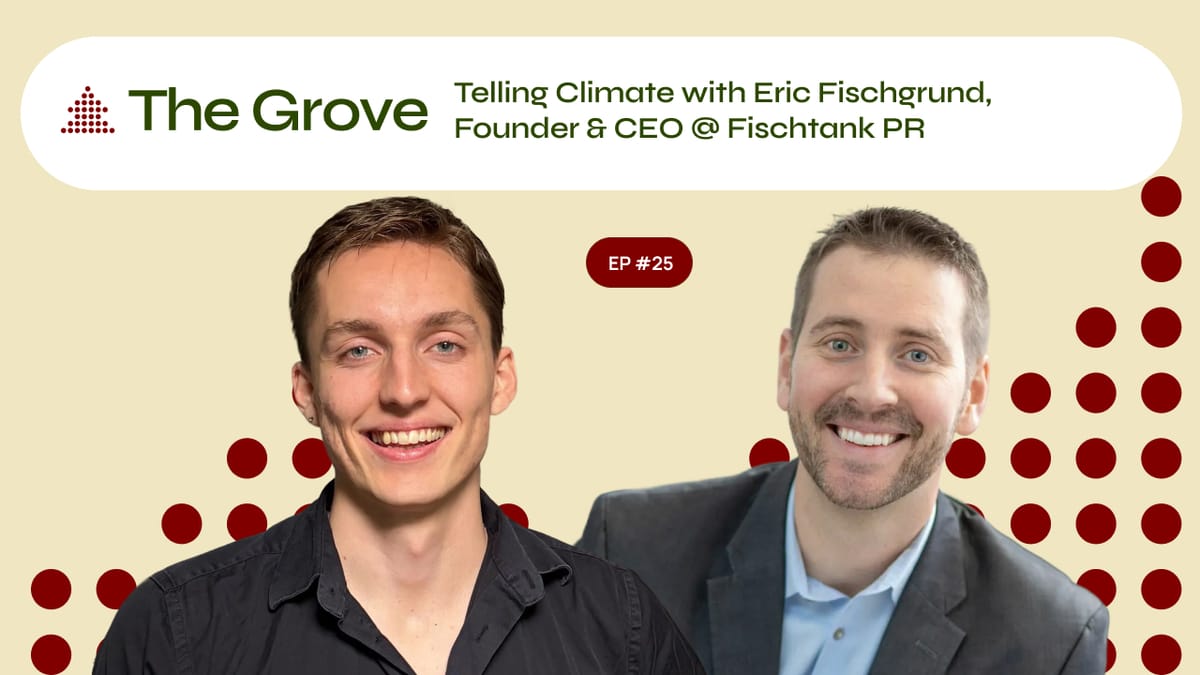
Eric Fischgrund built FischTank PR. Get it? Fish with a "c". It's in his last name. That's not PR, as Eric teaches me in the episode, but I think it's definitely good branding.
The company is 12 years old with 27 employees. He didn't plan any of it. Sounds like entrepreneurship to me.
Full conversation on youtube and spotify
In 2008, fresh out of Shippensburg University with a journalism degree, Eric took a job at a small agency in Hackensack, New Jersey, that happened to have a few solar and hydrogen clients.
"Without knowing, of course, that it would become a rapidly growing industry category," Eric reflects. Back then, the sector didn't even go by "climate tech." It was green tech, alternative energy.
He went in-house for a couple of years, loved it, and then in late 2013 started picking up freelance clients on the side while still employed full-time. A solar company in New Jersey. A hydrogen technology startup. A warehousing tech platform. When he finally put in his notice in early 2014, the first paycheck that didn't arrive hit differently than he expected.
"That to me was the moment I was all in," he says.
Since then, Eric has gained mastery over what PR is and how to make the most of it for cleantech. Here is some of his wisdom:
PR for Startups: Objectives Matter
The most common mistake Eric sees founders make is hiring a PR firm for the wrong reasons.
"They solicit a public relations firm because they think, 'we need to be out there,'" he says. "Or they see their competitors are out there, so they need to be out there."
Eric treats that kind of thinking as a warning sign. The founders who get the most out of media relations start by identifying what they actually need: capital, customers, talent, partnerships. PR serves each of those goals differently, and conflating them produces expensive, unfocused campaigns.
Take hiring. If a promising engineer Googles a company and finds only a website with no outside mentions, coverage or signal of credibility, they might reasonably wonder whether this is real. A few well-placed articles can solve that problem.
Or take fundraising: getting media visibility before going out to raise capital can shape how investors perceive a company before the first pitch call. Business development works the same way. Eric points to a hypothetical solar company looking for customers in the Philadelphia region — a feature in the Philadelphia Inquirer explaining the benefits of rooftop solar reaches exactly the audience that matters, in a context where they're already open to learning.
At the same time, there's a ceiling. If a company doesn't have a product or initial data, even the best PR firm can't sustain consistent coverage. "You need to have something that's newsworthy," Eric says. "An idea helps, but execution is what separates the companies that are commercially viable from those that aren't."
That's the other side of objective-driven PR: knowing when you're not ready. The founders who understand that tend to make much better use of FischTank's work when they do engage.
Informing the Public
Climatetech deals with a massive public education gap.
For example, people understand restaurants. But most people have only a vague sense of how solar panels generate electricity, how an EV actually charges, or how their tax dollars flow into grid modernization. That gap shapes policy, investment, and purchasing decisions at every level.
Eric sees FischTank's role in the sector as educational. "People are only now starting to understand that we have the same grid infrastructure we've had for 70 years," he says, pointing to the recent wave of winter storms that knocked out power across parts of the country. "And maybe that informs how they vote or how they understand where their tax dollars go."
Which brings Eric to one of the most instructive lessons FischTank learned early. In its first year, a client — an atmospheric water generation company that produced potable drinking water from ambient humidity — landed coverage in two places on the same day: the front page of USA Today's business section and a trade publication called Rig Zone. The USA Today piece generated almost no response. Rig Zone brought two Fortune 100 companies to the client's door.
"That speaks to the importance of going where your audience is," Eric says, "or where real decision makers spend quality time."
This orientation — toward relevance over reach, toward decision-makers over mass audiences — runs counter to the instinct most founders have when they think about PR. Everyone wants the Forbes logo. Eric's job is often convincing clients that the right newsletter, the right podcast, the right trade outlet can generate outcomes that Forbes simply won't.
Brand Reputation and Lead Generation
Media relations, as Eric defines it, is the practice of reaching out to a journalist and making the case for a story.
"I would guess 90% plus of the time, the journalist didn't come up with that story idea themselves," he says. "They got pitched by somebody that looks like me, somebody who talks like me." The idea that editorial coverage is purely organic is largely a fiction. Most of it starts with a conversation.
That's also why FischTank doesn't automate. Some PR firms have moved to mail-merge platforms, algorithmic distribution, AI-assisted outreach. Eric views that as a core strategic error.
The current policy environment adds another layer of complexity. With the current federal administration's hostility toward renewables, solar, wind, and EVs, several FischTank clients have paused or scaled back their engagements. When capital dries up in an unfavorable policy climate, communications budgets are usually among the first things to go. Eric understands it, even if it hurts the business.
But he also sees an opening. Larger agencies charging $25,000 a month are losing clients who can't justify the cost — and FischTank, charging a fraction of that with comparable or better results, is positioned to absorb some of that shift. "You have to be results-driven in a difficult policy environment," he says. "And FischTank is very results-driven."
The heat pump company story makes that concrete. About a year and a half ago, FischTank launched a media campaign for a hot water heat pump startup. Within the first push, the coverage generated hundreds of reservations and down payments. That's the outcome Eric means when he talks about PR as a lead generation tool — not brand awareness in the abstract, but a feature in the right outlet that prompts someone to reach out with a credit card.
Twelve years in, Eric still describes himself as entrepreneurial before anything else. He walked to a farmers market at age 10 to haul trash and carry groceries for a few dollars a Saturday. He built a freelance practice into an agency while keeping his day job. He still believes, without apology, that 20 or 30 years from now most of the world will run on solar plus batteries — not for idealistic reasons, but because the economics increasingly demand it.
"Sea levels are not going to drop because FischTank PR is doing its thing," he says. But helping the companies building that future get noticed, raise money, hire talent, and land customers? That's a contribution he's willing to make every day.
To learn more about FischTank PR's media relations and corporate communications work for climate tech, renewables, and sustainability companies, visit fischtankpr.com or connect with Eric directly on LinkedIn — he's the only Eric Fischgrund out there. Follow their progress as they continue their mission to amplify the companies building a cleaner energy future.
Member discussion: