
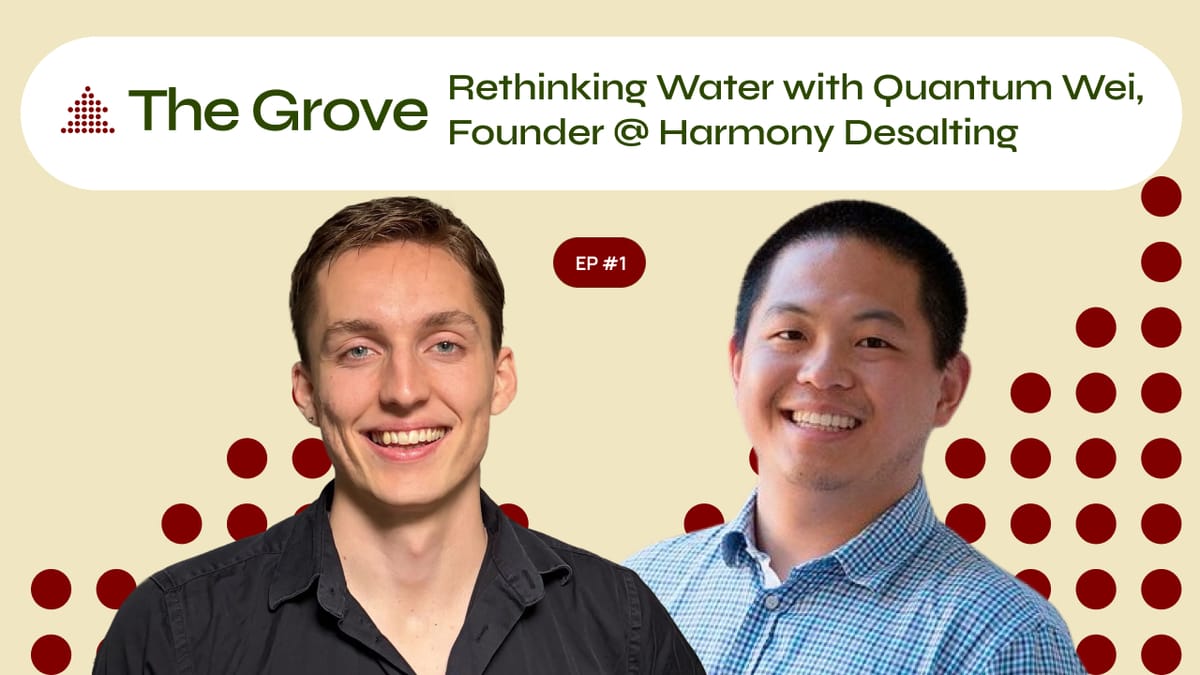
Listen to the full episode on youtube or spotify
Quantum paused to let the forklift rumble past. This was his team's take on the typical conference room: a corner of a storage container on a Boston shipyard.
Seven years ago, I had no idea this conversation would happen. Back then, Quantum presented at a small online water summit I attended. Today, as we sat in Harmony Desalting's facility, watching his team assemble pilot systems that could change how the world thinks about turning seawater into drinking water.
Quantum's story is about engineering...but it's also about the profound responsibility that comes one of a few people in the world who truly understands a technology that could help solve the global water crisis.
The Journey to Desalination: Kenya & Fluid Mechanics
Before Quantum Wei became the founder tackling humanity's water challenges, he was simply a mechanical engineering student who liked working with his hands. The path to desalination wasn't planned emerged from a combination of practical interests and a life-changing experience.
"I declared mechanical engineering as a major my freshman year at MIT," Quantum reflects, but the real foundation was laid earlier, during a gap year that would forever change how he thought about water.
In Western Kenya, teaching at a high school with no running water, Quantum lived the reality that billions face daily. "We were reliant on rainwater. We had a cistern to collect that rainwater for all of our cooking, cleaning, showering," he explains "We never ran out of water, fortunately, but the cistern got low at times."
That experience planted a seed that would sprout years later after Quantum found the fascinating world of thermodynamics, heat transfer, and fluid mechanics. Unlike other research groups focused on microscopic phenomena, he wanted to work on something tangible, something he could "see and hold with his hands."
When he joined Professor John Lienhard's research group at MIT in 2015, desalination was already a mature technology with a fundamental contradiction: we knew how to do it, but we couldn't do it well enough. Two massive problems stood in the gates to affordable freshwater.
Desalination: The Two Big Problems
The first problem is energy; desalination simply consumes too much of it. Traditional desalination plants utilize thermal-based systems that heat seawater until it evaporates (leaving salt behind) and condense the pure water vapor back into liquid. While effective, these systems require enormous amounts of heat that made them economically viable only in regions with cheap energy and expensive alternatives.
For some time the solution seemed to be reverse osmosis (RO), which emerged in the 1960s and revolutionized the industry by the 1990s. Instead of heat, RO used pressure to force water molecules through specialized membranes, leaving salt behind. "It's much more energy efficient than those thermal-based systems," Quantum explains.
RO, however, brings its own hurdle: membrane fouling. "These membranes work great while they're clean, but the real challenge is the fouling," Quantum puts simply, "These membranes get clogged and then they don't work so well."
To add to RO's narrative, 2015 saw the Carlsbad Desalination Plant commissioned near San Diego. At the time of this writing, it is still the largest seawater desalination facility in the Western Hemisphere and represents state of the art at that scale. Massive, expensive, and requiring constant membrane maintenance, it produces fresh water but at massive upkeep costs.
What did Quantum do about all of this, you ask?
From Theory to Prototype: Day 0-60 at Harmony
Stop with the sensationalism. I know what you're thinking. No, the breakthrough did not send eureka through the halls of the university. Like most genuine innovations, it emerged from the quiet persistence of researchers who refused to accept that trade-offs were permanent. Quantum's group at MIT had worked on a process that could potentially sidestep both energy intensity and membrane fouling simultaneously for years.
"This technology we're working on," Quantum says, "at that time, I'm probably one of about five people in the world who knows it super intimately."
Once the academic traction was there, though, the transition from research to startup was similarly gradual. Harmony Desalting didn't officially emerge until 2019-2020, years after the theoretical foundation had been laid.
The early days tested every assumption about what a company needed to succeed. "We never really hit the targets that we wanted to hit in terms of raising money," Quantum admits, "But we have found a way to keep going, regardless."
The team of three would pitch to investors, face rejection, regroup, and continue building. Built into their DNA:
"You can get a lot done with less than you might think you need."
Day zero at Harmony looked like most deep tech startups: long hours in labs, prototypes that didn't quite work, and the constant challenge of translating scientific possibility into engineering reality. Along with this came something else: an almost moral clarity about the mission. This wasn't about building another app or optimizing another algorithm. This was about solving a problem that affected billions of people.
The responsibility felt enormous. "When you work on something that's so specialized," Quantum reflects, "I think at some point I realized that if you don't do it, maybe nobody else will." It's potentially the key to unlocking affordable desalination for communities that had been priced or engineered out of existing solutions.
The Desalination Breakthrough
After support from early competition victories and subsequent pilots, Harmony had entered what Quantum calls "phase two" of their development journey. The theoretical breakthrough had been proven in controlled conditions. The initial prototypes had demonstrated feasibility. Now came the ultimate test: could their technology work reliably in real-world conditions over extended periods?
Quantum gestured toward the twin pilot systems taking shape nearby. "This is a pilot skid, one of two identical ones that we're making," he explained.
Danny and Arnold (after the movie "Twins") are being prepared for pilot deployements on the west coast in late 2025/early 2026.
"We're using all off-the-shelf reverse osmosis components to make a small batch system to demonstrate our process," Quantum explains. It's important to note that this isn't about inventing things entirely novel, these systems utilize existing components that work together in entirely new ways.
Perhaps the most remarkable aspect of Harmony's breakthrough isn't the technology itself—it's the team that's bringing it to life. The challenge ahead is monumental. Harmony stands at the threshold between demonstration and commercialization, between proving their technology works and proving it can scale to meet global demand. "In order to keep going, we need to really transition away from development and demonstration and into really commercial operations, where we are selling systems to customers and delivering on those systems."
The Ripple Effect of Innovation
As our conversation wound down, the sounds of the facility provided a fitting backdrop—the hum of pumps, the click of switches, the purposeful movement of a team building something that matters. Quantum's eyes lit up when he talked about learning something new almost every day, about the joy of working with people who share a vision of making water desalination more affordable, reliable, and accessible.
This isn't just another startup story. It's a glimpse into how real change happens—not through flashy announcements or viral marketing campaigns, but through the patient work of people who see problems that need solving and refuse to accept that solutions are impossible.
The global water crisis affects billions of people. Climate change is making freshwater more scarce while populations continue to grow. Traditional approaches to desalination, while valuable, haven't been able to scale to meet the need.
Quantum Wei and his team at Harmony Desalting aren't just building better desalination technology—they're rewriting the rules about what's possible when you refuse to accept trade-offs as permanent. They're proving that sometimes the most profound breakthroughs come not from accepting limitations, but from questioning whether those limitations are really necessary at all.
To learn more about Harmony Desalting's breakthrough technology, visit harmonydesalting.com or contact them at water@harmonydesalting.com. Follow their progress on LinkedIn as they continue their mission to make water desalination more affordable, reliable, and accessible for communities worldwide.
Member discussion: