
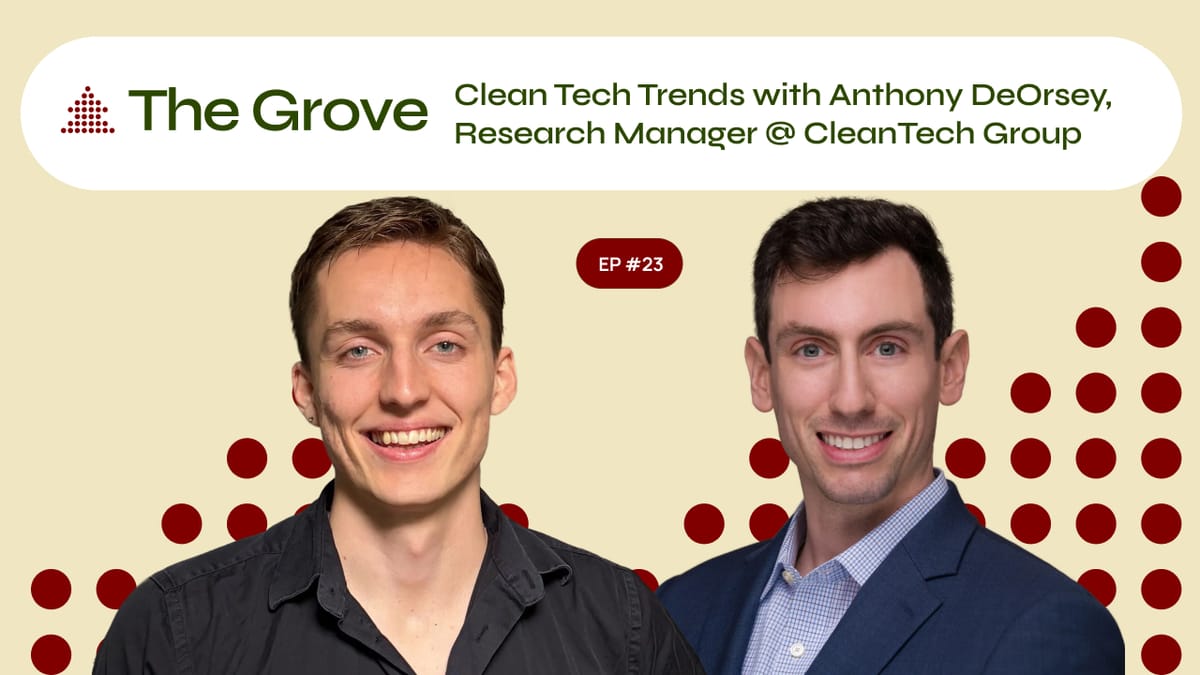
Anthony DeOrsey wanted to play safety for the New England Patriots. As anyone would when pro sports plans don't pan out, he moved to China after college to teach English.
This is article 1/4 a special series with Cleantech Group breaking down their research in Global Cleantech 100 report. Full episode available on youtube and spotify
Halfway through the program, Anthony joined a startup making natural cleaning products. This gave him a firsthand perspective to the collision between a hyper-growing economy and environmental crises.
"You really saw this very nuanced thing happening in China," Anthony says. "People's lives were getting measurably better every year, but there was this huge environmental impact of that much growth in the economy." The tension between prosperity and planetary cost became the through-line of his career.
Today he's the Research Manager at Cleantech Group, an organization he describes as "the human intelligence authority on cleantech innovation".
Anthony & I dive into core concepts of CTG's annual Global Cleantech 100 report and use those to understand the space more broadly.
We begin with a simple argument: A better way to look at cleantech is as a continuous evolution.
Clean Tech: A Continuous Evolution
The first thing Anthony wants to correct is the category error. Cleantech is a theme, rather than an industry. It stretches across agriculture, energy, materials and chemicals, transport, waste, and natural resources. Treating it like a single sector leads to bad pattern-matching.
"It's very common to take venture capital investments as a proxy for confidence in the technology," Anthony explains. "You'll hear a lot of reports of a big drop off since 2021 and 2022." Those reports exist, but he thinks they misread what actually happened.
2021 and 2022 were aberrations. Near-zero interest rates & net-zero policy signals supported a wave of trend-chasers who pivoted into cleantech because the moment demanded it.
Companies got funded beyond what their eventual revenue could support. When the macro environment shifted, down rounds followed and the narrative calcified: cleantech is struggling.
Anthony's counter is to zoom out. A full year of cleantech VC investment in 2015 equals roughly one quarter of investment in 2025. Strip out the COVID-era spike and you still see a strong, consistent upward trend. "We're still up from 2019," he says. "That is really still growing."
I asked if this story held up using proxies other than VC investment. He said yes, as long as we are careful about what each one actually measures.
- VC investment looks forward. It captures confidence in future potential before any return has materialized.
- Deployment numbers tell you where the market is today. Ex: how much renewable energy and battery storage is actually going into the ground (which by most measures is higher than it's ever been).
- Offtake agreements track the 'middle ground'. A company might have a pilot plant running and a committed buyer lined up, but no exit yet and no revenue. That offtake agreement is the signal that something real is happening. "Today," Anthony says, "that is becoming a very good barometer of that middle period."
The deeper point is about timeframe. CleanTech Group doesn't use the 1.0 / 2.0 language popular in the media. "We see this as just being a continuous evolution," Anthony says. "Energy transition, mobility transition, transition into cleaner chemicals. These are multi-decade journeys." If you assess a multi-decade transition by its performance in any single quarter, you're going to reach the wrong conclusions almost every time.
Scoring Companies: Innovation to Impact
How can we predict which technologies/companies actually break through and when?
Cleantech Group's answer is their Grow / Flow / Slow framework, rendered annually as a bullseye chart in the Global Cleantech 100.
- Grow: the outer ring Grow captures technologies they expect to accelerate holistically: more investment, more deployment, more adoption.
- Flow: the middle ring holds things progressing at roughly their current pace.
- Slow: the inner ring flags technologies facing headwinds, likely to see pullback in investment or deployment.
For 2026, Anthony describes the overall picture as a "pressure cooking effect." The Grow ring is both expanding and intensifying. Two themes dominate:
First, the race to own AI infrastructure. "Every day I read a press release about a new company that was born to do AI optimization," Anthony says. Everything in that value chain from fission and geothermal to photonic chips to data center cooling to waste heat recovery is getting pulled through to market faster because the demand signal is enormous.
Second, the emerging nexus between cleantech and defense has accelerated interest in two places. Critical minerals technologies (rare earths, lithium, copper) as well as dual-use technologies like Earth observation and methane sensing that have always straddled the environmental and military worlds.
The Flow and Slow rings tell a different story.
Technologies that are more capital-intensive, that had predicated long-term plans on stable tax credits or specific input costs, are feeling the current macro environment acutely. Some of those headwinds, particularly in hydrogen and voluntary carbon markets, were already building before the policy changes of 2025.
The effective repeal of key provisions in the Inflation Reduction Act didn't create those headwinds so much as accelerate them. "I don't think it kills what would have been zombie industries," Anthony says. "What I think it does is it just makes it a little bit harder to compete in the US in those areas."
The placement of technologies in each ring draws from a proprietary company scoring system across innovation, cost competitiveness, ability to scale, and impact (defined as resource efficiency combined with resilience).
The framework also considers demand signals: Are offtake agreements materializing? Are corporates acquiring companies in the space? Are IPO filings appearing? The Nvidia-Grok licensing deal or the wave of M&A in data center cooling, for example, are the signals Anthony's team reads as confirmation that something has crossed from promising to real.
What the Pressure Cooker Means for Builders
Understanding the framework is one thing. Knowing where to place your bets is another.
The battery cost drop is the clearest example of how the pressure cooker actually gets built. Batteries have fallen roughly twentyfold in cost since 2008 because an industry got relentlessly smarter at manufacturing.
That cost curve follows the same logic as consumer electronics. Anthony's compares this with the iPhone costing roughly $1,000 in nominal terms fifteen years ago. In inflation-adjusted terms, today's version is three or four times cheaper. Batteries are on the same trajectory.
That matters because EVs are essentially giant batteries. As battery costs fall, EV adoption follows, and more EV adoption means more materials demand — lithium, cobalt, copper, rare earths.
More materials demand exposes whoever doesn't control the supply chains. That chain of causation is why critical minerals sit in the Grow ring, why the cleantech-defense nexus is intensifying, and why the pressure cooker looks the way it does in 2026. Electrification creates a cascade of opportunity, each pulling the next into relevance.
For builders: the macro environment is working against you in ways that aren't going away quickly. The assumption that high cost has a linear relationship to eventual revenue has dissolved. "People are becoming very practical," he says, in two ways.
Some founders are using contract manufacturing, off-the-shelf components, and conducting smaller pilots to be faster to revenue.
In other spaces, specifically battery materials, specialty chemicals, some investors are pushing the opposite direction: skip the partnership, do the whole value chain yourself to compress the time to commercial traction. "There's no reason these two ideas can't come together," Anthony says. A strong lithium refining technology might find a faster path to revenue by simply producing and selling lithium directly rather than waiting for a refiner to adopt the process.
The area where Anthony thinks the gap between opportunity and engagement is widest is adaptation and resilience. This space includes wildfire detection, flood resilience, grid hardening, parametric insurance.
Getting attention to the space has felt like "shaking people by the shoulders" for whatever reasons. The reality is, if you accept that extreme weather keeps compounding, and that most people and institutions are behind the curve on preparing for it, the market for these technologies is both large and underpopulated.
"We're going beyond the 1.5 degree warming world," Anthony says. "The weather events you see this year are just going to repeat themselves every year."
The Close
The cleantech transition doesn't move in headlines. It moves incrementally in decades, then all at once. Anthony has watched geothermal go from a conversation starter to commercial operation. He's watched critical minerals move from a niche supply chain concern to front-page Wall Street Journal coverage.
To understand our place in Cleantech history, track the signals across the full technology and deployment spectrum & resist the temptation to call any single year representative of the whole are those who've seen clearly.
That's what Cleantech Group is building toward: the ability to see two steps ahead.
To learn more about Cleantech Group's market intelligence on cleantech innovation, visit cleantech.com or contact them at research@cleantech.com. Follow their progress on LinkedIn as they continue their mission to deliver human intelligence on the technologies and companies driving the global energy transition.
Member discussion: