
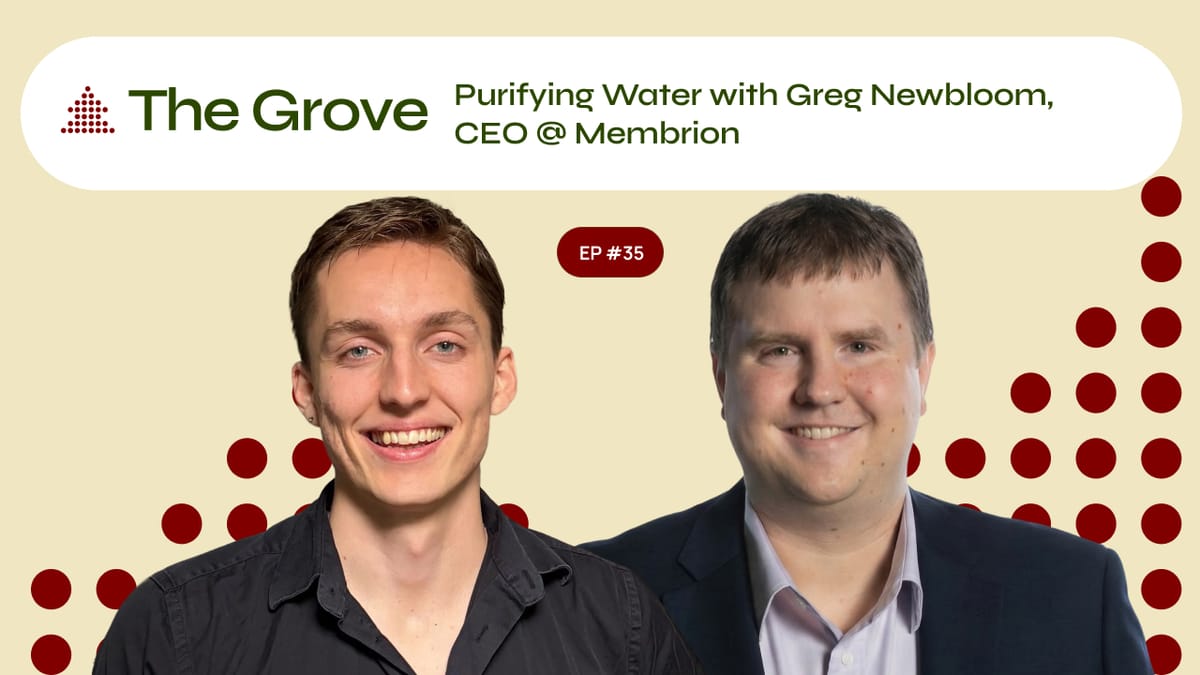
Imagine 10 year old Greg Newbloom selling snacks at his brother's baseball games. Very cute.
Unfortunately, when the league decided he was competing too much with the concession sales, they kicked him out. Apparently, Greg was born for the entrepreneurial life.
By the time Greg founded Membrion, he'd already built and closed another ventures. Those years of trying, failing, and extracting the right lessons from both experiences is the reason Membrion just crossed its tenth year as a company.
They also have a full commercial manufacturing line, deployed systems in the field, and a team of 30+. His story is a good one about what it takes to build in deep tech. Here we go.
Step Back to Step Forward
After his PhD at the University of Washington, Greg first helped spin out a company based on an anti-static coating technology developed with Boeing. The tech was promising, but the team was not built for the job. It was Greg's first taste of 'what am I doing with my life'.
"Running a company requires lots of different functional skills and expertise," Greg says. "We didn't have that. And we were trying to learn on the job."
In deep tech, learning on the job costs time. And time, when you're burning through a runway, is the one resource you can't recover. Greg's first main takeaway: speed is the variable that determines survival and the people sitting next to you determine your speed.
Wandering the liminal space post-winddown and pre-other job, Greg arrived back at the University of Washington. As fate would have it, his PhD advisor was looking to fill a year-long spot in their research department. Greg took it.
The research had two qualities that made it special: it was in membranes and it was promising.
At a critical point in development, Greg connected through UW's tech transfer office with a mentor who had already built a deep tech company from founding to exit. Over six months of Greg regularly showing up and saying "I need help," Membrion was born & that relationship evolved into a formal one. Greg handed the CEO role to this person entirely for the first two and a half years.
"I got to shadow someone who really knew what they were doing," Greg says.
The second lesson Greg carries forward is about customer discovery. His earlier company talked to customers, but in the wrong direction. They used those conversations to validate the technology rather than to understand whether they were actually solving a problem worth solving.
"There's a million reasons why someone doesn't want something better than what they're doing today," Greg says. "Maybe you're not even solving a problem they really care about."
At Membrion, the approach flipped. The signal Greg learned to look for wasn't a customer saying the technology was impressive. It was a customer trying to pull Membrion faster than the team was ready to move. That kind of urgency is the only reliable indicator that you've found a problem worth building around.
The Pivot
Membrion's ceramic membrane was originally developed to survive the brutal chemical environment inside redox flow batteries — grid-scale energy storage devices. The research grant Greg landed when he returned to UW was solving a battery problem, not a water one. Overtime, Greg's team discovered the market for redox flow batteries wasn't large enough to build a company around. They needed to pivot.
The silica membrane itself turned out to be exceptionally suited for water treatment, specifically for the industrial customers that conventional membrane technology had never been able to serve.
Why this matters: desalination does not only refer to removing salt from seawater. At its core, desalination means separating dissolved ions from water. This challenge shows up across dozens of industrial processes.
Semiconductor manufacturers deal with dissolved copper, tin, nickel, and palladium in their wastewater.
Food and beverage facilities, oil and gas operations, and chemical manufacturers all generate complex waste streams with ions that have to be removed before the water can be discharged or reused.
For decades, industry handled this with heat or chemicals. When polymer-based reverse osmosis membranes arrived, they transformed the field — but only for relatively clean environments. Harsh, chemically complex streams destroy conventional membranes. Foulants stick to the surface, efficiency drops, and the cleaning cycles required to maintain performance become so frequent that the system stops making economic sense.
Membrion's ceramic membranes behave differently. Unlike a conventional membrane that works like a coffee filter that pushes water through & leaves contaminants behind, Membrion's technology functions more like a kidney. Because ceramic materials are inorganic, organic foulants simply don't bind to the surface the way they do with polymer membranes. When cleaning is required, it's faster, uses fewer chemicals, and restores performance more completely.
The result is a membrane that can operate in environments where no membrane has been commercially viable before: acidic streams, oxidizing environments, high-fouling industrial wastewater.
Greg frames Membrion's market not as competition with existing membrane companies, but as bringing the last segment of industry left behind by the desalination revolution into the modern era.
"We're taking that last part of the industry that's been left behind on the desalination journey and bringing them up to the modern age," Greg says.
Huge lesson: Membrion didn't try to out-compete reverse osmosis in its strongest markets. It found where RO fails and built specifically for that.
The Machine Behind the Membrane
Ten years in, Membrion has completed the arc from university research to full commercial deployment. Now the challenge has shifted entirely.
"When starting Membrion, I wanted to be an accelerant to the company, not a hindrance," he says. "My rate of learning and execution has to be such that I am continuing to move us faster rather than slowing us down."
Membrion now asks out of Greg what a younger version of the company did not. As a leader, he holds himself accountable to a growth rate that matches the company's needs. At 30 people, your job is building the systems that let a team of people move together quickly.
The accountability structure Greg describes is straightforward and worth noting for any founder building toward this stage. The company sets transparent goals across every function: revenue, product, uptime, customer metrics. The board holds Greg to those goals. The team holds itself. No one needs someone over their shoulder because the goals are shared and the motivation to hit them is genuine. "Aggressive but attainable with focus" is how Greg puts it.
The Close
What drives all of it, underneath the operational mechanics, is something that shifted for Greg about four years ago when his son was born. The sustainability mission that drew him into cleantech in the first place suddenly had a face attached to it. There's a specific person he's building a better world for.
Membrion sits at an intersection that's only going to become more critical. The semiconductor industry alone faces tightening discharge regulations that conventional treatment can't meet cost-effectively at scale. The customers Greg describes as being "dragged kicking and screaming" toward Membrion's solution aren't being dramatic. They genuinely have no better option.
For the founders reading this: the technical insight is important, but it's not the story. The story is
- a founder who failed twice,
- extracted the right lessons both times,
- handed over the CEO seat when the company needed someone who'd done it before,
- built customer discovery around urgency rather than validation,
- found the market segment the dominant technology structurally couldn't reach,
- and then built the internal systems to scale once product-market fit arrived.
That's the playbook.
To learn more about Membrion's ceramic membrane technology for industrial wastewater treatment, visit membrion.com or contact them at info@membrion.com. Follow Greg's progress on linkedin as he and the Membrion team continue their mission to bring sustainable, membrane-based water treatment to the industries that need it most.
Member discussion: