
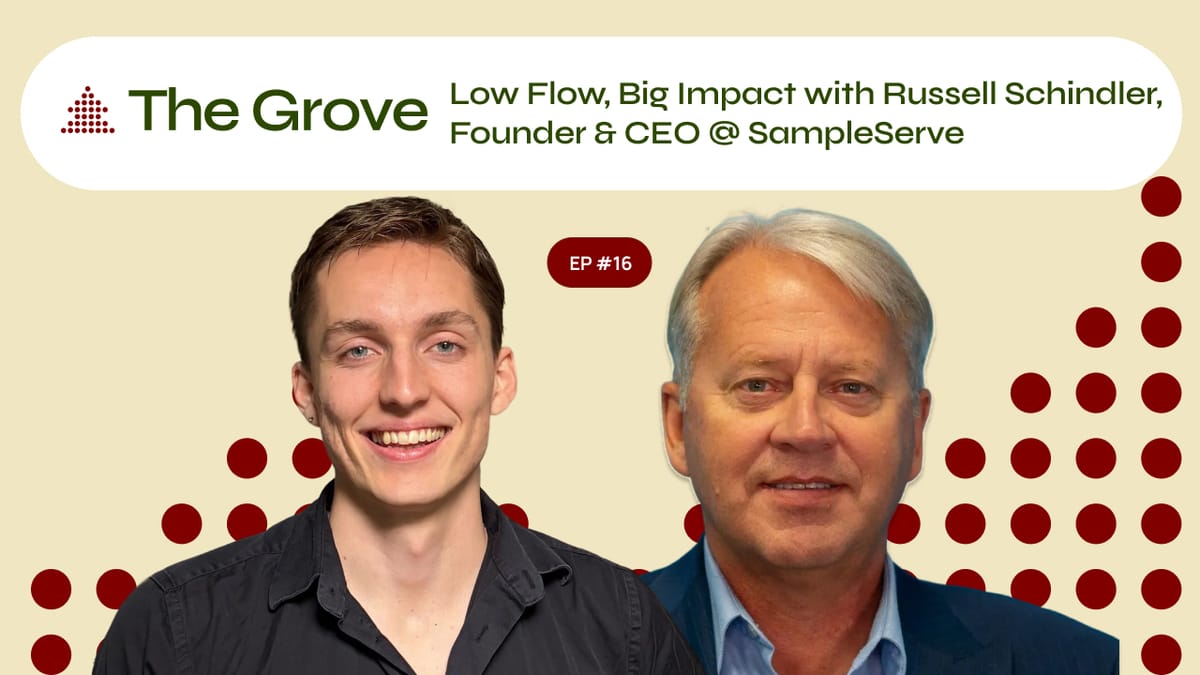
"I've actually had labs call me up and go, 'Could you please speak with Russell Schindler and ask him to write his threes and his fives better because we can't tell the difference?'" Russell Schindler recalls one of the embarrassing moments that shaped his entire business philosophy. "I'm like, I know what you mean. I'll have a talk with him."
watch the full episode on youtube and spotify
This wasn't just professional embarrassment—it was the genesis of SampleServe, a software platform transforming how environmental professionals collect, track, and manage water sampling data. What started as Russell's personal solution to illegible handwriting has evolved into a comprehensive platform serving thousands of wastewater treatment plants, crime scene investigators, and environmental consultants nationwide.
Russell brings a unique perspective to environmental software development. As a geologist doing environmental work since 1987, he understands field-level challenges. He's built multiple companies, from charter boat operations to jet ski rentals, but consistently returns to solving real problems for people working with water and environmental data.
"I'm a software owner, but I've never written a line of code in my life," Russell explains. "I don't write the code, but I understand what needs to be solved because I've been doing this work for decades."
This combination of deep domain expertise and entrepreneurial instinct has positioned SampleServe at the intersection of several growing markets: municipal water management, environmental compliance, and evidence collection. As regulatory requirements intensify and missed samples trigger expensive fines, Russell's platform addresses challenges affecting public health, environmental protection, and legal accountability.
Monthly Customer Discovery Meetings: Building Software That Actually Solves Problems
Russell's product development centers on a practice that many software companies discuss but few execute: genuine customer discovery. "We try to do monthly customer discovery meetings with every new customer," he explains. "First I ask: any problems, bugs, or issues over the last month? Then, what can we do better?"
The monthly meetings generate most of SampleServe's new features, revealing needs customers might not even recognize.
"A guy missed a sample last month and they got fined $10,000 because it was their fifth missed sample this year," (due to this legislation) Russell recounts from a recent session. The breakdown: someone collected the sample but left it in the fridge, and the next shift forgot to transport it to the lab. Russell immediately saw the solution: "We can build an alert system so when someone stores a sample, the system reminds the next shift to transport it."
These conversations reveal the high-stakes nature of environmental sampling. A missed sample isn't paperwork—it's potential regulatory violations and fines reaching thousands of dollars. When Russell builds features to prevent these failures, he's protecting public health and saving organizations from significant penalties.
The meetings also illuminate complexity hidden beneath seemingly simple environmental work. "They have daily samples, weekly samples, monthly samples, quarterly samples, semi-annual samples, and annual samples," Russell explains. "Each from different locations with different parameters."
This regulatory complexity creates operational challenges that generic software can't address. "Sometimes you're collecting the daily, the weekly, the monthly, and the quarterly samples all at the same time," he notes. "The challenge is creating efficiency so you don't send someone to collect a daily sample, then realize after they've left that you wanted them to collect the monthly sample too."
Municipal Water Testing in Texas: Scaling Beyond Environmental Consulting
Russell's expansion into municipal water management addresses a significant market opportunity. "We're picking up so many clients quickly, especially wastewater treatment plants and drinking water plants," he explains. "I'm talking thousands of new customers in the pipeline."
Municipal water testing differs significantly from consulting work in scope and complexity. Where consultants manage sampling for specific projects, municipal operators oversee comprehensive monitoring across entire water systems. The stakes are particularly high—failed compliance can trigger public health emergencies and regulatory sanctions.
"Sometimes they have to collect a sample every shift—first shift, second shift, third shift," Russell explains. "Sometimes it's just once a day, depending on the size and volume of water processed." This variability creates scheduling challenges that compound as systems grow larger.
The Texas market has proven particularly receptive to SampleServe's municipal solutions, reflecting both the state's substantial water infrastructure and growing emphasis on compliance. Russell's expansion strategy focuses on building software flexible enough to adapt to different regulatory frameworks without requiring custom development.
The municipal market requires different onboarding processes compared to consulting clients. "Right now our onboarding takes 90 to 120 minutes per customer," Russell admits. "With thousands in the pipeline, that becomes a full-time job." This scaling challenge drives his current focus on automation and AI integration, aiming to reduce onboarding from hours to minutes.
Streamlining Wastewater Sampling Schedules: AI Meets Environmental Compliance
Russell's most ambitious current project involves developing AI agents that automatically optimize sampling schedules for maximum operational efficiency. "We're working on AI agents that will look at schedules and automatically stack sampling events to make everything as efficient as possible," he explains.
The complexity becomes clear when considering the variables involved. Different parameters require different sampling methods, containers, and preservation techniques. Some samples must be collected at specific times, others can combine with routine monitoring. The AI system needs to understand these technical requirements while optimizing for operational efficiency.
This automation addresses labor constraints many water treatment facilities face. Skilled operators command high salaries, and training requires significant time investment. Software that reduces sampling coordination complexity allows facilities to operate more efficiently while reducing costly compliance failures.
"My goal is to get onboarding down to 10 minutes, then eventually to zero minutes where customers just upload their permit and existing schedule, and the AI organizes everything automatically," Russell explains.
The automation extends beyond scheduling to real-time operational support. The system tracks sample collection, storage, and transport, providing alerts when actions are required. "We can't make someone drive the sample to the lab," Russell admits, "but we can alert them that there's a sample in the fridge that needs to get to the lab."
This regulatory awareness distinguishes SampleServe's AI development from generic scheduling optimization. "The AI needs to know that if you miss your fifth sample this year, you're facing a $10,000 fine," he explains. "That context changes how the system prioritizes different sampling events."
Taking Tech into New Spaces
Russell's expansion into crime scene investigation illustrates how sample tracking principles apply across industries. "The whole crime scene thing is just blowing up," he notes, explaining how SampleServe's core capabilities translate to evidence collection and forensic applications.
The connection becomes clear when understanding the requirements. Both environmental sampling and crime scene investigation require meticulous documentation, chain of custody protocols, and precise tracking. The consequences of errors are severe in both contexts: missed environmental samples trigger regulatory violations, while compromised evidence undermines legal cases.
"My dad was a detective, so I grew up with cops around," Russell explains. "He taught me to take fingerprints when I was 11 years old." This personal connection provides intuitive understanding of law enforcement needs while highlighting how different domains share similar operational challenges.
Russell's approach follows his established pattern of deep customer discovery. "Tomorrow I have a meeting with the top crime scene evidence collection expert in the state of Michigan," he explains. "He's been in the industry for 26 years and he's interested in our software."
This expansion demonstrates how specialized platforms can grow by identifying adjacent markets with similar underlying requirements. Rather than building generic solutions, Russell focuses on solving specific problems extremely well, then finding other contexts where those solutions apply.
The Bigger Picture: Environmental Technology That Actually Works
Russell's journey from geologist with bad handwriting to software innovator reveals important principles about environmental technology development. The most effective solutions often emerge from deep domain expertise combined with genuine understanding of user needs rather than from pure technological innovation.
SampleServe succeeds because it solves real problems that Russell experienced personally and continues to understand through ongoing customer relationships. The monthly discovery meetings ensure that product development stays aligned with actual user needs rather than theoretical requirements or competitive features.
This approach becomes increasingly important as environmental regulations become more complex and the consequences of non-compliance become more severe. Organizations need software built by people who understand the regulatory context, operational constraints, and professional pressures that environmental workers face daily.
Russell's expansion into municipal water management and crime scene investigation demonstrates how solid foundational technology can scale across multiple markets when guided by deep understanding of user requirements. Rather than trying to build everything for everyone, SampleServe excels at sample tracking and compliance management, then adapts these core capabilities to serve different professional contexts.
The AI development represents an evolution rather than a revolution, applying advanced technology to solve problems that Russell and his customers understand intimately. This grounded approach to innovation creates AI applications that enhance human decision-making rather than replacing professional expertise.
Looking forward, Russell's vision for SampleServe reflects broader trends in environmental technology: increasing automation, better integration between field operations and data management, and software that understands the regulatory context of environmental work. His success suggests that the most impactful environmental technologies will come from people who combine deep industry knowledge with persistent focus on solving real problems for real users.
"It's fun solving new problems and exploring different opportunities," Russell concludes. This enthusiasm for problem-solving, combined with decades of environmental experience and relentless customer focus, positions SampleServe to continue evolving as environmental compliance requirements become more complex and the need for reliable, user-friendly solutions continues to grow.
The story of SampleServe reminds us that transformative environmental technology doesn't always emerge from cutting-edge research laboratories or well-funded startups. Sometimes it comes from experienced professionals who recognize that their industry's biggest challenges require better tools, then commit to building those tools with the same attention to detail they bring to their original profession.
To learn more about SampleServe's environmental compliance and sample tracking solutions, visit SampleServe.com or contact Russell directly through the website. Follow their progress on LinkedIn as they continue their mission to streamline environmental sampling and compliance management for water treatment facilities, environmental consultants, and evidence collection professionals nationwide.
Member discussion: