
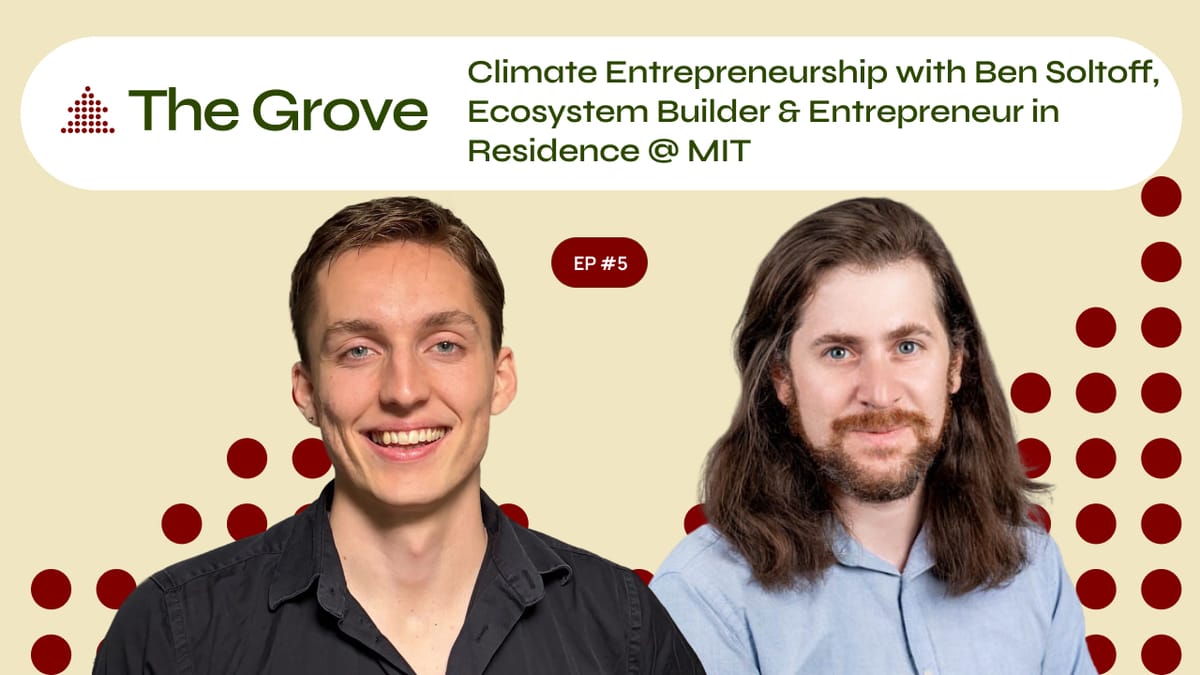
Listen to the full episode on youtube or spotify
Ben Soltoff holds up his new book during our conversation and smiles.
Anyone that has written a book can appreciate the gratification that comes from finally putting it into the world. I've never written a book. But I can do my best to imagine.
"This is my first book," Ben admits. Disciplined Entrepreneurship for Climate and Energy Ventures is the distillation of insights from MIT's most successful climate tech program.
Ben's story reveals something more intriguing than traditional entrepreneurial narratives. In an ecosystem dominated by technical founders and venture capitalists, he represents a different archetype: the translator. His path from studying ecology and conducting forest research to becoming an entrepreneur in residence at MIT's Martin Trust Center illuminates a critical truth about climate solutions—they require more than just breakthrough technology.
Research's Hidden Impact
The transformation began when Ben was measuring trees and conducting forest research in those early career days. While it might seem worlds away from startup accelerators, those years laid the foundation for understanding how environmental solutions actually scale. "I've now seen several waves and several different approaches of how to navigate issues in the sustainability space," he reflects.
His academic journey taught him something crucial that many tech entrepreneurs miss: environmental impact operates on different timelines than business cycles. Forest ecosystems change over decades, not quarters. Climate patterns shift over generations, not product development sprints. This perspective proved invaluable when working with startups eager to move fast and break things in a domain where patience and systemic thinking matter more than rapid iteration.
Most importantly, those research years taught him systems thinking. Forests aren't just collections of trees—they're complex ecosystems where soil health, water cycles, wildlife patterns, and human intervention interact in ways that can produce unexpected outcomes. This thinking is essential when working with entrepreneurs whose solutions apply within equally complex systems of policy, market incentives, and often hard-tech infrastructure.
The transition from pure research to applied solutions happened gradually. Ben found himself increasingly drawn to work that could bridge the gap between what scientists knew about environmental problems and what policymakers and business leaders needed to understand to take action. This led him into advocacy and informational outreach, where he began developing the communication skills that would eventually make him an effective coach and advisor to climate tech startups.
Climate Tech: The High Price of Poker
"I think that there's a misrepresentation of folks in this world of entrepreneurship that they think everything can be solved with a startup and with a new venture," he observes.
The stakes in climate tech are particularly high because failure doesn't just mean lost investor money—it can mean missed opportunities to address urgent environmental challenges.
"Entrepreneurship is just this wonderful way of building solutions...but entrepreneurship is not the only route to building solutions," Ben explains. This realization became central to his approach: helping entrepreneurs understand not just how to build their technology, but whether they should build a company around it at all.
The poker analogy extends to the bluffing that often characterizes early-stage climate tech. Founders would pitch investors on massive market opportunities without understanding the regulatory hurdles, incumbent resistance, or infrastructure requirements that would determine their actual addressable market.
Ben learned to help entrepreneurs develop "disciplined" approaches—methodologies for testing assumptions, validating market demand, and building sustainable business models rather than just compelling pitch decks.
His journalism work for GreenBiz (now Trellis Group), Canary Media, and TechCrunch gave him a front-row seat to both successes and spectacular failures in the space. He watched companies raise massive Series A rounds based on promising lab results, only to struggle for years to achieve commercial viability. Others with less glamorous technologies but better market understanding built steady, profitable businesses that actually deployed climate solutions at scale.
The experience taught him that climate tech entrepreneurship requires different discipline than traditional software startups. "They often don't get the glory and attention, but they deserve it," he says of the climate entrepreneurs he admires most. These founders face longer development cycles, complex regulatory environments, and the need to coordinate with established industries that aren't always eager for disruption.
Entrepreneurship Beyond Startups
The revelation that would eventually shape Ben's book came from recognizing that climate solutions require entrepreneurial thinking far beyond traditional startups. During his work with MIT's climate and energy ventures program, he observed that some of the most impactful innovations were happening within large corporations, government agencies, and non-profit organizations.
"Climate and energy entrepreneurship is not just about startups. It's also about innovation within large companies and corporations, innovation within government, innovation within large institutions and nonprofits," he emphasizes.
This broader definition challenged conventional wisdom in venture capital, where success is measured by exit valuations and unicorn status. Ben began working with intrapreneurs—innovators within established organizations—applying entrepreneurial methodologies to drive change from the inside. These innovators faced many of the same challenges as startup founders but had unique advantages: existing resources, established relationships, and the ability to implement solutions at scale without raising venture capital.
The book project emerged from this insight. Working with co-authors who had created MIT's successful entrepreneurship frameworks, Ben adapted proven methodologies specifically for climate and energy ventures. "My job as the lead author was to take all of their insights and inputs and turn that into a framework and structure and useful set of steps," he explains.
The resulting framework acknowledges that climate solutions require longer time horizons, more complex stakeholder management, and different success metrics than typical tech startups. "You can do good work in this space in just about any industry with just about any skill set," Ben realized.
The Inspiration Engine
When I ask Ben what inspires him, his answer comes without hesitation: "It's the entrepreneurs." But he's not talking about celebrity founders who grace magazine covers. He's thinking about researchers-turned-founders developing better battery chemistry, policy experts building software that streamlines renewable energy permitting, and former utility engineers creating startups focused on grid modernization.
"The folks who are starting companies in this space, it takes years. It takes a lot of effort. It's often thankless," he reflects. These entrepreneurs face unique challenges that make traditional startup advice inadequate. They're building solutions for markets that often don't exist yet, developing technologies that require regulatory approval, and trying to disrupt industries with entrenched interests and century-old business models.
"Their ability to keep showing up, to keep doing difficult, sometimes seemingly impossible things, that's what inspires me," he says, speaking with genuine admiration. This inspiration drove him through the long process of writing the book. The book represents Ben's attempt to give these entrepreneurs better tools—not just for building companies, but for understanding how their work fits into the broader ecosystem of climate solutions.
A Blueprint for Systemic Change
Disciplined Entrepreneurship for Climate and Energy Ventures launched on November 25th, designed as a reference guide entrepreneurs return to repeatedly. "When you encounter a problem, you go back to it and what was that one story in there? What was that one step that could be really useful?" Ben explains.
The book represents something larger: recognition that addressing climate change requires entrepreneurial thinking at every level of society. Ben's journey from forest researcher to climate tech ecosystem builder illustrates how seemingly unrelated skills can combine unexpectedly to create impact. His scientific research provides credibility with technical founders. His journalism experience helps him communicate complex ideas clearly. His policy work helps him understand regulatory contexts that shape market opportunities.
"Climate isn't an industry. Sustainability isn't an industry, it's something that cuts across a lot of different industries," he reminds me. This perspective—that climate solutions require coordination across multiple sectors—permeates his work.
The book provides practical tools while embedding a philosophy: building climate solutions requires humility about complexity, discipline in validating assumptions, and persistence facing systemic obstacles. For readers ready to join the climate tech ecosystem, Ben's framework offers a roadmap. But perhaps more importantly, his story demonstrates there's no single path to creating climate impact.
The entrepreneurs Ben works with daily continue to inspire him because they represent hope made manifest—people willing to dedicate their careers to building the future we need rather than simply adapting to what seems inevitable. Their persistence embodies the disciplined optimism that climate solutions require.
As Ben continues promoting the book and supporting the next generation of climate entrepreneurs, he carries forward lessons learned from measuring trees in Boston forests, writing stories about breakthrough technologies, and coaching founders through the complex process of turning scientific insights into scalable solutions. The book represents more than a publishing achievement—it's a tool designed to help others navigate the bridges he's been building throughout his career, expanding the definition of who can be a climate tech entrepreneur.
To learn more about Ben Soltoff's framework for climate and energy entrepreneurship, visit https://www.de4cev.com/ or find the book "Disciplined Entrepreneurship for Climate and Energy Ventures" at major retailers. Follow Ben's continued work supporting climate tech entrepreneurs through the Martin Trust Center for MIT Entrepreneurship as he continues his mission to democratize access to entrepreneurial frameworks for climate solutions.
Member discussion: