
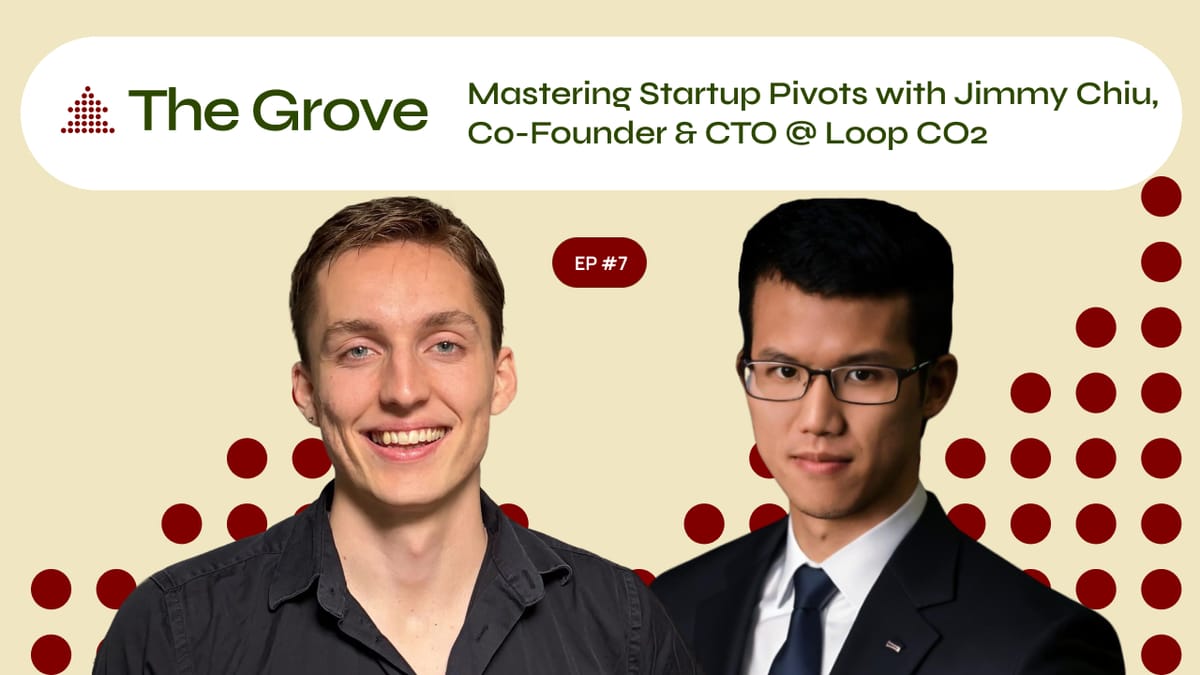
Listen to the full episode on youtube or spotify
The moment that changed everything happened in a Taiwanese high school, where a visiting professor delivered what might have been the most consequential sales pitch of the 21st century. "Everyone can do math, can do physics, can build some machine," he told a room of teenagers exploring their futures. "But if you really want to become a maker—a world maker—then you should become a scientist, a chemist. You are making the molecules, like the maker of modern nature."
In that audience sat Jimmy Chiu, who decades later credits those words for his entire career trajectory. "That's actually the moment I thought, all right, that's cool. That's awesome that I can make the world happen, the real world," Jimmy recalls. "So I decided to become a chemist."
What followed was a decade-long odyssey through academic and corporate worlds, each chapter building toward a revelation that would reshape how we think about carbon emissions. Jimmy's journey to the University of Minnesota, his early work with Professor Tonks on CO2 utilization, the pivot away from that research when funding dried up, and his subsequent rise through DuPont's ranks are each discussed honestly in the conversation.
Today, Jimmy stands at the forefront of a revolution that's turning carbon dioxide from climate villain into the hero of sustainable materials. His company, LoopCO2, represents the culmination of a journey spanning continents, corporate laboratories, and the kind of scientific persistence that transforms abstract chemistry into world-changing technology. But looking back, they were all preparing him for the moment when his advisor would call with news of a patent that would change everything.
Building a High-Pressure Lab
The call came at exactly the right moment, though Jimmy couldn't have known it then. He was settled into his role at DuPont, one of America's chemical giants, with a clear path toward management and corporate security. "Hey, Jimmy, we have filed a patent on this new CO2 utilization technology," Prof. Tonks said, "Are you interested?"
The technology wasn't the same CO2 project Jimmy had worked on during his PhD—that dream had been shelved when funding disappeared around 2015. This was something new, but it represented the same fundamental vision that had first attracted him to chemistry: taking a problem and transforming it into a solution at the molecular level.
"I thought, yeah, that sounds very cool, because that's still my dream to solve some real world challenges using CO2," Jimmy explains.
When the Department of Energy funding came through—1.9 million dollars total—the abstract possibility of a laboratory began to take concrete shape. The laboratory they built in Marlboro wasn't just a research facility; it was a testament to the ambitious engineering required to bridge laboratory chemistry and industrial application. Working with CO2 requires specialized equipment capable of handling high pressures and precise temperature controls.
"We use the whole chunk of that money to build our kernel lab at Marlboro," Jimmy recalls.
The transition from consultant work to running a full-time laboratory marked a fundamental shift. Academic research operates on different timelines than commercial development. Building the laboratory meant committing to the iterative process that turns promising chemistry into viable technology—and confronting one of chemistry's most fundamental challenges: the gap between what works in theory and what works in practice.
Chemistry's Hidden Complexity
The conversation shifts when Jimmy begins explaining the fundamental challenge of working with materials most people take for granted. "For example, based on my personal experience, whenever I say, hey, I'm a chemist, people would say, that's so cool. Like, we suffer from chemistry in high school or in college, right?"
"If you see a liquid, you think, that's water. But this actually can be ethanol, right? It can be alcohol. It can be a lot of different things. It's really hard just by seeing this colorless liquid to tell what it is."
This invisibility creates fundamental communication problems affecting everything from investor relations to customer adoption. When Jimmy talks about developing new bioplastics from CO2, he's describing molecular transformations that happen at invisible scales, creating materials that might look identical to conventional plastics while possessing entirely different properties.
"When we talk about plastic, for a lot of people, plastic is plastic," Jimmy continues patiently. "But if you look at the recycling chart, there are at least seven different categories for recycling. And there are actually more than 100 different plastics."
The implications extend to funding challenges. "Because if we are making new molecule, and the investor, if their LP is not like chemical corporates, then that would be a little bit challenging for them to make connections," he explains with the weary wisdom of someone who has weathered multiple funding cycles.
But this complexity creates competitive advantages lasting decades. Unlike software or hardware, new materials technologies create moats measured in chemical bonds and molecular interactions. "Once we get into the commercialization stage, this material will stay there forever," Jimmy says. "Once it gets into this complex supply chain, once people love it, once we prove it, it will stay there forever."
So how does LoopCO2 get there?
Discovering Bioplastics: From Zero to Proof of Concept
The breakthrough came through patient accumulation of small discoveries rather than a single moment of inspiration. Jimmy's technology integrates carbon dioxide directly into the polymer backbone, creating materials that are both biodegradable and derived from waste streams rather than fossil fuels.
"We actually can use CO2, which normally is the waste from the industrial process, to make into biodegradable polymer," Jimmy explains. The elegance masks years of development required to make it commercially viable.
Professor Tonks' contribution proved crucial in bridging the gap between academic research and commercial application. "Professor Tonks came up with the idea of how to turn certain waste into relevant, commercially available materials," Jimmy recalls with evident gratitude. "Then that was our aha moment to say, that's the route. We potentially can commercialize that."
Jimmy has strategically focused on two specific applications: adhesives and coatings. These markets offer advantages for a materials startup—they don't require massive production volumes, performance requirements are clearly defined, and customers are sophisticated enough to understand sustainable materials' value proposition.
"We're developing two applications to get into the market. One application is adhesive application. We know that currently there are a lot of adhesive applications that cannot be recycled. So our material can make those into compostable or even into recycling loop," Jimmy explains.
The validation comes from industrial engagement rather than academic publications. "A lot of Greentown Labs partners have stopped by our booth and just want to have a deeper conversation, to make connection with their technical team," Jimmy notes. "So once we make that connection and really successfully commercialize it, this material will just stay there forever."
The journey from zero to proof of concept in materials development requires proving that chemistry works reliably, cost-effectively, and at scales that matter to industrial customers. Jimmy's success represents more than technical achievement—it demonstrates the systematic development that transforms laboratory curiosities into commercial realities.
The Maker's Legacy
Today, Jimmy's motivation creates remarkable resilience in the face of inevitable setbacks. "As a chemist, I always feel curious to everything I'm handling," he reflects. "Even though this chemistry has been demonstrated in small scale, during the scale up process, there are a lot of questions that we have to answer. And that's pretty fascinating."
But scientific curiosity alone wouldn't sustain the long-term commitment required to bring breakthrough materials to market. Jimmy's motivation runs deeper, connecting professional work to personal legacy in meaningful ways. His father's entrepreneurial example provided inspiration, but Jimmy's role as a father himself gives his work profound meaning.
"I'm also the father of two boys so I really want to show them 'hey this is hard and causes a lot of frustrations. But I'm not giving up yet'," he says. "So I want to demonstrate to my boys that, yeah, your father can do it. And they should be able to do it as well."
The laboratory has become a teaching environment where the next generation can see how scientific knowledge translates into real-world impact. The internship program has produced tangible results: students pursuing PhD programs, others joining full-time, all carrying forward the understanding that chemistry can drive positive change.
"Developing those young talents demonstrate that there are possibilities in this world," Jimmy observes with satisfaction. "Us running this technology is not just to sell something, right? We are developing the technology together. We are making this world more sustainable."
The vision extends beyond individual products to encompass fundamental transformation in how industrial chemistry approaches environmental responsibility. Instead of treating the atmosphere as unlimited waste repository, Jimmy's technology demonstrates how emissions can become feedstocks, creating economic incentives for environmental stewardship.
In Jimmy's laboratory, CO2 enters as waste and emerges as building blocks of a more sustainable future. It's a transformation happening at the molecular level, invisible to the naked eye but profound in its implications. The teenager inspired by a professor's vision of chemists as world-makers has indeed made the world—not by creating something entirely new, but by reimagining something that was always there, waiting for the right combination of curiosity, persistence, and vision to reveal its hidden potential.
To learn more about LoopCO2's CO2-to-bioplastics technology, visit loopco2.com or contact Jimmy directly via LinkedIn. Follow their progress as they continue their mission to transform industrial waste streams into sustainable materials.
Member discussion: