
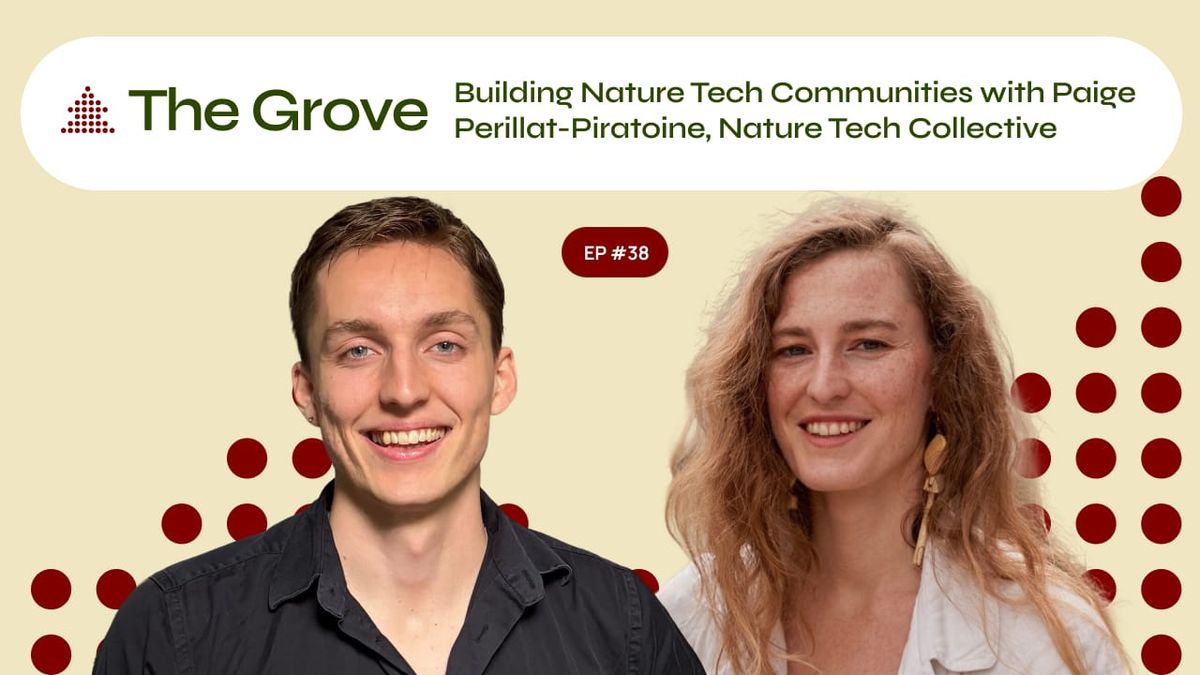
"A lot of businesses are using the word community in a way that's fraudulent."
That's Paige Perillat-Piratoine being precise. Paige runs community for the Nature Tech Collective, a growing ecosystem of startups, investors, corporates, and academics all working toward a nature positive future. She's spent her career learning the difference between an audience list and a group of people who actually lean on each other.
watch the full episode on youtube or spotify
I wanted to talk to Paige because I've been thinking a lot about community lately. In my own world doing this podcast and the other work I do with Earth Onward, I hear a lot that founders are lonely. They're building something that matters and they feel like nobody in their immediate circle can relate to the daily grind of making something from nothing.
For anyone that doesn't know yet, the Nature Tech Collective is a community of organizations spanning the entire nature tech ecosystem. These are companies measuring the health of nature, restoring it, or financing the flow of funds toward it. Paige is the person making sure all those different stakeholders talk to each other in ways that are generative rather than random.
Building Nature Tech Community
Something incredibly tangible: there are actual building blocks to community that most people skip.
(1) The first is creating spaces where people can find each other and connect easily.
For NTC, that's a Slack forum. Could be anything — WhatsApp, Circle, whatever — but the point is that members can see who else is in the space and reach out with no friction. The implicit message is you're also part of this collective, so I can contact you and say hey, I'd love to talk.
(2) The second building block is a shared set of values.
NTC's are clear: everyone is tending toward a nature positive future, technology is essential to accelerating that future, and the space is non-solicitation. You're not here to get clients. You're here to collaborate and wrestle with the hard questions.
(3) The third is skin in the game.
NTC asks for either a fee or an in-kind service from every member. Paige is clear that free communities can work — she specifically called out Work on Climate as an example — but for what NTC is trying to do, having members invest something creates accountability on both sides. The collective gives something, members give something back, and that exchange builds the foundation.
To quality control, Paige does a one-on-one call with every organization before they join. She walks through what actually happens inside the collective and asks a direct question — is this really what you're looking for? That vetting process ensures that when someone shows up in the Slack channel, everyone else knows they've been through the same door.
I asked Paige what advice she'd give someone evaluating whether to join a professional community: First, did someone you trust invite you? Referrals matter because they carry embedded trust. Second, do you have the time and motivation to actually give back? Community isn't a spectator sport. Third, can you give it a try and see if you feel like you belong in those first one or two interactions?
Nature Tech Collective: Connecting Supply and Demand
The Nature Tech Collective started as the MRV Collective — Measuring, Reporting, and Verification. They focused specifically on the technologies that help measure and verify nature data and actions. About 80 people signed up almost immediately because there was such a vacuum in the space. No community like it existed, so they kind of popped up out of thin air.
As conversations deepened over the first year and a half, Paige and the team realized they were siloing themselves into just one part of the market. They were the supply side with incredible measurement and verification tools lacking demand.
So they rebranded. The Nature Tech Collective became this broader tent that now includes project developers, corporates, investors, academics, and consultants alongside the original tech providers.
The good part: you now have this wildly diverse set of organizations and people from across the globe, and you can pick anyone's brain about probably anything in the nature tech ecosystem.
The challenging part: how do you serve all of those different stakeholders without favoring any one group? That's a tension Paige navigates every day.
Measuring Impact Beyond KPIs
By its nature (pun intended) community has many real outcomes that are hard to track. NTC take is that they're not dead set on KPIs, which means the team can work much more intuitively.
Hear her out.
When you're tending toward something as abstract as 'accelerating the nature positive transition', traditional metrics don't always tell you whether you're succeeding. What tells you is harder to count. How many connections have you enabled that turned into real collaborations? How many working groups did you spur that shed light on important tensions or created resources the sector can use long-term?
Paige tracks what she can: the number of introductions made, event satisfaction, collaborations that NTC directly facilitated. But she's honest that the most meaningful signals are often the ones not in a dashboard. A member reaching out unprompted to say, "Thank you for facilitating this space. I met this person and it changed our approach." Someone telling her that a resource NTC published directly helped them navigate a specific challenge. Those moments of unsolicited feedback become the compass.
There's a huge part of intuition in community work, and I think that's actually true of a lot of the hardest problems in climate tech. The data matters, but so does the pattern recognition you develop when you're deeply embedded in an ecosystem and actually listening.
The Close
My favorite thing from the episode:
it's part of the life cycle of community to die eventually.
When you're building a community, part of the thinking has to be — when this community sunsets, what is the artifact that will live on? What story did we create together that persists after the Slack channel goes quiet?
For Paige, it's building the connective tissue between the organizations trying to figure naturetech out.
Let's keep making this world a better place.
To learn more about the Nature Tech Collective's work connecting the nature tech ecosystem, visit naturetechcollective.com or contact Paige directly at paige@naturetechcollective.com. Follow their progress on LinkedIn as they continue their mission to accelerate the nature positive transition by bringing together the people and organizations making it happen.
Member discussion: