
Did Majid Hajibeigy find kelp or did kelp find him? You decide.
listen to the full conversation on spotify or youtube
The first time, organic chemistry beat him. He'd enrolled to become a wildlife vet, drawn to animal biology and the idea of healing sick creatures. Something about the suffering animals wasn't working.
He then switched to ecology and wildlife studies, trading the examination room for fieldwork. This didn't work either.
Frustrated with a system that kept him from the work he actually wanted to do, Majid walked away to fight wildfires.
It was the wildfire veterans, ironically, who convinced him to return to school. . Their logic was simple: you're so close to finishing, don't lose now. He went back, completed his degree in plant biology and agricultural studies, and shortly after stumbled into a random job opportunity on Vancouver Island that would change everything.
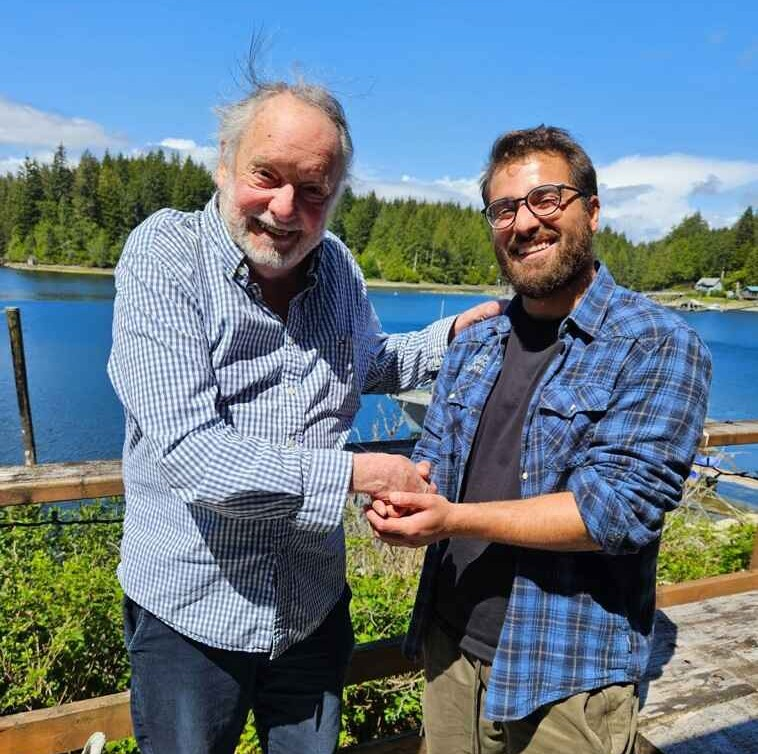
The job was with Professor Louis Druehl, a kelp researcher working out of Bamfield, a tiny coastal town with a couple hundred winter residents. Louis had spent decades studying marine botany and single handedly introduced sea farming from Asia to Europe and North America. When Majid showed up, his background was mostly terrestrial ecology—he knew almost nothing about kelp. "He taught me pretty much everything I know about kelp," Majid says. But Louis offered something beyond scientific knowledge: a blueprint for how to build a business that serves both profit and planet.
What Majid witnessed during his eighteen months with Louis was a parade of aspiring kelp entrepreneurs, each paying thousands of dollars for consultation, each making the same mistakes.
They'd arrive with grand plans to build vertically integrated operations—growing seed, farming kelp, processing biomass, developing products—all on their own. Majid sat in on meeting after meeting, watching the pattern repeat. These weren't failures of ambition. They were failures of system design.
By 2019, Majid launched his own venture: Canadian Pacifico Seaweeds. But unlike those who came before him, he wasn't trying to build another kelp farm. He was building the connective tissue the entire industry was missing.
Sustainability's Three Pillars
The kelp industry operates on a boom-and-bust cycle, Majid explains, surging with hype every ten to fifteen years before collapsing under the weight of unmet promises. By 2019, another wave hit—this time driven by carbon sequestration claims and climate tech enthusiasm.
The problem wasn't the plant. Kelp grows faster than trees, filters ocean water, reduces noise pollution for whales, provides critical habitat for fish, and controls sea urchin populations that can turn coastal ecosystems into underwater deserts. The problem was the business models.
"A lot of times the folks that are involved in this hype and growth, they're not really coming at it with a long-term point of view," Majid says.
These ventures typically came from people with mining backgrounds or pure business experience who saw market opportunity but didn't understand ocean ecology or plant biology.
They'd make sweeping promises about carbon credits and planetary salvation, secure funding, then fail to deliver.
Investors would lose interest.
Community partners would lose trust.
The cycle resets.
Majid's university training had drilled into him the actual requirements for sustainability: three pillars that must all hold weight simultaneously. Environmental benefit, social benefit, economic viability. "If it doesn't make money, it doesn't make sense," he says bluntly. "You can't just have something that's good for people and good for the planet, but it's losing money—it's not going to scale."
This wasn't abstract theory for Majid. He'd watched the marine biology and ecology world operate under a damaging assumption: that making good money meant doing bad for the planet.
His contrarian take: "If marine biologists were making more, if ecologists, if environmentalists were making more, then they could focus on that important work more." He points to professional athletes earning millions to bounce a ball. He's not criticizing their salaries—Kobe Bryant inspired countless young people, and that cultural impact justified the investment.
But if athletes deserve that compensation for their influence, why shouldn't the people trying to restore ocean ecosystems?
Kelp became Majid's platform for demonstrating that all three pillars could support the same structure. The plant itself is a keystone species, meaning its removal causes ecosystem collapse. But for Majid, kelp was also a keystone business model—one that could connect youth programs, First Nations communities, academic institutions, NGOs, private companies, and government policy work under a single coherent framework.
Vertical Integration in Farming
Majid's first year in business, he worked as a consultant setting up seed farms. Louis, at 86, still drew aspiring kelp entrepreneurs from around the world, but he couldn't personally visit every site to implement what he taught. Majid became his extended arm, traveling to farms across British Columbia to translate theory into infrastructure.
The problem he kept encountering wasn't technical—farmers already knew how to put lines in the water and grow biomass. What they lacked was processing capacity.
Year two, he pivoted to solving that bottleneck. Individual farmers were building their own small-scale dryers (kelp dryers), investing capital in equipment that would sit idle eleven months a year. Majid sourced processing technology from Asia, fabricated a "plug-in dryer" system, and created communal processing infrastructure that multiple farmers could share.
By year three, Majid had moved into product development. The breakthrough came from a simple insight: people don't know what to do with kelp, but they know what to do with flour. "If we converted that kelp into flour, now a baker knows how to use it. If we convert that kelp into a gel extract, now the skincare manufacturer, the chemical distributor, knows how to plug that into their products."
He rented space in a commercial kitchen in Vancouver—the same kitchen that Beyond Meat had used during its development phase. He started with a pickled kelp product, working with Chef Lilou to develop proper recipes.
Next, instead of building his own manufacturing capacity, Majid approached established third-party manufacturers who already had the infrastructure.
A sauce company with a 2,000-liter kettle didn't need Majid to invest $50,000 in his own 250-liter version. He could toll process through them, sending his materials and specifications, letting their existing operations handle production.
McCormick Canada, one of the world's largest seasoning companies, developed Seaweed Network's seasoning product line.
This approach—connecting existing players rather than building redundant infrastructure—extended across the supply chain. Hemp processing technology, Majid discovered, could be adapted for kelp extraction using the same ionizers and methodologies.
By year four, Majid had built something more valuable than any single kelp operation: a network. He had mentors in Japan, contacts in Europe, relationships throughout North America. His co-founder, who'd started as a volunteer on wild harvesting crews, helped him see what he'd actually created.
The shift was from operator to architect. Seaweed Network became an advisory and consulting firm—the connective tissue that the fragmented kelp industry desperately needed.
Wild Kelp Harvesting vs Farming
Three years into building the kelp industry's connective infrastructure, Majid started questioning one of its foundational assumptions.
Everyone talked about kelp farming as the solution—controlled cultivation on rope systems, predictable harvest cycles, scalable biomass production. Wild harvesting, by contrast, carried the stigma of overfishing and ecosystem damage. The conventional wisdom said farming was progress.
But the conventional wisdom was wrong.
The carbon sequestration claims that fueled much of the kelp industry's hype start unraveling first.
Yes, kelp grows incredibly fast and captures carbon rapidly—faster than trees. But trees live for forty or fifty years. Kelp lives for one season, then decays and releases that carbon back into the water. "The reality is it could actually add more carbon to that ocean," Majid explains.
The problem compounds when farming moves beyond coastal regions into open ocean. Kelp is a benthic organism—it naturally grows in coastal areas where depth ranges from ten to thirty meters. When companies install artificial infrastructure in waters one hundred or two hundred meters deep, they're not restoring natural kelp populations. They're exceeding what the ecosystem can sustainably support.
"If historically you can sustain a thousand tons, now you're growing 10,000 tons, you're going to actually mess up the chemistry in that water," Majid explains. More kelp breaking off means more food for heterotrophs—plankton and other organisms that consume organic matter. Those populations explode, releasing more carbon dioxide.
There's a second problem with conventional kelp farming: it provides almost none of the ecosystem services that wild kelp forests deliver. Farmed kelp grows on ropes suspended off the ocean floor. The moment it matures into a forest where fish can hide and feed, farmers harvest the entire system. Wild kelp beds, by contrast, remain intact year-round, providing consistent habitat.
Wild harvesting—done correctly—preserves that habitat while still producing marketable biomass. Small boats move across the surface at high tide, trimming the canopy and leaving the majority of the plant structure below intact.
The kelp forest continues supporting fish populations, filtering water, dampening wave energy, protecting coastlines from erosion. And the harvesting schedule aligns better with market realities.
"The market demand calls for small batch, rapid supply," Majid explains. "It doesn't call for millions of tons of kelp just one month out of the year."
Over the past two years, Seaweed Network has shifted toward what Majid calls "ocean ranching." The term borrows from cattle ranching—letting animals roam in the wild rather than confining them in feedlots. For kelp, it means restoring natural substrate and wild populations, then harvesting selectively rather than farming on artificial infrastructure.
The business model works better: lower infrastructure costs, less maintenance, better margins. The social economics work better: small boats that every coastal fishing community already owns can participate, rather than requiring specialized vessels and equipment that consolidate operations with a few large companies.
"There's no better farmer than Mother nature," Majid says. COVID lockdowns reinforced this perspective. During just two weeks of reduced human activity, rivers in Italy that had run brown and green for years suddenly turned crystal clear. Longfin blue sharks returned to waters they'd abandoned. "Wildlife bounces back. Mother nature is powerful. We don't even need to help her. We just need to get out of her way."
In the End
The biggest hurdle now isn't technical. Seaweed Network has solved seed reliability, processing infrastructure, and product development. The constraint is market pull—creating sufficient demand for kelp-based ingredients and finished goods that farmers and wild harvesters can actually sell what they produce.
Majid sees this as an opportunity, particularly for younger people who understand digital marketing, storytelling, and direct consumer relationships. "The youth are kind of the most powerful salespeople nowadays. The consumer is becoming smarter and they're doing more research. When they do that research, they really want to find the source and find the people behind it."
You don't need to be in the ocean or in the processing plant to contribute. You just need to connect products with the people who'll value them. The infrastructure exists. The supply chain works. What the industry needs now is the final connection: reaching the customers who'll pay for sustainability that actually delivers on all three pillars.
On rough days—and Majid admits today was one—what keeps him going is simple. "Just being able to work with good people to do what I want to be doing. I know that what we're doing is important and it has an impact both on people and the environment. That's what lets me sleep at night."
The kelp industry will boom again. It always does. But maybe this time, with networks instead of silos, with ranching instead of industrial farming, with actual market demand instead of speculative promises—maybe this time it builds something that lasts.
To learn more about Seaweed Network's approach to building resilient kelp supply chains and ocean ranching systems, visit seaweednetwork.com or reach out directly through their website. Follow their progress on LinkedIn as they continue their mission to create sustainable kelp industries that benefit coastal communities, ocean ecosystems, and the climate simultaneously.
Member discussion: