
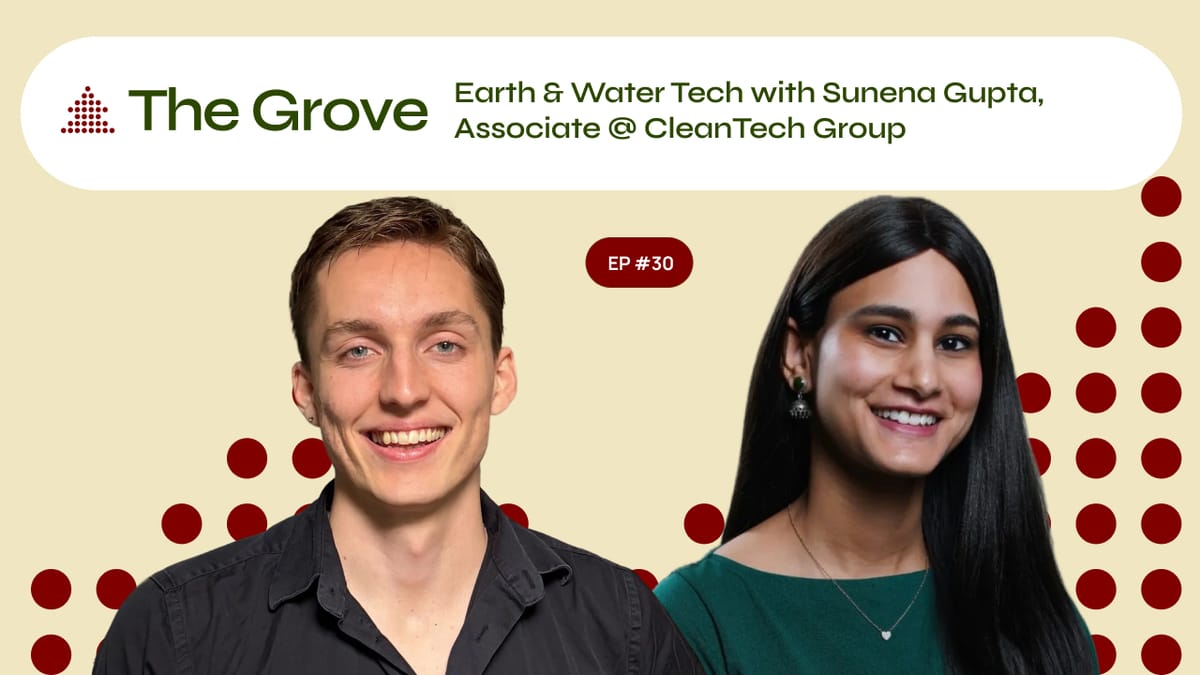
Just like the rest of us, Sunena Gupta can see. Unlike the rest of us, Sunena observes. It's only fitting that the industry she observes the most is about observation itself.
This is article 4 of 4 in a special series with Cleantech Group breaking down their research in the Global Cleantech 100 report. Full conversation on youtube and spotify
We're talking about Earth Observation (EO). Unlike grid modification or data centers, EO doesn't get as much mainstream press as it should. It is truly the basis of much of the cleantech space.
As for Sunena, she didn't grow up wanting to work in cleantech. Her father was in renewable energy finance for years & pushed solar books as a kid. She wasn't interested. It took a public policy degree, a master's program with a climate focus, and a series of fascinating conversations with founders and researchers before she found herself at Cleantech Group. Now, she covers one of the most technically complex corners of the climate economy.
Her coverage spans water, mineral exploration, infrastructure resilience, and the technology that underpins is all: Earth observation.
Sunena's map to understanding Earth observation breaks into two buckets.
Bucket 1: Data Acquisition
Data acquisition covers every technology that collects raw information about the physical world. Without this layer, there is nothing to analyze. It splits into two sub-buckets: satellites, which observe from distance at scale, and sensors, which report from inside specific environments at close range.
Satellites
- SAR (synthetic aperture radar): The workhorse of disaster monitoring. Works at night and sees through cloud cover, making it reliable when weather conditions would blind optical satellites entirely. The standard tool for flood detection and post-disaster damage assessment.
- Hyperspectral: reads the chemical composition of surfaces and subsurfaces by capturing light across hundreds of wavelengths simultaneously. Reveals what's underground without drilling. The primary sensing technology for mineral exploration.
- Thermal infrared: detects heat signatures invisible to standard imagery. Identifies fire formation, tracks wildfire progression, and monitors urban heat distribution. Catches what's happening before it becomes visible.
Sensors
- In-situ: physical instruments placed directly into specific environments: forests, rivers, agricultural fields, industrial facilities. Hyper-localized and decentralized. Where satellites observe broadly, in-situ sensors report precisely from inside the thing being monitored.
- Quantum gravimeters: detect extremely minor changes in gravitational fields to reveal subsurface composition without any physical contact or extraction. Cutting edge technology. The sensing category Sunena is most cautious about overstating, and most interested in watching.
Bucket 2: Data Analytics
Data analytics covers everything that happens after acquisition. Here, we analyze, interpret, and deliver a specific output to a specific end user. The insights become the basis for decisions that couldn't have been made otherwise. Two subbuckets: analysis and delivery.
- AI-driven analysis: the current standard for processing the volumes of data acquisition produces. Pattern recognition, anomaly detection, predictive modeling.
- Insight delivery: the final step in the chain. Converting processed data into outputs specific enough for an end user to act on.
EO's Evolution from Data to Insights
The two buckets used to be two separate businesses. Satellite companies collected data. Analytics companies bought it, processed it, and sold the insights. The handoff created friction, latency, and accountability gaps when the chain broke down.
That separation is collapsing. Satellite providers now build analytics capabilities in-house and analytics companies launch their own satellites. LiveEO, a data analytics firm, moved backward up the chain and began planning its own satellite constellation. The market is consolidating around end-to-end platforms because end users want answers fast. They don't care about raw imagery.
Sunena calls this the data-to-insight chain. Here's where it's heading: companies that control the full chain win. Companies that hand off at the midpoint get squeezed. The acquisitions happening in this space right now reflect that larger players are buying capability gaps rather than building them from scratch.
Each satellite type covers something different, as we saw earlier. They don't compete so much as address each other's blind spots, which is why use case matters more than technology type when evaluating companies in this space. For floods, SAR dominates. For mining exploration, hyperspectral. For wildfire detection, thermal or a combination.
Orora Tech operates in the thermal space, using heat detection as an early warning layer for fire risk before a fire becomes visible to standard optical imagery.
On the sensor side, Dryad places instruments directly into forests that detect smoke at ultra-early stages. They can identify wildfire formation well before satellite coverage catches it.
The same logic applies to water where in-situ sensors placed in rivers or water treatment facilities detect chemical changes and contamination in near real-time. The Chicago River now runs continuous sensors monitoring water quality, reporting what compounds are present, what the water can be used for, and what treatments it needs. What used to require periodic manual testing now reports continuously and automatically.
Quantum gravimeters sit at the far edge of this landscape. These instruments detect minute gravitational changes underground, revealing subsurface composition without any physical extraction. Sunena is careful not to overstate what they can do yet, but sensing what's beneath the surface without touching it could have huge impact. Some obvious implications are mineral exploration, infrastructure monitoring, and anything else where what's underground matters but digging to find out is expensive or destructive.
The through line: better sensing produces better data and better data produces better decisions. The specific technology is less important than how completely it closes the gap between observation and action for a specific use case.
Edge Computing in Disaster Response
Inside data acquisition, one development changes the architecture of the entire chain.
Traditionally, satellites collect raw imagery and transmit it to ground stations where processing happens. The latency in that transmission isn't palatable in a disaster scenario.
Edge computing moves the processing onto the satellite itself. The instrument collects data, analyzes it on board, and transmits finished insights rather than raw files: here is where the fire is, here is its current perimeter, here is its projected path in the next two hours.
Sunena calls this a future table stake. Right now it differentiates the companies deploying it. In a few years she expects it to be a baseline expectation from buyers.
The emergency response use case makes the logic undeniable: firefighters and rescue operations need to act in minutes. Dispatching resources based on insights that are forty minutes old in a fast-moving fire is a fundamentally losing.
The same logic extends well beyond disasters. Infrastructure operators monitoring the grid need to know about fault risk before the fault occurs. Agricultural companies tracking drought stress need soil moisture data current enough to affect irrigation decisions that day. Mining operations watching for slope instability need alerts early enough to evacuate. In every case the value of the insight degrades rapidly with time. Edge computing attacks that degradation at the source.
Here is where solution stacking enters the picture. Detection alone used to be the breakthrough. Sunena describes companies now moving past detection entirely into stacking suppression on top of monitoring, deploying autonomous drones that respond to confirmed fire signatures without waiting for human dispatch.
The bar for what counts as valuable in this market keeps moving. A few years ago detecting a wildfire early was groundbreaking. Now, Sunena says, to be groundbreaking you need to put it out.
Insurance Drives Climate Adaptation Tech
Now, who pays for Earth Observation?
Sunena identifies insurance as the backbone demand driver for adaptation technologies broadly. Insurers need to understand risk at granular geographic and asset levels to price it accurately, manage their exposure, and meet the regulatory requirements that govern how much capital they need to hold against potential claims.
Parametric insurance takes this further. Traditional insurance pays out after loss is assessed while parametric insurance pays when a predefined trigger occurs. For example, a flood reaching a certain depth, a wind event exceeding a specific threshold, or a wildfire crossing a defined perimeter.
The policy pays when the satellite or sensor confirms the event. No adjuster required. In regions where infrastructure damage makes traditional claims adjustment impractical, parametric insurance backed by data becomes the only viable mechanism for covering losses at all.
Beyond insurance, the demand picture connects to anyone managing assets exposed to weather hazards that grow less predictable every year. Sunena points to the LA wildfires specifically as the event that pulled this market into mainstream attention. They made visible what the technology could do at scale and made the economic case for investing in it impossible to dismiss.
The adaptation market didn't appear suddenly in 2025. Cleantech Group began tracking it as a distinct segment four or five years ago. What shifted last year was the inbound signal; investors and corporates arriving with basic questions about what adaptation technologies are, whether they're investable, and what applies to their specific exposure.
Why? The 1.5 degree goal is not going to be met. Mitigation technologies remain essential but are no longer sufficient as a sole focus. The world needs to adapt to conditions already in motion and the technologies enabling that adaptation are no longer niche or speculative.
The Close
What Sunena describes is a sensing layer being built underneath every critical system in the physical world.
- Satellites watch from above.
- Sensors report from within.
- Analytics convert signal into decisions.
- Edge computing compresses the gap between observation and action.
- And insurance, infrastructure, and industrial operators provide the economic demand.
The framework is a simple pair of buckets. Inside those buckets, though, is a technology landscape that touches wildfires in California, mineral deposits in Chile, river quality in Chicago, and flood risk on coastlines that didn't used to flood.
Sunena's hot take considers is integration. The best sensor paired with a weak analytics platform loses to a complete chain. A strong AI model running on commodity data loses to a company with a proprietary sensing technology no competitor can replicate.
AI itself, she argues, has crossed the threshold from differentiator to baseline requirement; if you don't have it, you don't have a business. What separates companies now is the data that feeds the model, which means the competitive advantage in Earth observation lives in how completely the layers connect and how exclusively a company controls the data flowing through them.
The companies doing this well identified where the chain was weakest and built something that closes it. The full sensing infrastructure won't assemble in a straight line, but it is assembling one innovation at a time.
To learn more about Cleantech Group's research on Earth observation, adaptation technologies, and the climate intelligence market, visit cleantech.com or reach out at research@cleantech.com. Follow their work on LinkedIn as they continue tracking the innovations building the sensing infrastructure the climate economy runs on.
Member discussion: