
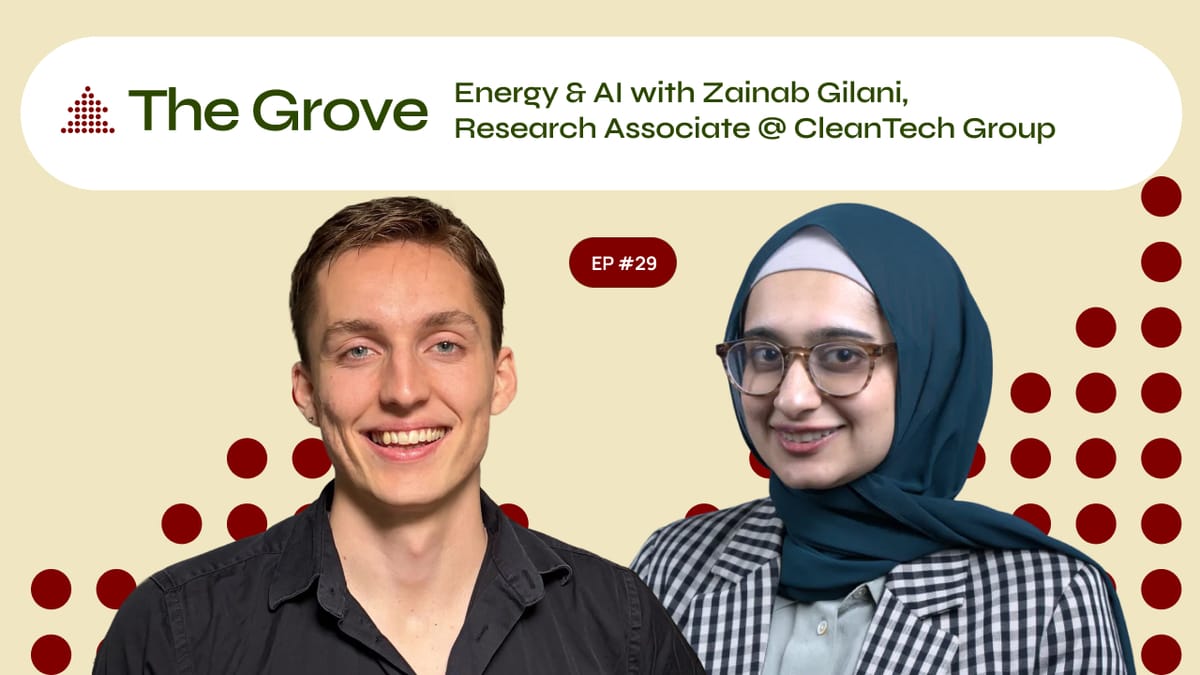
Do you feel lost sometimes in all the talk around the energy industry lately? I do. I need foundation. Luckily for me, and all of you, Zainab Gilani doesn't skip the foundation. In fact, she built it from scratch LIVE in our episode. What a treat.
This is article 3/4 in a special series with Cleantech Group breaking down their research in the Global Cleantech 100 report. Full conversation on youtube or spotify
As an energy and power associate at Cleantech Group, she tracks innovation across the full spectrum of generation, storage, and grid infrastructure. Her background is cool: she studied physics and English as an undergraduate, a combination exactly right for someone whose job is to translate technical reality into comprehension.
Zainab's framework helps us traverse the energy and power industry. It also helps us make sense of how we got here, what's happening now, and where we're going.
Shall we?
The Two End Uses
Before any of the buckets in our framework make sense, we should establish what energy systems try to accomplish. At the most fundamental level, energy serves two purposes:
Electricity: powers devices, manufacturing lines, data centers, electric vehicles, lights anywhere. You're familiar.
Heat: powers industrial processes like steel mills, cement plants, and district heating systems that require sustained high temperatures, often above 600–700 degrees Celsius.
Everything in this industry is about producing, moving, and/or storing one of those two things.
Bucket 1: Generation
Where electricity and heat get produced. The heat source vary between coal, gas, nuclear, or geothermal, but most electricity generation works the same way.
- Heat will turn water into steam
- steam spins a turbine
- and the turbine produces electrons.
Wind and solar skip the turbine entirely, converting kinetic energy and photons directly into electrons. Six subbuckets:
- Solar & Wind: The commercially mature workhorses of the clean energy transition, now accounting for roughly a third of the global electricity mix. Innovation here has largely shifted from the core technology to the systems that keep massive deployments running efficiently.
- Geothermal: Geothermal drills deep into the earth's crust to access superheated rock and water, brings that heat to the surface, and uses it to spin a turbine and generate electricity.
- Nuclear Fission & Small Modular Reactors (SMRs): Nuclear fission splits uranium atoms to release enormous amounts of heat & generating dense, continuous, carbon-free electricity. Small modular reactors apply that same process in a standardized, factory-built unit small enough to deploy where a traditional large-scale plant never could.
- Hydropower: Uses flowing water to spin turbines and generate electricity. Large dam projects carry heavy infrastructure and environmental costs, so the current innovation is in making hydro modular and deployable without those constraints.
- Wave & Tidal: Harnesses the kinetic energy of ocean movement to generate electricity. Technically viable for years but hasn't reached commercial deployment at scale, largely due to the cost and difficulty of operating in harsh marine environments.
- Fusion: Merging two hydrogen isotopes to release enormous amounts of clean energy, replicating the process that powers the sun. The furthest out on the timeline, but attracting serious and growing capital from both governments and the private sector globally.
Bucket 2: Grid Management
How we move generated electricity to end use. Traditional grid infrastructure was designed for steady, predictable generation from large centralized plants. As renewables introduce variability and data centers introduce massive new concentrated demand, the equipment managing that flow needs to become smarter.
- Transformers & Power Electronics: The systems that regulate voltage and manage power quality as electricity moves through the grid. As the mix of generation sources becomes more complex, static conventional transformers are giving way to programmable, intelligent systems that can actively respond to fluctuating inputs.
- Transmission: The physical infrastructure that carries electricity over long distances. Aging lines and limited capacity are a growing bottleneck, and materials innovation could dramatically expand what existing corridors can carry.
Bucket 3: Storage
Where energy goes between when it's produced and when it's needed. Solar and wind generate power on natural schedules outside of demand schedules. Storage bridges that gap.
- Thermal: Captures energy as heat in materials like molten salt, graphite bricks, or specialized ceramics that retain temperature for hours or days before releasing it. Particularly relevant for industrial applications that require sustained high heat rather than electricity.
- Electrochemical (Batteries): Storing energy in chemical form and converting it back to electricity on demand. The most commercially active storage category, with lithium-ion currently dominant. Multiple competing chemistries like sodium-ion, vanadium flow exist at various stages of maturity and commercial deployment.
- Residential & Virtual Power Plants (VPPs): Home-scale battery systems that function individually as energy bill management tools and collectively as distributed grid infrastructure. When networked together, they give grid operators access to meaningful storage capacity without building centralized facilities.
China and the Battery Race
The story of where generation and storage costs are today is mostly a story about China. Zainab returns to this thread across every bucket as the practical explanation for why cost curves look the way they do and why Western energy strategy is playing catch-up.
China deployed roughly 300 gigawatts of solar in a single year. That's against global deployment of around 370 gigawatts total. This is in addition to ~100 gigawatts of wind representing 60–70% of global capacity.
The battery chemistry story runs through the same playbook. Lithium-ion costs have fallen from ~$150 per kilowatt-hour in 2021–22 to ~$105/kWh for mobility and ~$70/kWh for stationary storage by 2025–26.
China's manufacturing scale is most responsible for these price changes. In response, innovators are looking to chemistry.
Zainab says to watch Sodium-ion batteries most closely: sodium is abundant and domestically available in most regions, manufacturing infrastructure largely overlaps with existing lithium-ion production, and the fire risk profile is more benign.
The tradeoff is energy density. Sodium-ion batteries are heavier per unit of stored energy, which creates real challenges for mobility applications but largely disappears for stationary storage where weight is irrelevant. China has already deployed one of the largest sodium-ion systems in the world and is actively developing sodium-ion for EVs, suggesting the energy density gap may be closable.
Vanadium flow batteries are the last one we discuss. They are well-suited for large-scale, long-duration stationary storage. Here's another chemistry where China's domestic resource advantages give it the same structural position as with lithium-ion.
The consequence runs through every bucket. The cost reductions China drove in solar, wind, and battery manufacturing are what made renewables competitive globally. The gap between their processing and manufacturing capability sits and Western domestic capacity is huge. Same as in Diana's recap of Critical Minerals, it's also the map of where the opportunity is strongest.
Data Centers & Demand
So, yes. Of course we covered data centers. It is everything making energy and the grid mainstream right now.
The IEA projects data centers could require between 800 and 1,200 terawatt-hours of power by 2030, figures comparable to the entire electricity consumption of medium-sized countries. That demand is landing on a grid designed for steady, predictable generation from large centralized plants. This differs greatly from the combination of variable renewable inputs and massive concentrated loads that data centers represent.
Arguably harder problems than innovating on the aging infrastructure are the fossil fuels filling that electric demand in the near term. Approximately 65% of new natural gas turbine orders are currently tied to data center demand.
In regions with available land and established permitting, like Texas, some operators are pairing with renewable developers. Google's partnership with TotalEnergies for solar procurement is a recent & positive example. Despite this, the near-term trajectory still runs more on gas than the industry's stated sustainability commitments would suggest.
Zainab's optimistic scenario is that data centers, because of their scale and sophistication as energy buyers, could become the anchor customers that early-stage technologies need to reach commercial viability. Whether that happens depends on procurement decisions being made right now, inside organizations simultaneously claiming net-zero commitments and signing long-term fossil fuel contracts.
Modularity and Superconductors
Zainab made sure to mention what happens when an industry finds its replicable model.
In nuclear, the historic failure of the US approach was treating every plant as a bespoke engineering problem. China found a reactor design that worked and replicated it until the process was routine.
Small modular reactors are the modern attempt to apply that logic in a Western context. Standardized designs that can be permitted, financed, and built without reinventing the process each time.
The same logic shows up in hydropower, where Aslan Renewables builds modular systems that bring hydro's reliability to contexts where a full dam project would never get permitted.
In geothermal, Quaise Energy's drilling breakthrough opens geothermal to the same standardize-and-replicate economics that made other generation technologies scalable.
Superconductors are where Zainab is realllyyyy excited. Conventional conductors lose energy to resistance as electrons push against the material. Superconductors eliminate that resistance entirely, enabling roughly ten times the power transfer capacity through the same physical infrastructure.
Veir is commercializing the cooling systems that make high-temperature superconductors practical outside laboratory conditions. What makes their position unusual is that three independent application domains all pull in the same direction.
- Fusion reactors require superconducting magnets to confine plasma, so as fusion scales it drives down superconducting material costs for every other application downstream.
- Long-distance transmission lines need dramatically more capacity to move renewable energy from where it's generated to where it's consumed without building entirely new corridors.
- Data centers are approaching the limits of conventional conductors inside the facilities themselves. As chip energy density rises, superconducting materials offer a direct path around the internal cabling bottleneck.
"If we have renewables in the middle of the country and we're trying to get energy to the coast, if we can improve the lines and the power flow capacity by ten times, that opens up a whole new world."
If any one of those curves accelerates, the others benefit. It's the same logic as modularity applied to materials: find the technology that sits at the intersection of multiple scaling forces and build there.
The Close
The energy transition isn't a single problem with a single solution. It's a system!
Generation feeds into grid management, grid management depends on storage, storage enables the generation mix to change.
Zainab offers a way of seeing how the pieces connect in order to make sense of our place now and predict where we're going. It's a vantage point from which things can make sense.
To learn more about CleanTech Group's research and intelligence on energy and power innovation, visit cleantechgroup.com or connect with Zainab Gilani directly on LinkedIn. Follow their progress as they continue tracking the technologies and companies reshaping the global energy system.
Member discussion: