
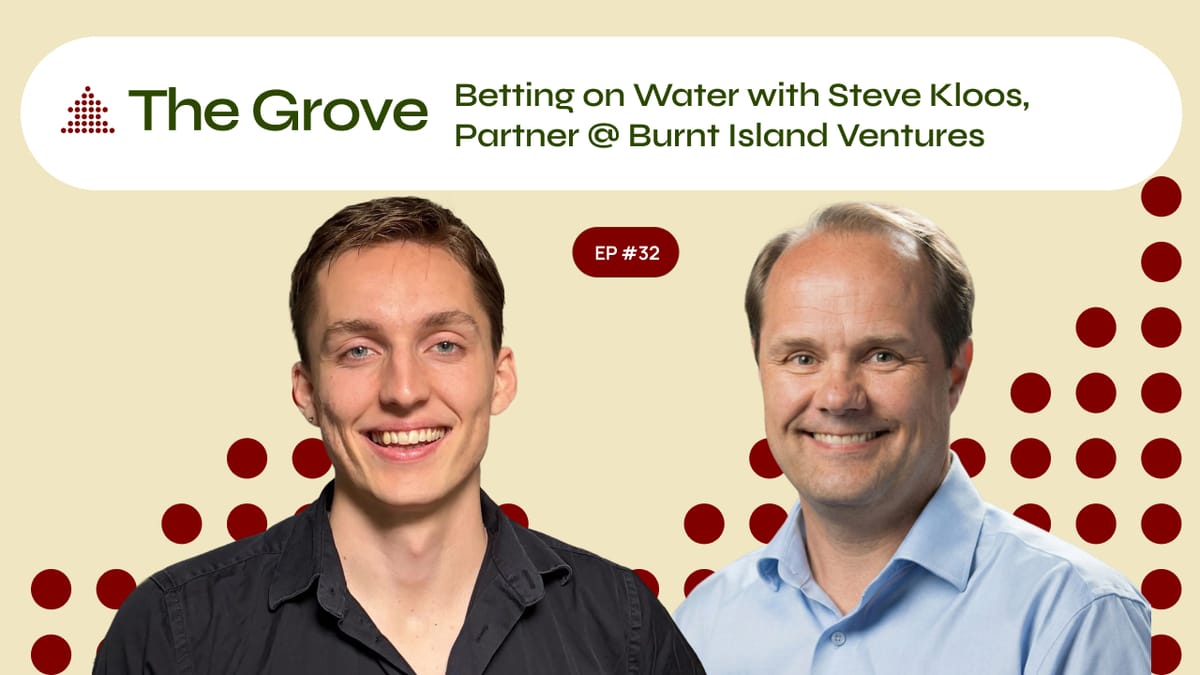
Steve Kloos is in water. The world is thankful.
Like many of these stories, Steve did not set out to spend his career in water. He only set out for a job and landed at Osmonics making membranes for water treatment and industrial separations.
One of their early applications was concentrating maple sap (classic Minnesota) using membranes to pull out enough water that you could finish the syrup with a fraction of the usual fuel. It was the beginning of a thirty-year education in how water touches everything.
Today Steve is a partner at Burn Island Ventures, one of the few dedicated water technology venture funds in the world. Along the way he ran R&D at GE Water after Osmonics was acquired, spent three and a half years in Shanghai, helped launch the Chicago Water nonprofit Current as its founding board chair, and worked as a partner at True North Venture Partners investing across the broader sustainability sector.
Water, he says, just kept pulling him back.
What he's built over those decades is a mental model for an industry that most people, even in climate tech, don't fully understand. Let's unpack carefully.
Water's hard to describe. It's Horizontal.
The first thing Steve does when someone asks him to explain water tech is reframe the question entirely.
"You're in commercial real estate? You're also in the water business. Food and beverage? Water business. Semiconductors? Water business."
The global water sector runs about $1.6 trillion a year in total annual spend — OPEX and CAPEX combined, across municipal, industrial, commercial, and consumer uses. That's roughly one and a half percent of global GDP. More importantly, water functions like energy: a foundational input the entire economy runs on. Almost every industrial process uses water as a cooling fluid, a cleaning agent, or a core part of production.
Steve & his portfolio draws the boundary of water tech at the terrestrial sector — drinking water supply, wastewater treatment, industrial water use, stormwater management, and the flood/drought risk that climate change amplifies at both ends of the spectrum simultaneously. Within that boundary, the map breaks into distinct subsectors, each with its own dynamics, buyers, and innovation needs.
Municipal water supply is where scarcity pressures are sharpest. Drought frequency and intensity are both increasing, which pushes water recycling, reuse, and desalination from expensive edge cases into mainstream infrastructure decisions.
Municipal wastewater is an infrastructure story as much as a technology one. In the US there are 800,000 miles of sewer pipe. In Europe, 1.5 million miles. Most of it was built after World War II and has been deteriorating ever since. The civil engineering grade on US water infrastructure is, as Steve puts it, "a D-minus." Utilities operate on thin margins with limited capital budgets, which means the most valuable innovation often is about smarter inspection and prioritization of where to spend repair dollars first.
Industrial water use is enormous and growing. As water becomes scarcer and rates rise, industrial users face strong economic pressure to get more efficient. Data centers are the most visible current example: hyperscalers now track Water Use Efficiency (WUE) alongside Power Use Efficiency (PUE) as a core operational metric. Many face genuine license-to-operate pressure from communities and regulators; but data centers are just the most prominent tip. Chip fabrication requires ultra-pure water, and purity requirements keep rising as transistor lines get thinner. Lithium and critical minerals processing is water-intensive. The new industrial economy carries a much larger water footprint than the one it's replacing.
Flood risk and insurance is where Steve draws the most unexpected connection. The majority of flood-related losses are uninsured. Extreme rainfall events are becoming more frequent and intense — one of the most predictable near-term consequences of continued emissions growth. Billion-dollar flood loss events have been rising exponentially. The gap between insured and uninsured loss is a massive market signal, and granular flood forecasting at the property level is the infrastructure that makes better insurance products possible.
Sensing and monitoring cuts across all of the above. Water treatment has historically been underloved on the instrumentation side and you can't optimize what you can't measure. A huge number of the most impactful companies in water are innovations in sensing and monitoring.
Water's WAKIN' UP!
Understanding where water tech is going requires understanding why it moved so slowly for so long.
When freshwater was abundant and cheap, economic pressure to innovate was limited. Utilities could draw from aquifers and rivers, run treatment through decades-old infrastructure, and deliver water at prices that left little room for new technology.
Water has historically been structurally underpriced relative to its actual value, and that suppressed the market pull that drives innovation in other sectors. The Clean Water Act established a regulatory floor after the Cuyahoga River caught fire in 1969, but regulation alone doesn't create technology markets.
Things are different now. The change is accelerating from several directions at once.
Climate is the most visible accelerant and operates at both ends of the water cycle. The same emissions trajectory that increases flood frequency also increases drought intensity. Regions that relied on predictable seasonal water availability are finding that predictability gone.
There's the infrastructure aging problem, which has been building for decades and is now arriving as a capital crisis. Treatment plants and pipe systems built in the postwar era are past their design lives. Utilities that operated on thin margins with limited capital budgets face replacement costs they can't easily absorb. Here's the opportunity.
There are the new demand drivers that simply weren't on the map twenty years ago. AI data centers, chip fabrication, battery manufacturing, critical minerals refining; the industrial infrastructure of the energy transition and the digital economy both run through water-intensive processes. The timing of these converging pressures is what makes this moment different from any previous period in the sector's history.
Tom Ferguson founded Burn Island Ventures after running the Imagine H2O accelerator and watching these forces converge in real time. As market dynamics shifted, he noticed that the quality of water startup founders was improving — better entrepreneurs were showing up with better ideas because the markets were finally opening up.
Burn Island started specifically to fund that cohort at the seed stage, where no dedicated water VC existed to do it. Five years later, Burn Island has launched a growth fund because the seed-stage companies from that early wave are now scaling.
Where's the Breakthrough Happening in Water
The sector map explains the opportunity. Where's the action happening?
Steve is straight up about hype cycles. PFAS is his clearest recent example. When US EPA and EU regulators put per/polyfluoroalkyl substance limits in place, many people expected an overnight explosion in advanced destruction technology demand. The real response was more gradual.
Activated carbon is an existing technology and handles a significant portion of the compliance load. The market for advanced PFAS destruction is real, but it's developing on a pragmatic timeline rather than a regulatory one. Steve sees echoes of earlier water sector hype cycles: ballast water treatment had a similar pattern when international shipping regulations came in.
Aquatic Labs, for example, built a chip-based sensor that continuously measures alkalinity without reagents (chemicals or titration). The founder, an MIT Woods Hole professor, built it specifically for ocean-based carbon dioxide removal: measuring alkalinity changes in seawater is how you verify that ocean co2 removal is actually working. That market, for both technical and political reasons, has been slow to materialize.
What the founder discovered was that the same chip solves a completely different and commercially active problem. Continuous alkalinity measurement is the missing variable in pool water chemistry management and cooling tower treatment.
The Langelier Saturation Index — a key indicator of whether water will corrode pipes or deposit scale — requires alkalinity to calculate, and there has been no way to measure it continuously online without reagents until now. That's the beachhead. The ocean carbon verification use case stays on the roadmap, but the company pivoted and now uses the revenue to get to that use case later.
The subsea desalination story shows the other side of breakthrough: what happens when physics works unexpectedly in your favor.
Conventional land-based seawater desalination is a series of engineering compromises:
- You spend tons of money and pass lots of regulation to intake water from the ocean, then treat it with chemicals to remove particulates.
- Then, you pressurize it to force it through reverse osmosis membranes, of which only about 40% converts to fresh water.
- The remaining 60% becomes concentrated brine, which goes back into the ocean along with treatment chemicals.
It uses substantial land, substantial energy, and the brine disposal carries real environmental consequences.
Take that same system and place it 500 meters below the ocean surface and the physics transforms. At that depth, natural water pressure already exceeds what reverse osmosis requires. You only need a suction pump on the permeate side handling the fraction of water being purified, rather than a high-pressure pump pushing the full feed volume on land.
Below the aphotic zone (around 120-150 meters, where sunlight can't reach), particulate levels, chlorophyll, and marine life all drop sharply. Pre-treatment requirements shrink accordingly. The brine that returns to the ocean disperses into water that's already cold and dense at depth, rather than sitting as a concentrated layer near the surface.
The result, in aggregate, is roughly 40% lower energy than a comparable land-based system and cheaper water at scale. Burn Island portfolio company Flocean — a Norwegian company built by engineers from the subsea oil and gas industry who know that operating environment cold — is constructing the world's first commercial subsea desalination plant right now at a major industrial facility in Norway.
How Burn Island Evaluates Founders
Steve evaluates water startups on two criteria before anything else: founder-market fit and entrepreneurial process.
Founder-market fit means the founding team has lived the problem they're solving. Beagle Services came from founders who understood the plumbing industry from inside. Sewer AI came from people who understood the specific inspection burden that cash-constrained utilities carry. When someone has genuinely lived a problem, their insight into the solution tends to be categorically different from someone who arrived at the market through research alone.
Entrepreneurial process is harder to describe but Steve is precise about what he looks for: intellectual honesty about what isn't working, clear thinking about where to focus limited resources, and a realistic picture of the path to the next funding milestone. "Once we write a check, it's already in the past," he says. What he's underwriting is the team's demonstrated ability to advance the company from where it stands now.
The fundraising environment for water startups is difficult. Investor capital for early-stage hard tech is tight across the board. Burn Island spends significant time helping portfolio companies sharpen their messaging and prepare for raises.
At the same time, the exit dynamics are strengthening: last year produced $7-8 billion in water sector M&A, well above what Burn Island had projected at the start of the year. Strategic acquirers and infrastructure investors are showing up in real numbers, which signals where sophisticated capital thinks the sector is heading.
The Close
Israel now recycles nearly 90% of its water and has reversed the pumps on the Sea of Galilee, refilling it with desalinated seawater. Singapore built water independence into its founding national strategy under Lee Kuan Yew. The Netherlands manages water as a core expression of national identity. These places took water seriously before the rest of the world had to and built the innovation ecosystems to match.
The rest of the world is catching up by necessity. The founders building solutions for this moment are, by Steve's account, the best cohort he's seen in thirty years of watching the sector.
To learn more about Burn Island Ventures' water technology investment strategy and portfolio, visit burnislandventures.com or reach out directly at steve@burnislandventures.com. Follow Steve's work on LinkedIn as Burn Island continues its mission to fund the most promising water technology startups shaping the future of the global water sector.
Member discussion: