
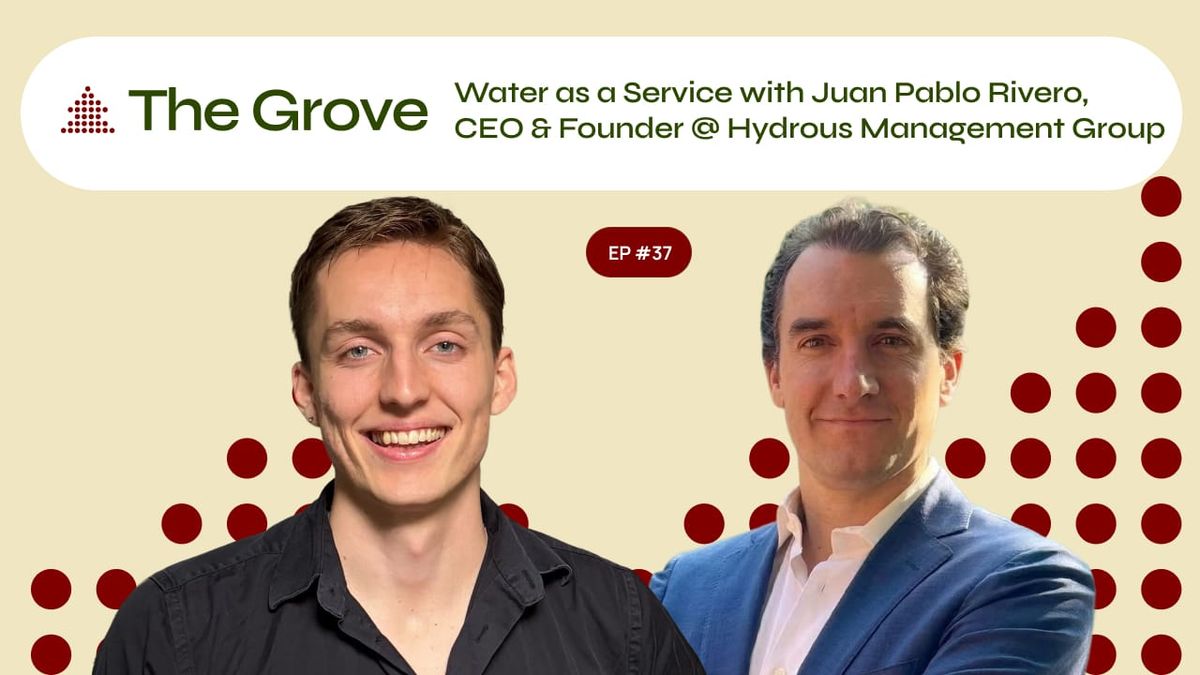
What was that? More content about wastewater innovation? We heard you and are here to deliver.
Juan Pablo Rivero's first company Ibima commercialized bioenzymes and bacteria that industrial facilities in Mexico could use to improve the performance of their existing wastewater treatment plants. Processes back then were so crude, JP said, that if you walked near a chile pepper manufacturing site your eyes would water. With the right microbial augmentation, those facilities could battle the air pollution that happened during busy seasons.
Fifteen years later, he's channeling that perspective into Hydrous Management Group, a Houston-based company that helps industrial and commercial facilities treat wastewater as a recoverable asset.
The concept is Water as a Service (WAAS). It's the same to how the solar industry restructured energy purchasing. Instead of a power purchase agreement, Hydrous offers a water purchase agreement: the company designs, finances, and installs decentralized water recycling equipment on a client's site & sells them back clean, specification-compliant water under a long-term contract.
The client reduces their reliance on external water sources, lowers their disposal costs, and gains a degree of insulation against the water stress that's clearly squeezing parts of the American Southwest and Mexico.
Sounds simple, right?
Centralized vs. Decentralized Treatment
The conventional model for treating wastewater at scale runs through centralized municipal systems. It's a proven model with legit economics of scale. Treating large volumes in one place drives down the cost per gallon significantly.
To get to that scale, though, costs allotttt of money. Moving water through hundreds of miles of aging pipeline is expensive to build and even more expensive to maintain. A significant slice of the $500 billion gap the U.S. faces in water infrastructure is the distribution network required to make centralized treatment work at regional scale.
Hydrous is building on the other side. Decentralized water recycling places treatment capacity directly at or near the point of use. A manufacturing facility, a commercial building, or mixed-use development each become a closed-loop system that utilizes its own wastewater. With the right build out, this system processes the water on-site and returns it to service for cooling, irrigation, toilet flushing, or process reuse, depending on the quality specification required.
"If you treat a very big amount of wastewater in a centralized facility, your operational cost per meter cube or per gallon is going to be much lower," Juan Pablo explains. "But if you go to a decentralized approach, you're going to save a lot of money on distribution...and you're going to increase the rates at which water is being recycled and reused."
Currently Hydrous targets industrial and commercial facilities where there's large volume and big need for processing. These facilities include oil and gas, mining, petrochemicals, automotive, food and beverage, aerospace.
Many of these places show up in our content about membrane fouling - industries where wastewater carries complex chemistry. For procedural or regulatory reasons, disposal costs run high and a day without water access could shut everything down.
Despite the many benefits, many jurisdictions haven't yet built the permitting infrastructure to make on-site reuse straightforward. That regulatory unevenness is part of why the U.S. lags behind places like Israel and Singapore in widespread application of these technologies.
Water as a Service Explained
The solar analogy really helped me understand what we meant by WAAS. Again, the power purchase agreement model transformed residential and commercial solar adoption by removing the capital barrier: a third party owns the panels, the customer buys the electricity. Hydrous applies the same logic to water recycling equipment.
- A facility signs a water purchase agreement
- Hydrous designs and finances the decentralized treatment system
- The client pays for water delivered at the required quality spec instead of equipment itself.
"The purpose of these projects for the end user, the investor, is financial," Juan Pablo says. "They're looking at this expecting a return on their investment. It needs to make financial sense. And then of course, it's sustainable. You lower the amount of water being used and create a new source."
The capital stack for Hydrous's target projects runs between $500,000 and $10 million in capital expenditure, though larger opportunities in oil and gas, mining, and semiconductors can run to $50 million or more.
Hydrous also builds a parallel proposition for investors: the ability to participate in water infrastructure projects at various scale points, with the stable, contract-backed return profile that long-term service agreements tend to generate.
It is interesting and beneficial to Hydrous' trajectory to look at this as so strictly financial. Whether financiers care about the environment or not, the returns on these projects are often good enough that they'll support them anyway.
"VC firms, they're getting involved in water more from a software or hardware standpoint," Juan Pablo notes. "For the infrastructure, centralized or decentralized, it's more like institutional money. They're not going to do the 10x exits they're looking for."
Not everything is so perfect
Juan Pablo's path to Hydrous isn't a clean founding story. He moved to Houston in 2019 because a passive investment he'd made in a Texas produced-water recycling facility. This was his first attempt at the Water as a Service model and it went sideways when the execution team underdelivered.
Rather than write off the investment & concept as a whole, he relocated and spent the next several years working to salvage it while advising on other water infrastructure projects in the region.
Staying with the theme, one of the most impactful results from that experience was learning how water finance operates in the U.S., what institutional investors look for, and where the gaps between promising technology and deployable projects actually live.
He tried to launch the Water as a Service concept in Mexico before the U.S. move, but the financing environment wouldn't take to it. Interest rates from Mexican banking institutions ran north of 15% in 2018 and 2019, and the technical staff at those institutions didn't have the background to underwrite the risk of a Water as a Service project. This is still a problem in the US, but the development is further along.
"A banking institution back then, and I still think today, doesn't have the technical capabilities to be able to understand the risk for a Water as a Service project," he says.
Juan Pablo faces a different version of that challenge in his first journey raising funding. Hydrous's track record runs fifteen years deep, but most of it lives in Mexico. U.S. institutional investors don't always know how to validate international operational history, even when the underlying engineering is universal, he says.
His response to the skeptics is that wastewater treatment physics don't change when you cross the border. The microbes, the chemical oxygen demand parameters, the filtration challenges are all different flavors of the same problems regardless of geography.
The Close
Entering the U.S. market also required a different kind of learning. Juan Pablo is candid about the adjustment: his early sales meetings in Texas ran the way meetings in Mexico typically do: forty minutes of relationship building, five minutes of business. His American counterparts grew visibly uncomfortable. The cultural gap cost him time and, probably, some early deals before he recalibrated.
"I lost some time trying to do business as if I was in Mexico being in the U.S.," he says. "It's very important to understand the culture and how business is conducted. Be aware of the process, methods, and the thinking of how people do business there."
This extends to Hydrous's go-to-market approach. Without the deep professional network he'd built over years in Mexico, Juan Pablo invested in automating the early sales workflow. He builds AI-assisted tooling that lets a potential client submit their water analytics and receive a project proposal showing how their wastewater problem becomes a financial opportunity. The goal is reducing friction at the top of the funnel while Hydrous is still establishing its name in a new market.
For Juan Pablo, the larger point is that water is a source of life and facilities in Mexico/the US Southwest can close their water loop, build resilience, and provide more stability to the communities that rely on them.
The job now for Hydrous is execution.
To learn more about Hydrous's decentralized water recycling and Water as a Service solutions, visit www.hydrosmgmt.com or contact Juan Pablo directly through the website. Follow Hydrous's progress on LinkedIn as they continue their mission to turn industrial wastewater into a recoverable, financially viable water source.
Member discussion: