

Heard Around The Grove
By Blake Newcomer • February 09, 2026
This week we saw two incredible guests with two starkly different roles in the Cleantech ecosystem.
Anthony DeOrsey runs the research team at Cleantech Group unlocking big picture perspective and connecting dots across industries.
Majid Hajibeigy is in the weeds (literally) at Canadian Pacifico Seaweeds helping farmers onsite and developing the seaweed industry for Canada + beyond.
A unique read this week takes us from both extremes. Stretching the brain in a good way :)
This issue is about building resilient business models, understanding clean tech's competitive cycles, and creating value through ecosystem coordination.
Let's dive in.
Was this email forwarded to you? Subscribe here!
Business Models That Weather Policy Shifts
A common narrative I hear is that the current administration's teardown of cleantech policy is filtering out the businesses with weak economics.
Anthony said yes and no: it's accelerating a reckoning that was already underway. CleanTech Group's research shows that while 2021-2022 saw investment spikes driven by zero interest rates and net-zero signals, the real story is a 4X increase in venture capital over the past decade when you remove those aberration years.
What separates companies that thrive? It comes down to whether they built for subsidies or built for markets.
Some technologies were "hitting an economic wall prior to the removal of those tax credits." Areas like carbon removal and hydrogen were struggling with market fundamentals before policy changed – voluntary carbon markets faced scandals, hydrogen struggled to penetrate new applications even with incentives, and project cancellations signaled economic headwinds independent of government support.
The companies navigating this successfully share common approaches.
Clean Tech Trends with Anthony DeOrsey, Research Manager @ CleanTech Group Anthony explains why clean tech is better understood as a theme rather than a single industry, introduces the “grow, flow, slow” framework, the global push toward electrification and energy security, and how supply chains for critical minerals and batteries have been shaped by international competition.
Clean Tech's Competitive Pressure Cooking Effect
Anthony also outlined a "pressure cooker" effect: two powerful thematics pulling talent, capital, and attention while everything else faces increased friction from inflation, geopolitics, and tariff uncertainty.
The first thematic is the race to own AI infrastructure, now overlapping heavily with national security arguments. This encompasses fission, fusion, and enhanced geothermal for clean baseload power to data centers; modular power solutions bringing electricity to site; energy-efficient chips optimized for inference; and everything from cooling technologies to waste heat recovery systems.
The second thematic is the emerging nexus between clean tech and national security, particularly around critical minerals. Technologies gaining traction include rare earth processing, lithium refining, copper extraction, and AI-powered mining solutions. Companies previously focused on battery recycling are pivoting to rare earth extraction. Steel tailings treatment companies are repositioning for critical minerals.
The implication for founders is if you're in the outer grow ring (listen about CTG grow/flow/slow framework on the episode), your challenge isn't demand – it's differentiation in an increasingly crowded field. Companies are getting funded at seed stage for AI data center management software weekly. The question becomes: what makes your approach defensible when fifty other teams are attacking the same problem?
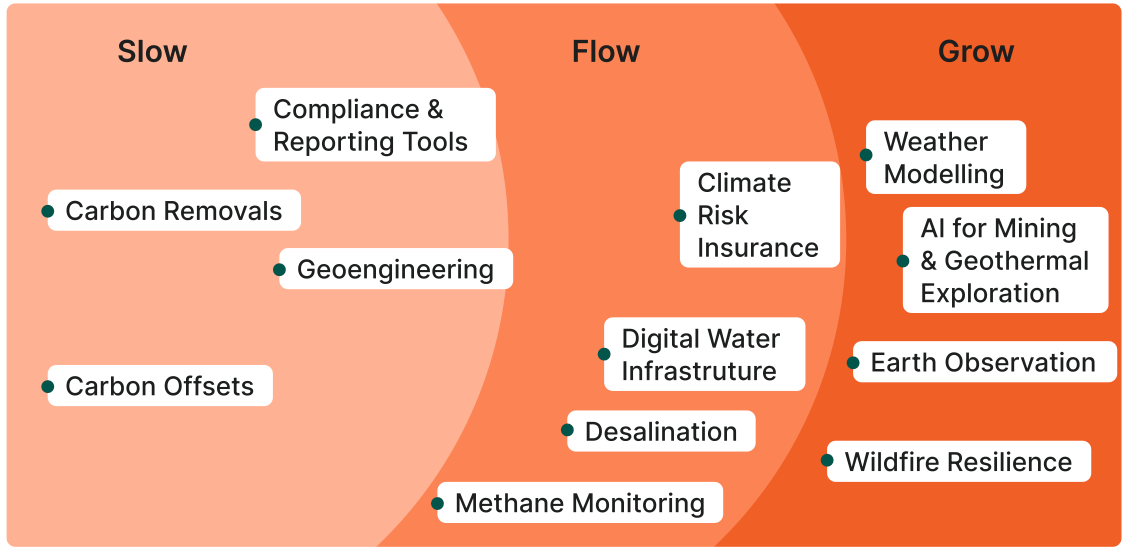
If you're in the flow or slow rings, your challenge is patience and capital efficiency. Enhanced geothermal was "great for the 2030s" six years ago and is now seeing companies file for IPO. Nuclear fission went from indignation ("that's not pure clean tech") to full force adoption. The timeline just stretched.
Anthony's observation cuts to the core: "This is a space that frankly rewards patience, but it requires a lot of patience." The gradual-then-all-at-once pattern repeats across clean tech. Position accordingly.
Creating Value Through Ecosystem Coordination
Now Majid's mission is something I resonate with. The Grove's whole mission is to catalyze connective tissue across a large network. On our episode, he spoke about watching new entrants to the seaweed space repeatedly try to vertically integrate everything themselves – growing seed, farming, processing, product development. Each one burned out before reaching scale. The pattern was clear: the technology existed, the biology was understood, but the system was broken.
Kelp Economy with Majid Hajibeigy, Ecopreneur @ Canadian Pacifico Seaweeds Majid explains why kelp is considered a keystone species in marine ecosystems, how sustainable kelp ranching can support both environmental restoration and viable business models, the cyclical challenges and opportunities in the kelp market, and the importance of biodiversity for climate resilience.
Therein lied the calling: become the networker. Connect seed producers with farmers. Link farmers with processors. Bridge processors with product manufacturers. Build the infrastructure that allows specialization instead of forcing everyone to do everything.

As a storyteller, the way his journey unraveled is quite pleasing to me:
- Year one: setting up farms and showing others how to run infrastructure.
- Year two: bringing in shared processing equipment so multiple farmers could access dryers without individual capital investment.
- Year three: developing products because farmers couldn't sell raw kelp – bakers needed flour, skincare manufacturers needed gel extracts.
- By year four, his founders got him to stop working in the business, start working on the business. The value wasn't in doing each piece better – it was in ensuring all the pieces connected properly.
Majid's philosophy on for-profit conservation captures it: "If marine biologists were making more, if ecologists were making more, then they could focus on that important work more." Build businesses that support people while supporting the planet. The economic pillar isn't separate from environmental and social pillars – it enables them.
For founders evaluating opportunities: sometimes the highest leverage point isn't building a better mousetrap. It's building the distribution system that gets all the mousetraps to market.
The Inosculation
Anthony's theme of AI infrastructure encapsulates Vik's opportunity clearly. Vik outlined repeatedly how long he had to wait for the market to catch up to his technology.
Majid's ecosystem coordination approach reminds me very much of my conversation with Agabas about AppCyclers. Battery recycling needs logistics networks and that's what they're laying. Basic infrastructure for an industry to be connected.
The founders who succeed aren't always the ones with the most elegant technology – they're the ones who understand their place in the value chain and build the connections that make the whole system functional. Nili Persits conversation comes to mind.
From some perspectives, cleantech is entering a mature phase where the winners are the builders who understand this is a decades-long transformation, not a quarterly sprint.
This Week's Playbook: Ecosystem Coordination
For the sake of encouraging more ecosystem building. Here's a framework inspired by how Majid did it.
- Start with hands-on credibility, then identify shared bottlenecks. Majid spent years setting up farms and processing equipment before recognizing the burnout pattern. When you see the same operational problems appearing across multiple players, that's a systems opportunity, not a technology gap.
- Build for the three-pillar sustainability test: environmental, social, economic. His insight on kelp ranching vs. kelp farming captures this—ranching (trimming wild beds with small boats) beats farming (ropes harvested by big companies) because it supports natural ecosystems, distributes income to local communities, and works economically without subsidies. If your coordination model fails any pillar, it won't scale sustainably.
- Transition from operations to orchestration by working on the business, not in it. After three years of doing everything hands-on, Majid stepped back to focus on connecting specialized nodes rather than being all the nodes. The value wasn't in processing kelp better—it was in ensuring flour got to bakers and gel extracts got to skincare manufacturers. In emerging industries, coordination often creates more value than optimization.
Resources
Fun pictures of Majid's successes
Cleantech Group's Global 100 report we mentioned
Legit moves by the NFL for sustainablity or distraction?
Feedback
Have any thoughts about what you'd like to see? Let's build together
Roundtables
Curated, pitch-free roundtables that spark real collaboration between and your prospects. GTM solution for long and complex sales cycles.
Cohort-based event series
Small groups (10-15 people) + industry expert speakers + 4-5 targeted sessions = accelerated career development. Want to participate or present? Reply to this email.
Podcast Guests
Would you or anyone you know like to be a guest on The Grove? Reply to this email to get the conversation started.
With love, Blake
See you next week!
Member discussion: