
Daniel Russek said "nah" to a regular job. Like anyone that gets what they wish for, what he got instead was nearly two decades building a biotech company that revolutionizes shrimp. One of the messiest, most ecologically fraught industries on the planet.
Today, Daniel runs Atarraya, a company working to solve what he describes as "everything that is wrong with shrimp farming."
Why care about Shrimp? Most shrimp farming happens in the tropics, where Mangroves live. Unsustainable shrimp farming kills mangroves.
I see. So, why care about mangroves then? Daniel describes mangroves as "the nursery of the ocean".
Mangroves: Ocean's Nursery
In 2009, Daniel was running an NGO focused on economic development in fishing communities along Mexico's South Pacific coast. The work had grown from post-hurricane relief into microfinance aquaculture support and the team was about to approve a significant shrimp farming expansion into the rainforests of Oaxaca.
Julia Carabias — the former Mexican Minister for Environmental Protection and the woman who wrote Mexico's current ecological management law — sat on the board. She stayed quiet through the entire meeting about the expansion. Right as the vote was about to happen, she stopped the room:
"Who among these people is going to be happy being the assholes that will bring this destructive industry to the pristine rainforests of Oaxaca?"
The project didn't get approved. Daniel's trajectory changed entirely.
What Carabias laid out that day was damning. Conventional shrimp farms discharge antibiotics, organic waste, even insecticides into surrounding waterways. But the deeper problem is land.
Shrimp farming has driven more than 50% of global mangrove forest loss. That matters far beyond the ecosystem itself. Mangroves are the nurseries of the ocean. They sit at the intersection of coastlines and lagoons, they're breeding grounds for marine life, and are storm buffers for coastal communities. Per acre, they sequester carbon at five times the rate of any inland ecosystem on earth.
Daniel left that meeting with a new problem worth solving. Carabias pointed him toward academia + innovation and he ran with it. His question became: what would shrimp farming look like if it worked with marine biology instead of against it?
The NGO era was over. The biotech era had begun.
Aquaculture's Nitrogen Challenge
From 2009 to 2012, Atarraya explored a multi-trophic system. These farms combine marine fish, tilapia, and shrimp in layered food chains that mirrored natural ecosystems.
The first patent covered a three-species system. The economics looked promising until a truth was uncovered: mastering one species' reproductive biology is hard enough. Mastering three simultaneously, across completely different seasonal cues, lunar cycles, and salinity triggers, was a compounding nightmare.
They chose shrimp, the most commercially liquid of the three (David says "I can walk through Mexico City with a kilogram of shrimp and sell it immediately"), and committed.
The farm that emerged relied on a technique called biofloc.
Shrimp excrete ammonia constantly. In conventional systems, that ammonia buildup becomes toxic and farmers flush it out with water exchanges, sending a chemical soup into surrounding waterways. Biofloc instead cultivates specific bacterial communities that convert the ammonia through a two-stage nitrogen cycle: one set of bacteria converts ammonia into nitrite, another converts nitrite into nitrate.
Nitrate is roughly 300 times less toxic per mole of nitrogen before hitting dangerous concentrations. The system closes the loop & creates a functioning microbial ecosystem inside the farm.
The challenge is that each stage of the nitrogen cycle introduces new technical problems. Getting it right at commercial scale took years of iteration measured not in software sprints but in shrimp biology: four months per grow cycle, each population teaching them something new.
By the time Atarraya built its Oaxaca farm, they'd reached 60 to 80 tons per hectare. Conventional shrimp farming yields 1.4 to 5 tons per hectare. The gap was enormous, but conventional farmers weren't interested. They were profitable with existing methods, so why would they change growing methods?.
Daniel spent years trying to license or partner the technology across Ecuador, Mexico, Guatemala, and the Philippines. Farmers kept saying the same thing: "Yeah, but you're not making money. We are. So shut up."
That rejection forced a more interesting insight. Ninety percent of shrimp consumed in the United States comes from abroad, because American regulations prevent farms from dumping pollution into coastal waters; aka exactly what traditional shrimp farming requires.
Atarraya's closed-loop system, by contrast, works anywhere. A parking lot in New Jersey. A warehouse near Manhattan. The regulatory barrier that locked out conventional aquaculture was the very thing that made Atarraya's technology a competitive advantage on the world's largest shrimp market.
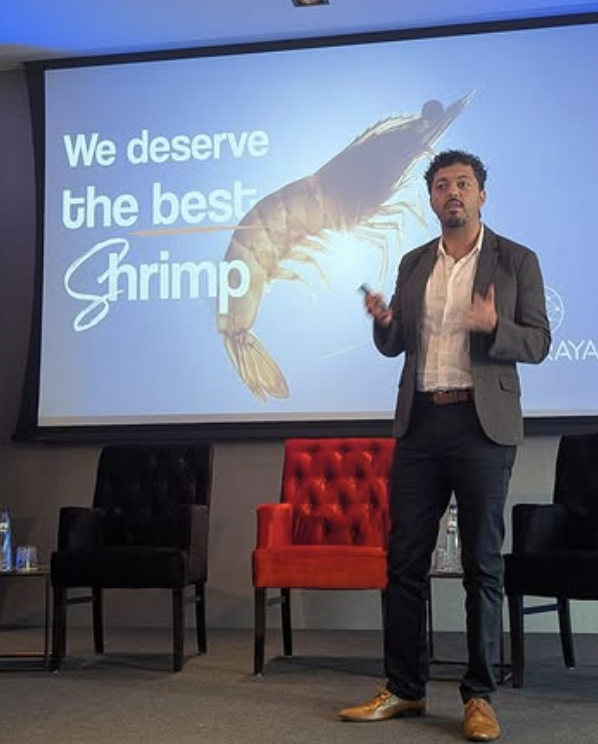
The shrimp box concept — a hyper-modular, indoor farming unit — was born from a dinner conversation with a Harvard physicist at the Boston Seafood Show. He wanted live shrimp in the city, but thought it impossible. Daniel said it was possible. The physicist pushed back on the energy density assumptions. They ended up at the physicist's house, eating shrimp with organic wine, sketching out what a system designed for the American market would actually need to look like.
By 2022, Atarraya's Indianapolis farm hit 120 tons per hectare. The target they needed for profitability was 160. They hit that in late 2024. By 2025, they'd reached 240 tons per hectare — a number that makes urban shrimp farming economically viable nearly anywhere on earth.
The crises along the way, Daniel notes, were never biological. "The crises are more ape-borne than crustacean-borne." Investors calibrated to software company timelines struggled with a business where learning happens at the pace of shrimp reproduction. Managing those expectations proved harder than managing nitrogen cycles.
Pivoting to Master Franchise Model
When the funding environment tightened after 2021, Atarraya faced a problem that many climate tech hardware companies know well: capital-intensive industries and risk-averse venture markets don't pair naturally.
Daniel's response was to restructure the entire go-to-market model. Instead of owning farms, Atarraya licenses its system. Instead of raising capital to deploy infrastructure, it builds master franchise relationships with partners who already have land, distribution, and market relationships. Scalable in a way that doesn't require Atarraya to be the balance sheet behind every farm.
The most interesting version of this pivot is where it's pointing. Many of Atarraya's current partnerships involve tomato producers. The connection is weirder and more compelling than it sounds.
A hectare of tomatoes in a good year generates around $150,000. Add a shrimp system to that same land, using infrastructure the tomato producer already has, and the revenue potential jumps to $500,000 per hectare.
The real value is the biofloc itself. The microbial community Atarraya cultivates in its shrimp water can be applied directly to tomato soil, functioning better than synthetic fertilizer. It's transplanting a living microbial ecosystem from water to soil, where it keeps working. Clean shrimp and regenerative tomatoes from the same footprint, the same infrastructure, the same operation.
A pilot farm breaks ground in Abu Dhabi this summer through a partnership with a sovereign wealth fund whose explicit mission is UAE food security. The UAE was the first country in the world to create a Ministry of Food Security. If the pilot succeeds, Atarraya moves into a deployment targeting 5% of UAE national shrimp demand.
The leads for this deal came from a LinkedIn video featuring Bruce Lee. For real.
Atarraya's creative content strategy — deliberately unconventional, technically grounded — generates meaningful inbound from serious partners. Spain, the UK, Canada, and the UAE are all now in conversation.
The Close
Daniel Russek spent seventeen years turning a community development NGO into a biotech company, navigating cartel threats, investor mismatches, biology's stubborn timelines, and the fundamental absurdity of trying to sell clean innovation to an industry that didn't want to be disrupted.
What he built at the end of that road is a system that produces shrimp at fifty times the yield of conventional farming, in closed-loop facilities that can operate next to a city, that turns waste into fertilizer, and that's beginning to attract the kind of global partners that can actually scale it.
The mangroves are still disappearing. But there's now at least one commercially viable reason not to need them for shrimp.
To learn more about Atarraya's closed-loop aquaculture technology, visit atarraya.co or connect with Daniel Russek directly on LinkedIn. Follow their progress as they continue their mission to make clean, sustainable shrimp farming profitable anywhere in the world.
Member discussion: