
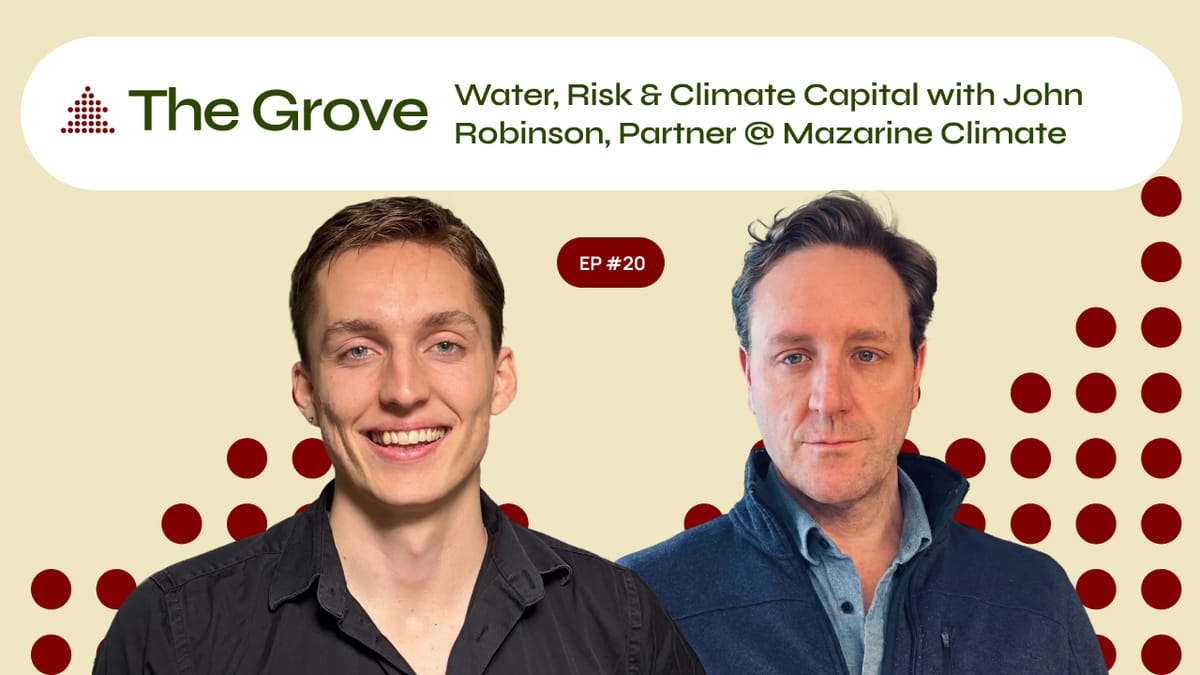
"Everyone knows what a carbon footprint is," John Robinson tells me, "Turn the lights off, use less fuel—carbon footprint. Got it. But water footprint?" He pauses.
You can watch the full episode on spotify or youtube
After 17 years in the water and wastewater industry, John runs Mazarine Capital. The firm is a climate adaptation fund that views the world's mounting environmental challenges specifically through the lens of water risk. The turning point happened while living in China years ago. Compromised air and water forced him to confront environmental risks that most of us never have to think about.
"I was working in commercial real estate then, and I didn't know what to do with that insight or that passion," John explains.
What makes John's conversation valuable is how he bridges the gap between water's immediate, tangible reality and its vast, often invisible influence on life. As climate adaptation moves from theoretical concern to urgent imperative, dialogue like this is what will drive solutions.
Water's Two-Headed Monster
Water innovation's biggest challenge is deceptive familiarity. "People think they know water because they interact with it every day," John explains, but that direct interaction represents only about a fifth of our actual water use.
John learned this the hard way during his consultancy years, helping water technology companies understand communication with customers. "Power plants use water. So every time you switch on the lights and run your HVAC, that's pulling water. Every time you turn the light switch, that's a water decision."
So are they in the water industry, too?
This abstraction creates what John calls water's "two-headed monster"—the dual nature of being simultaneously essential and invisible. Energy companies, supply chain managers, agricultural purveyors are managing massive water risks that don't appear on any sustainability report.
"The cow drinking water isn't the water footprint," John continues, "It's the water put on the soy and the corn that the cow ate. You eat a cheeseburger, that's about a thousand gallons of water. You eat a steak, that's about 3,000 gallons." This is the other 4/5s of the equation.
For Mazarine Capital, this complexity is an investment opportunity to recognize. Companies that can help other businesses understand and manage their virtual water footprint are positioned to capture value from a market that most people don't even know exists yet.
Water: The Protagonist and Antagonist
"Living in China for so many years, one becomes aware of environmental and health related risks relating to air and water and food," he reflects. "The air looks bad, but the water's probably bad too. How do I test it, monitor it?"
In this way, water is both life-sustaining necessity and potential health threat. If we zoom out and look at the typical daily relationship to water, our behavior doesn't adequately respect this truth.
"The city that you're buying water from will tell you their water's compliant. It probably is at the plant, but by the time it gets to your house, there are no guarantees," John explains. This infrastructure gap between centralized treatment and point-of-use quality represents a kind of market opportunity that Mazarine Capital targets.
Water's role as both protagonist and antagonist extends far beyond individual health decisions. In John's portfolio, companies are tackling water challenges that range from too little (drought, scarcity, contamination) to too much (flooding, infrastructure overwhelm, climate migration). Each company in their Fund One portfolio addresses a different aspect:
- sensors that monitor water quality in real-time
- pumps that manage flood response
- membranes that turn wastewater into drinking water
- valves that prevent catastrophic infrastructure failures
"We invested in 15 companies. All of them were young and now they're growing. One has been acquired, another had a liquidity event," John notes. Good for the firm, yes, but also indicator of a societal shift to awareness.
The companies that succeed in John's portfolio share a common characteristic: they help customers navigate water's complexity without requiring those customers to become water experts themselves.
The Too Much Water Problem
The conversation takes a practical turn when John addresses what he calls "the too much water problem". This challenge that becomes increasingly relevant as...you know...climate change.
Our reptilian brain, as John references, is always fixated on the scarcity. 'What is it we don't or won't have enough of? How can we mitigate that?'
In areas most affected by intense change of precipitation, traditional approaches are suddenly rendered inadequate. Ex: too much water overwhelms storm management systems designed for historical rainfall patterns.
For Mazarine Capital, the "too much water problem" is an underutilized perspective. Infrastructure needs to adapt to excess water as much as scarcity of water, but takes a long time to do so. Companies positioned to accelerate resiliency or communication of the state of water will win out.
Beyond the Water Footprint
"Test your tap water," John concludes. (And use MyTapScore.)
This recommendation captures John's approach to both investing and water management: start with what you can measure and control, then build from there.
Most people will never master the complexity of virtual water footprints or infrastructure adaptation planning, but everyone can understand their tap water quality and act on that information.
The broader implication for climate tech investors and entrepreneurs is equally straightforward: successful climate adaptation companies help customers take concrete action on specific problems. The companies in Mazarine Capital's portfolio that have achieved exits didn't try to solve water risk holistically—they solved specific water problems for specific customers in ways that created measurable value.
"I don't expect most people to ever really understand all the nuances of water," John acknowledges. "They're gonna focus on cryptocurrency and driverless cars and their favorite sports team and their checking accounts running down—things that are more immediate." But for investors and entrepreneurs working on climate adaptation, this reality creates opportunity rather than obstacle. The market need for water risk solutions will only grow as climate impacts intensify, regardless of whether end customers fully understand the complexity underlying those solutions.
John's journey from commercial real estate professional to water technology consultant to climate adaptation investor illustrates how expertise develops through direct engagement with real problems, not abstract theorizing. His success with Mazarine Capital reflects this practical approach: back companies that solve specific problems for specific customers, build reference cases that demonstrate value, then scale solutions that prove their worth in real-world conditions.
As climate adaptation moves from environmental aspiration to business necessity, investors like John who understand both the technical complexity and the market reality of water risk will play increasingly important roles in directing capital toward solutions that actually work.
To learn more about Mazarine Capital's climate adaptation investment approach, visit their LinkedIn page or contact John Robinson directly through LinkedIn. Follow their progress as they continue their mission to back early-stage companies developing technology solutions that help customers manage water risk in an era of climate change.
Member discussion: