
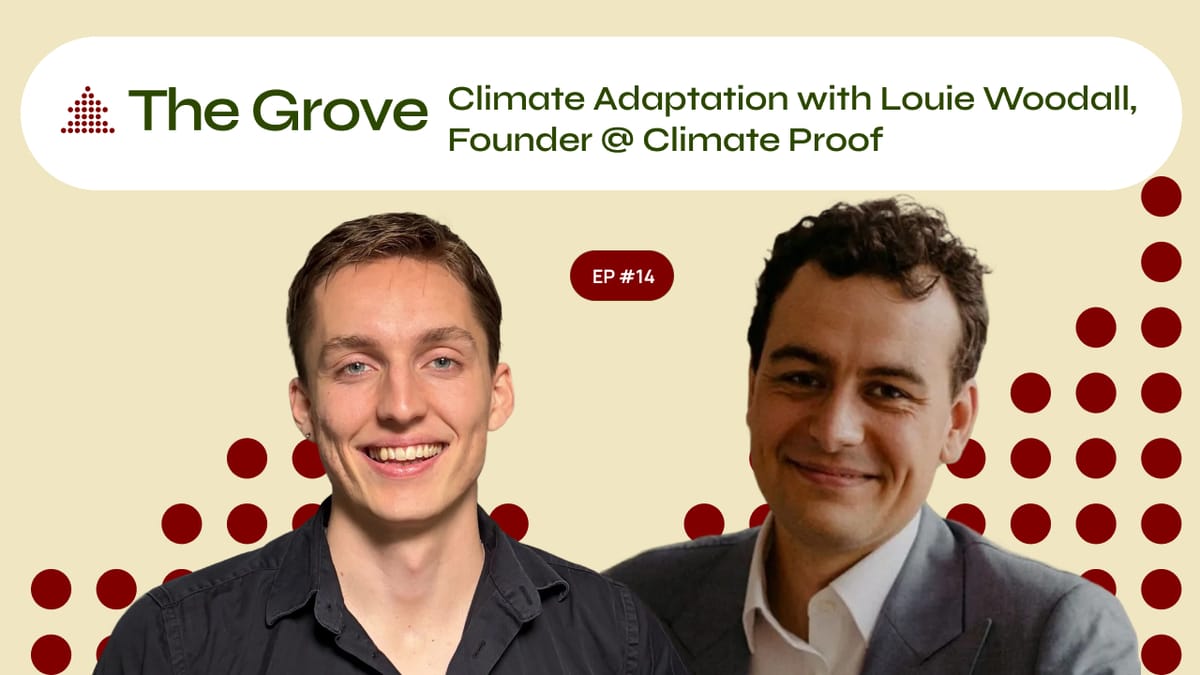
The notification came through at 2:30 AM—another catastrophic wildfire in Los Angeles. This followed Hurricane Helene's devastation, the European floods, and Southeast Asian typhoons. For most of us, it's breaking news. For Louie Woodall & Climate Proof, it's validation of a thesis he's been building for years: we need a different perspective on a familiar problem.
"If global warming is the inconvenient truth," Louie says, settling his French Bulldog Gimli onto his lap during our conversation, "then climate adaptation is the unavoidable reality we're in right now. But it seems to be a reality we are choosing not to look at directly."
This observation drives everything Louie does through Climate Proof—a newsletter, podcast, and data platform focused exclusively on how businesses, governments, and communities are preparing for climate impacts that are already locked in. While the climate world obsesses over mitigation strategies, Louie has built his entire professional identity around a more uncomfortable truth: even if we stopped all fossil fuel emissions today, the warming gases already in our atmosphere will continue creating disasters for the next two decades.
It's a perspective that puts him at odds with much of climate media, and it's exactly where he wants to be. Through Gimli's occasional wandering and settling, Louie explains why adaptation isn't just overlooked—it's essential for anyone serious about the future of business and society.
Adaptation vs Resilience: A Common Definition
The first challenge Louie faced wasn't technical or financial—it was linguistic. In a field where policy makers, investors, and entrepreneurs speak different languages, the basic vocabulary around adaptation creates confusion that undermines real progress.
"We've been stuck in the last year or so on definitions and taxonomies of what is and what isn't adaptation," Louie explains. This definitional paralysis is a business problem. "When you have different groups defining adaptation and resilience differently, you can't build coherent strategies or allocate capital effectively."
The distinction matters because resilience often focuses on bouncing back from specific events—rebuilding after a hurricane, recovering from a flood. Adaptation, in Louie's framework, means fundamentally changing how systems operate to account for new climate realities. It's the difference between building stronger levees and relocating entire communities away from flood zones.
This definitional work became crucial when Louie realized that professional audiences—financial analysts at McKinsey, risk officers at investment houses, sustainability leaders at major corporations—needed a common language to evaluate adaptation investments. "A lot of my audience are financial professionals who need to understand not just what these companies do, but how their solutions fit into broader adaptation strategies."
The stakes of this linguistic precision became clear when Louie started tracking how companies describe climate risks in their own sectors. Without consistent definitions, adaptation becomes whatever companies want it to mean. "You'll have organizations that might have their own biases take on adaptation because it's the hot thing for a few minutes and then drop it again."
For Louie, clear definitions shield adaptation progress from interests that don't have society's best outcomes in mind. He's particularly concerned about fossil fuel entities that might frame adaptation as an alternative to emissions reduction rather than a necessary complement.
This definitional precision drives much of Climate Proof's value. Subscribers don't just get news about adaptation technologies; they get frameworks for understanding how different approaches fit together, how to evaluate their effectiveness, and how to communicate their importance to decision makers who control investment and policy.
Climate Adaptation: A New Theme
Louie's focus on adaptation emerged from his feeling that the climate conversation was missing its biggest story. Coming from a financial journalism background at University of London and experience at both established companies and venture-backed startups, he understood how narrative shapes everything from investment flows to policy priorities.
"There's a lot of focus in climate media, in climate policy on mitigation," he notes. "And that's really, really important. But the sad truth is that even if we cut out all fossil fuel usage today, the amount of warming gases in the atmosphere today are going to create impacts that will continue for the next 10, 20 years."
This realization hit him while working in traditional media and startup environments. At a medium-sized company, he experienced the comfort of stable revenue but felt constrained by predictable career ladders. Moving to a startup taught him that "everybody's kind of making it up as they go along"—there's no secret formula, just good ideas executed well with hard work.
That startup experience gave him confidence to build Climate Proof, but it also shaped how he thinks about the adaptation market. Like any emerging sector, adaptation lacks established playbooks. Companies are building solutions to immediate problems—water risks, wildfire threats, extreme weather preparation—without necessarily positioning themselves within a larger adaptation framework.
"You're seeing a lot of companies who are maybe not saying explicitly that they're adaptation companies, but they're dealing with water risks, they're dealing with wildfire risks. They're creating solutions to real problems today rather than problems that might happen 10 years from now."
This creates both opportunity and responsibility for Climate Proof. Louie sees his role as connecting these scattered solutions into a coherent narrative that helps investors, policy makers, and potential customers understand the broader transformation happening across industries.
The challenge is that adaptation doesn't have the clear technological pathways that make mitigation easier to communicate. Solar panels and wind turbines are straightforward stories. Adaptation encompasses everything from new insurance models to urban planning software to agricultural monitoring systems to flood prediction algorithms. Each serves different stakeholders with different risk profiles and different success metrics.
Building Climate Proof meant creating content that serves multiple audiences simultaneously—risk officers need different information than venture capitalists, who need different frameworks than government officials. "I think what I really love is getting complex information and writing about it in a way that's engaging, that really conveys meaning to people who can actually make use of what I'm writing about."
For Louie, this represents more than journalism—it's building infrastructure for a market that doesn't yet fully understand itself. Climate Proof doesn't just cover adaptation; it helps define what adaptation means for different industries and stakeholders.
Media's Role in Climate Adaptation
If narratives are what drive investment dollars and development momentum, who owns the narratives?
"I can't help but think about organizations that were funded by fossil fuel entities who were involved in discussions on decarbonization and net zero 10 years ago, plus, right, who are still active in many ways," he explains. "We don't want communication about adaptation to be captured by other interests, especially because one of the concerns about the adaptation conversation is that, if you're talking about adaptation, you're giving up on mitigation."
This dynamic creates a delicate communication challenge. Adaptation is essential, but it can't become an excuse for avoiding emissions reductions. Media plays a crucial role in maintaining that balance, which requires independence from both fossil fuel interests and environmental groups that might downplay adaptation to maintain focus on mitigation.
"Media communicating independently why adaptation is essential, what solutions are out there, what you should do about it, I think is so important," Louie says. This independence allows Climate Proof to cover adaptation solutions honestly without having to downplay their importance or oversell their capabilities.
The convening role has become equally important. Through Climate Proof, Louie connects financial professionals, consultants, entrepreneurs, and government officials who are working on different aspects of adaptation but might not otherwise interact. "I've got a large number of subscribers. I go to a bunch of events on adaptation. It's still quite a small circle, at least in the conference circle I'm on, but we need to grow it."
Building networks around media rather than around particular companies or policy positions creates more neutral ground for collaboration. Investors can learn from entrepreneurs without sales pressure. Government officials can understand private sector capabilities without procurement implications. Academics can share research without institutional constraints.
The data compilation role rounds out Climate Proof's platform. Louie is building databases of adaptation companies and tracking how different sectors discuss climate risks in their public communications. This creates a resource that serves multiple stakeholders while building institutional knowledge about how adaptation markets are developing.
"Providing like a compendium of references, citations, and hopefully best practices going forward," he explains. "Being a useful resource, I think, is what media can do."
For media to serve this role effectively, it needs sustainable business models that don't compromise editorial independence. Louie is currently raising equity funding to support growth, balancing subscription revenue with sponsorship and advertising. The goal isn't just financial sustainability—it's maintaining the independence necessary to cover adaptation honestly.
"I am heartened by the appetite that I'm seeing amongst professional audiences for adaptation information," he says. "A lot of my audience are financial professionals. A lot of them are consultants. I've got the McKinsey's, the KPMG's, the PWC's on my roster. So I know I'm speaking to the right people."
The challenge ahead is scaling that reach while maintaining the editorial independence and technical depth that makes Climate Proof valuable. As adaptation moves from intellectual discussions to real business decisions, media needs to evolve from covering the conversation to facilitating the market.
Building Tomorrow's Necessary Infrastructure
"We need to kind of get out of the intellectual sandbox and into the arena," he says, describing the current state of adaptation work. The definitional debates matter, but they can't substitute for actual implementation. Companies need to build real solutions to immediate problems, and those solutions need to connect into larger strategies that address long-term climate realities.
For Louie, this transition from conversation to action represents both opportunity and responsibility. Climate Proof exists to help that transition happen more effectively by providing better information to decision makers, creating connections between solution providers and potential users, and building institutional knowledge about what works across different sectors and risk profiles.
The inspiration comes from multiple sources—Greta Thunberg's example of speaking uncomfortable truths, independent content creators who have built successful businesses around specialized expertise, and the daily work of creating something meaningful while being in control of his own professional destiny. But it also comes from the practical impact of helping organizations understand and prepare for climate realities they can't avoid.
As extreme weather events continue to validate his focus on adaptation, Louie's work becomes increasingly essential for anyone serious about business or policy success over the next several decades. Climate Proof doesn't just cover adaptation—it helps build the information infrastructure necessary for adaptation to succeed at scale.
The adaptation imperative isn't going away. If anything, it's becoming more urgent as climate impacts accelerate beyond what mitigation alone can address. Through Climate Proof, Louie is building the communication and convening infrastructure that the adaptation economy needs to mature from scattered solutions into coherent strategies that actually protect communities and businesses from climate realities we can no longer avoid.
To learn more about Climate Proof's focus on climate adaptation solutions and insights, reach out to Louie directly via LinkedIn or email. Follow their progress as they continue building the information infrastructure necessary for effective climate adaptation across business, government, and community sectors.
Member discussion: